
Table of Contents
Overview
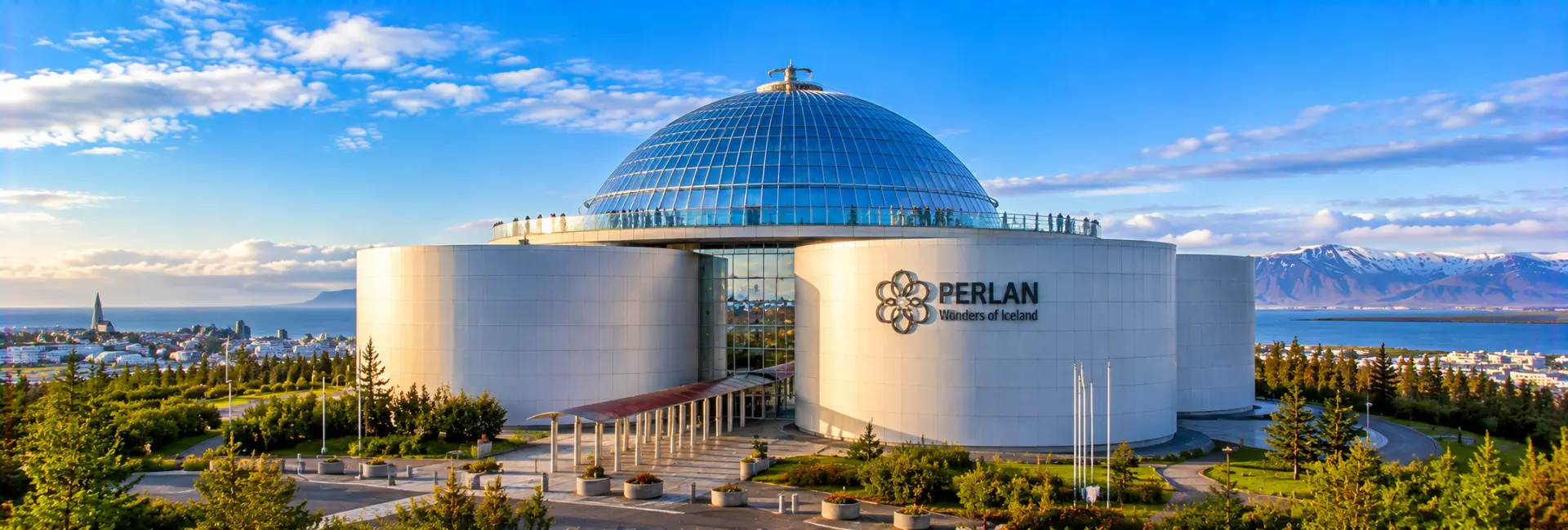
Perlan, which means The Pearl, is one of the most recognizable buildings in Reykjavik. A shining glass dome sits on top of a ring of enormous cylindrical tanks on the crown of Öskjuhlíð hill, and it can be seen from many parts of the city. Inside, it has been turned into a natural history museum called Wonders of Iceland, with an indoor ice cave, a Northern Lights planetarium, volcano and glacier exhibits and a panoramic viewing deck.
What makes Perlan special is the way it joins everyday infrastructure and visitor attraction. The tanks underneath were built to store hot water for Reykjavik's geothermal heating system, and most of them still do that job today. The museum occupies the converted ones and the dome above, so you can learn about Iceland's natural forces in the same building that quietly keeps the city warm. Geothermal water heats most of Reykjavik's buildings, which is one reason the capital is so unusual among northern cities.
A single ticket normally covers all the exhibitions and the observation deck, which makes it an easy, weatherproof outing that works for families, couples and solo travelers alike. Plan on a couple of hours, and more if you linger over the view or a meal.
History of Perlan
From Hot Water Tanks to Landmark
The story starts in 1939, when the first hot water tank was built on Öskjuhlíð hill to supply Reykjavik with geothermal water. Over the following decades more tanks were added until there were six, forming a vital part of the city's heating network. They stood on the hilltop as plain steel cylinders for many years.
Perlan Opens
In the late 1980s the tanks were rebuilt to serve as the base for a public building, a project championed by the then mayor, Davíð Oddsson, and designed by the architect Ingimundur Sveinsson. A great glass dome was placed on top, with a revolving restaurant and a viewing deck. Perlan opened to the public on 21 June 1991 and quickly became a symbol of the city's modern identity.
The Wonders of Iceland Museum
The interior was completely renovated in 2017, when the Wonders of Iceland exhibition opened. Four of the six tanks still store hot water for the city. One now holds the ice cave, and another houses the planetarium, so the old industrial structure has been given a second life as one of the country's busiest visitor attractions.
Architecture & the Glass Dome
Perlan's design is simple and striking. Six cylindrical tanks stand together on the hillside, and a rounded glass dome crowns them, standing roughly 25 meters high. The dome floods the upper floors with natural light and gives the building its look of a pearl resting on a stack of drums.
The glass allows views in every direction, while the tanks below give a feeling of strength and solidity. From a distance the building looks almost like a spaceship parked on top of the hill. Close up, you can see how the old infrastructure has been kept in plain view, which is part of the building's charm.
Inside, the floors are organized around the central space, with exhibitions on the lower levels, the observation deck on the fourth floor and the restaurant and cafe on the fifth, in the part of the dome that rotates.
Wonders of Iceland
The Indoor Ice Cave
The highlight for many visitors is the ice cave, a tunnel about 100 meters long built inside one of the former tanks. It is made from hundreds of tons of real snow and ice and kept well below freezing, so it feels like walking into the heart of a glacier. You will see blue ice walls, frozen formations and cleverly lit passages, and you do not need to travel to the southeast of the country to experience it.
The Áróra Planetarium
The Áróra planetarium shows a film of the northern lights across a full dome, with 8K projection and surround sound. It is the first planetarium of its kind in Iceland and is especially popular in winter, when the real aurora is never guaranteed, or on cloudy nights when the sky stays hidden.
Volcanoes, Glaciers and Birdlife
Other exhibits explain how Iceland's volcanoes, glaciers, geothermal energy and waters shape the island. A volcano show brings eruptions to life, and an interactive glacier exhibit explains how ice forms and moves. A ten-meter replica of the Látrabjarg cliff, one of Europe's largest seabird cliffs, is filled with lifelike birds, and a timeline traces the geological story of the country. The Icelandic Museum of Natural History also presents an exhibit here on water in Icelandic nature. Other displays include a virtual aquarium and a Forces of Nature exhibit, which explain how fire, ice and water have shaped the island.
The Observation Deck
The wraparound observation deck on the fourth floor is the other main reason to come. It gives a full 360-degree view of Reykjavik and the land and sea around it. On a clear day you can pick out the colorful rooftops, the harbor, Tjörnin pond, the mountains across the bay and even the Snæfellsjökull glacier on the horizon.
Because Öskjuhlíð is one of the highest points in the city, the deck is a good way to understand how Reykjavik is laid out before you explore it on foot. The deck is open to visitors who buy a museum ticket, and it is a natural last stop after the exhibitions. Telescopes set at the corners of the deck have recorded descriptions in several languages, which help you identify landmarks across the city and the bay.
Photographs are best on clear days, but the light is dramatic in almost any weather. In summer the sun lingers over the bay late into the evening, and in winter the city lights shimmer under the dark sky.
Dining at Perlan
The top of the dome holds a revolving restaurant, a cafe and a bar, all with views over the city. The restaurant floor makes a full turn, so the scenery changes slowly while you eat. Lower down there is also an ice cream parlor and a gift shop, which makes Perlan easy to enjoy as a half-day outing.
Opening hours for the restaurant, cafe and bar differ from the museum's, and some may be reserved for museum visitors, so check the current details on Perlan's website before you plan a meal.
Ways to Experience It
Perlan works for quick visits and for longer, slower ones. Here are a few ideas:
- Do the full Wonders of Iceland tour, from the glacier exhibit to the ice cave and planetarium
- Go straight to the ice cave and observation deck if you are short on time
- Catch the Áróra show on a cloudy day or before heading out on an aurora tour
- Have a drink or a meal in the revolving restaurant and cafe
- Walk up through the woodland from the city on a clear day and enjoy the view as a reward
- Bring children, who often love the ice cave, the volcano show and the bird cliff
Most visitors spend one to two hours, with longer stays for those who dine or linger on the deck.
Best Time to Visit
By Season
Perlan is a good stop at any time of year. In winter, its indoor attractions are a warm refuge from the cold, and the planetarium offers a chance to see the northern lights even when the sky is cloudy. In summer the long days and the midnight sun make the views especially beautiful, and the building stays open late.
By Time of Day
Mornings are usually quieter, and the ice cave is easier to enjoy when it is not crowded. Late afternoon and early evening give the warmest light on the city. If the weather forecast is clear, plan your deck visit for then. The museum is open every day with long hours, though the last admission is well before closing.
Visitor Tips
- Buy tickets online in advance, as booking ahead is usually cheaper than buying at the door.
- A single ticket normally covers all the exhibitions, the planetarium show and the observation deck, but check what is included when you book.
- The Reykjavík City Card offers a discount on tickets.
- The building is wheelchair accessible.
- Wear warm layers, because the ice cave is very cold, although jackets are normally provided.
- Last admission is about an hour and a half before closing, so arrive early if you want to see everything, especially if you plan to watch a planetarium show.
- City buses 13 and 18 stop near Perlan, and there is free parking. Walking from the city center takes about 30 minutes, uphill for part of the way.
- Check the schedule for the planetarium shows and the opening hours for the restaurant and cafe.
Nearby Attractions
Perlan sits on a green hill at the edge of the city, so you can combine it with some outdoor time:
- The Öskjuhlíð woodland and walking trails that surround the building
- Nauthólsvík, the geothermal beach on the coast near the hill
- Hallgrímskirkja, the landmark church in the city center
- Tjörnin pond and City Hall, visible from the observation deck
- Harpa Concert Hall and the Old Harbour on the waterfront
FAQs about visiting Perlan
What is Perlan? +
It is a glass-domed building on Öskjuhlíð hill in Reykjavik, built on top of former hot water tanks. Today it houses the Wonders of Iceland museum, an observation deck, a restaurant and cafe.
What is inside Perlan? +
You will find an indoor ice cave, the Áróra Northern Lights planetarium, glacier and volcano exhibits, a replica of the Látrabjarg bird cliff and a 360-degree observation deck.
Is the ice cave real? +
Yes, it is built from real snow and ice and kept below freezing. It is a man-made cave, but it recreates the look and feel of a natural glacier.
Are the hot water tanks still in use? +
Yes. Four of the six tanks still store hot water for Reykjavik, while one holds the ice cave and another houses the planetarium.
How long should I spend at Perlan? +
Allow one to two hours for the exhibitions and observation deck. Add more time if you plan to eat or watch a planetarium show.
Is the observation deck included in the ticket? +
Access to the observation deck is normally included with the museum ticket. Check Perlan's website for the latest details.
How do I get there? +
You can take city buses 13 or 18, drive and use the free parking, or walk from the city center in about 30 minutes.
Is it suitable for children? +
Yes. The ice cave, volcano show, bird cliff and planetarium are popular with families, and the building is wheelchair accessible.
