Table of Contents
Overview
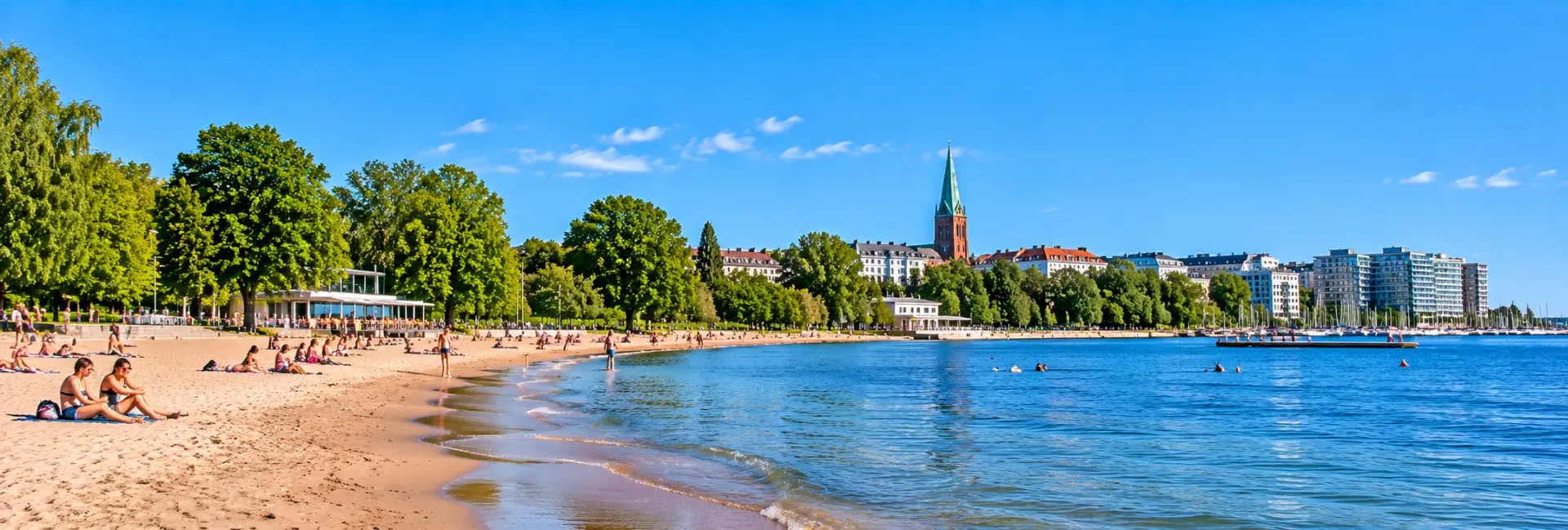
A short walk from the Sibelius Monument in the Töölö district, Hietaniemi beach, known to nearly everyone in the city simply as "Hietsu," is central Helsinki's most popular stretch of sand. Backed by pine-covered rock and bordered by the Hietaniemi Cemetery, it draws sunbathers, swimmers and volleyball players throughout the short but intense Finnish summer.
The name Hietaniemi means roughly "sand cape" in Finnish, and the beach's nickname, "Hietsu," is often said to derive from a colloquial word for fine sand. At its longest stretch, it is considered the largest sandy beach in central Helsinki, a scale that has earned it the half-joking nickname "Helsinki's Copacabana" among some visitors.
The beach is entirely artificial, built from sand dumped almost by accident in the early twentieth century, and it remains free, publicly supervised, and open to everyone for the length of its shoreline, making it one of the most accessible city beaches in Northern Europe.
History
An Accidental Beach
In the early 1900s, the remote shoreline at Hietaniemi was used first as a landfill and then as a storage site for sand dredged from the seabed and delivered by barge. The sand was never put to any particular use; it was simply left where it had been dumped, gradually spreading along the shore. By 1929, local residents had begun using the accumulated sand as an informal beach, and the city eventually formalised it as public swimming ground.
A Fixture of City Life
Photographs from as early as June 1948 show crowds already using the beach in the years immediately following the Second World War, confirming its place as one of Helsinki's standard summer destinations well before it acquired any of its current amenities. As the city's population roughly tripled during the urban growth of the 1970s, Hietaniemi became an increasingly central part of the urban fabric, a short tram or bus ride from a much larger surrounding population than it had originally served.
Later renovations added dedicated changing facilities, on-sand showers, and sauna access for swimmers, modernising a beach that had grown up almost by accident into one equipped for year-round, not just summer, use. On the hill beside the beach stands a stone sundial designed in 1931 by Gerda Qvist, one of the oldest fixed features on the site.
A Beach Shaped by the City Around It
Hietaniemi's proximity to the Hietaniemi Cemetery, one of Helsinki's principal burial grounds and the resting place of many notable Finns, has long given this stretch of coast a quieter, more residential character than some of the city's other recreation areas, even as the beach itself has grown into one of the busiest recreational sites in the city centre.
Facilities and Activities
A main pavilion at the centre of the beach holds toilets, changing rooms, a restaurant and a lifeguard watchtower, and the swimming area is marked out with red and yellow flags and buoys, with yellow warning signs flagging any sudden drop-offs in depth. The City of Helsinki supervises the beach with lifeguards through the official swimming season, typically running from June to August.
- A shallow, gently sloping swimming area suited to families and less confident swimmers
- Beach volleyball and basketball courts in regular use throughout summer
- A children's play area near the main pavilion
- The summer terrace and café Badenbaden, serving food and drinks with takeaway options for the sand
- A nearby miniature golf course and the Taivallahti Tennis Centre for those wanting activity beyond the beach itself
More recent improvements have added accessible showers directly on the sand and sauna facilities nearby, letting the beach serve as a year-round swimming spot for cold-water bathers rather than only a summer destination. The site is also considered one of the more accessible beaches in the city, with paths and facilities designed to accommodate wheelchair users and visitors with limited mobility.
Beach Volleyball and Festivals
Hietaniemi has hosted the Hietsu Beach Volley tournament every year since 1995, a fixture of the Finnish volleyball calendar that fills the beach's courts with competitors and spectators alike. The sport remains one of the beach's defining summer activities even outside tournament dates, with the courts in near-constant informal use whenever the weather cooperates.
The beach has also served as a concert venue, hosting the Rock the Beach festival in 2013 and 2017, the Sonisphere Festival in 2014, and the Weekend Festival in August 2018, temporarily turning its sand into one of the city's larger outdoor event spaces. Open-air parties and informal DJ sets are also a regular feature of summer evenings on the beach, adding a nightlife dimension to what is, by day, primarily a family and sports destination.
Best Time to Visit
The beach is busiest on warm days from June through August, when the swimming area is officially supervised and the terrace and courts are at their most crowded. Early mornings and weekday visits offer a quieter alternative during peak summer, while spring and early autumn bring pleasant weather with noticeably thinner crowds, for visitors more interested in a walk along the shore than a swim.
Because Helsinki's summer days stretch long into the evening, the beach also draws a late-night crowd around midsummer, when swimmers and sunbathers can still be found on the sand well after what would, in most cities, be considered nightfall.
Visitor Tips
- Check current water conditions before swimming; the Baltic here occasionally develops blue-green algae blooms during hot spells
- Stick to the flagged and buoyed swimming area, since parts of the seabed drop off suddenly close to shore
- Bring cash or a card for the Badenbaden terrace rather than relying on the beach itself for food
- Visit outside the official June-to-August season for a quieter walk, though lifeguard supervision will not be in place
- Combine a visit with a walk through the adjoining Hietaniemi Cemetery, a quieter contrast to the beach's summer crowds
- Take bus 55A or walk from the Töölö district if arriving without a car, since parking near the beach is limited in peak season
Nearby Attractions
- Hietaniemi Cemetery, directly adjoining the beach, resting place of many notable Finns
- Sibelius Monument and Sibelius Park, a short walk away in Töölö
- Temppeliaukio Church, the rock-cut Lutheran church a short distance inland
- Taivallahti Tennis Centre and a nearby miniature golf course
- Central Helsinki's shops, cafés and Market Square, a short tram or bus ride from the beach
FAQs about visiting Hietaniemi Beach
What is Hietaniemi beach known for? +
It is central Helsinki's most popular sand beach, known locally as "Hietsu," valued for swimming, beach volleyball and its lively summer atmosphere just minutes from the city centre.
Is the beach free to use? +
Yes, the beach and its swimming area are free and open to the public, with supervised lifeguard coverage during the official summer swimming season.
When is the beach officially supervised? +
Lifeguards are generally on duty from June through August, though the beach itself remains accessible year-round.
Is the water safe for swimming? +
The swimming area is shallow and marked with flags and buoys, though visitors should watch for occasional blue-green algae blooms in hot weather and check current conditions before swimming.
How do I get to Hietaniemi beach? +
It sits in the Töölö district within walking distance of the Sibelius Monument, and is also reachable by bus, including route 55A, from central Helsinki.
What facilities are available at the beach? +
The main pavilion has toilets, changing rooms, showers and a restaurant, with beach volleyball and basketball courts, a children's play area, and a nearby miniature golf course and tennis centre.
Does the beach host events? +
Yes, it has hosted the annual Hietsu Beach Volley tournament since 1995 as well as past music festivals including Rock the Beach, Sonisphere and the Weekend Festival.