Table of Contents
Overview
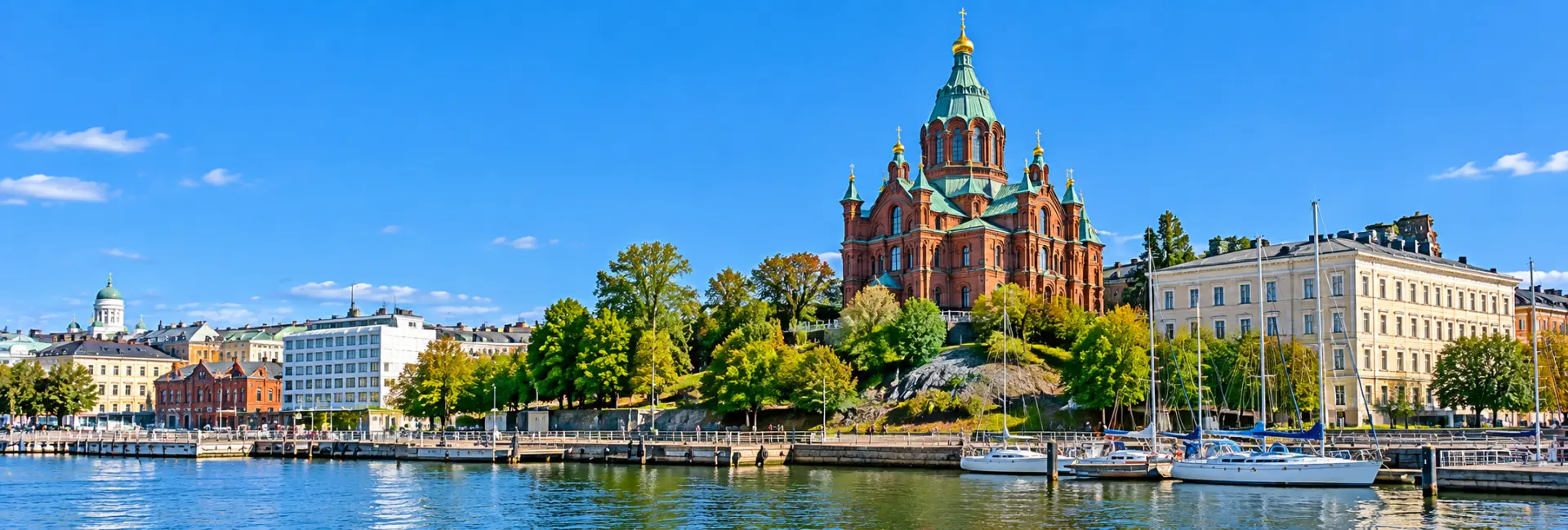
On the highest point of the Katajanokka peninsula, a short walk from Market Square, stands Uspenski Cathedral, a red-brick church crowned with thirteen gilded domes that has come to define Helsinki's skyline as much as any building in the city. It is the main cathedral of the Orthodox Church of Finland and, by most measures, the largest Orthodox church in Western Europe.
The cathedral's presence on a rocky hill overlooking the harbour is deliberate: it was built to be seen from the water, a visible marker of the Orthodox faith and of Russian influence during the decades when Finland was a grand duchy of the Russian Empire.
The name Uspenski comes from the Old Church Slavonic word "uspenie," meaning dormition or falling asleep, and refers to the belief that the Virgin Mary's earthly life ended not in death but in a peaceful passing into heaven, an event the Orthodox Church commemorates each August.
History
A Church for a Growing Parish
After Helsinki became the capital of the Grand Duchy of Finland in 1812, Tsar Alexander I set aside a share of the salt import tax to help fund two new churches for the city, one Lutheran and one Orthodox. Helsinki's Orthodox community, organised around the smaller Holy Trinity Church built in the 1820s, had outgrown its existing building well before a new cathedral was seriously planned.
Building on Bomarsund's Ruins
The design fell to Aleksey Gornostayev, an architect known for reviving older Russian building traditions, who based the new cathedral on a sixteenth-century church near Moscow. Gornostayev died in 1862, before construction began, and the project was carried through by the architect Ivan Varnek, who largely kept to the original plans. Construction ran from 1862 to 1868, using roughly 700,000 bricks barged over from the recently demolished Bomarsund Fortress in the Åland Islands, itself destroyed by British and French forces during the Crimean War.
The hilltop site was chosen deliberately: perched above the harbour, the cathedral would be one of the first buildings ships saw on approaching Helsinki, a visible marker of the Orthodox faith and Russian authority in the new capital.
The cathedral was consecrated on 25 October 1868, dedicated, at the wishes of Tsar Alexander II, to the Dormition of the Mother of God. Funding came largely from donations, including substantial gifts from the future Tsar Alexander III and from merchants in Moscow, and a plaque at the rear of the building still commemorates Alexander II's role in its construction.
A Landmark Through Two Regimes
Uspenski Cathedral outlasted the political system that produced it. It continued as the seat of Helsinki's Orthodox community after Finnish independence in 1917, even as the empire that had funded its construction collapsed. Tsar Nicholas II is recorded visiting the cathedral for a service in 1915, one of the last high-profile Romanov visits before the fall of the monarchy two years later.
Architecture and Design
Domes and Silhouette
Uspenski's most recognisable feature is its set of thirteen golden onion domes, one large central dome surrounded by twelve smaller ones representing Christ and the twelve apostles. The largest dome rises roughly 33 metres above the building and is topped with a gilded Orthodox cross, and each dome carries a layer of genuine gold leaf that has been renewed more than once over the cathedral's history.
Style and Materials
The building blends Russian Revival forms, particularly the tented roofs associated with northern Russian church architecture, with Byzantine influences in its massing and layout. Its deep red brick facade, drawn from the salvaged Bomarsund material, contrasts sharply with the pale neoclassical buildings elsewhere in central Helsinki, making the cathedral one of the most visually distinct structures in the city.
Regilding and Restoration
The domes were regilded in the 1960s ahead of the cathedral's 1968 centenary, and again in the early 2000s using 24-carat gold leaf, a restoration that cost roughly 500,000 euros and was funded largely by donations. These periodic renewals are the reason the domes still catch the light as brightly today as they did when the building first opened.
Interior and Iconostasis
Inside, the cathedral is far more ornate than Helsinki's Lutheran churches, with gilded fittings, chandeliers and a collection of icons that draws both worshippers and visitors. The focal point is the iconostasis, the screen separating the nave from the sanctuary, painted by the Russian academician Pavel Shiltsov in a style that leans closer to Renaissance figuration than to strict Byzantine convention, a detail that art historians often single out as unusual for an Orthodox cathedral of its era.
Visitors often note the contrast between the cathedral's plain red exterior and the brightness within: coloured mosaics, gilded icon frames and painted ceiling details give the interior a warmth that is immediately different from the more restrained interiors of Helsinki's Lutheran churches.
The cathedral's icons have not been without incident: in 2007, a nineteenth-century icon of St. Nicholas the Wonderworker was stolen from the cathedral in broad daylight while hundreds of tourists were present, and only recovered years later.
The Crypt Chapel
Beneath the main hall lies a smaller crypt chapel dedicated to Alexander Hotovitzky, who served as vicar of Helsinki's Orthodox parish between 1914 and 1917 before returning to Russia, where he was killed during the Great Purge. He was canonised by the Russian Orthodox Church in 1994, and the chapel that bears his name today hosts exhibitions and lectures on Orthodox art and history alongside its role as a place of prayer.
Visiting Today
The cathedral remains an active parish church as well as a major visitor attraction, drawing an estimated half a million visitors a year. Admission was free for most of the cathedral's history, but since May 2025 a small entry fee applies to visitors outside the times of divine services, with the proceeds directed toward the building's ongoing restoration.
The cathedral is closed to visitors on Mondays, and access is restricted during active services, so anyone planning a visit around a specific dome-lit photograph or a quiet look at the iconostasis is best checking service times in advance.
The cathedral sits within a small landscaped park laid out in 1897 by the gardener Svante Olsson, which softens the otherwise rocky hilltop and gives visitors a place to sit and take in the view before or after a visit inside.
Best Time to Visit
The cathedral's exterior is worth seeing at almost any hour, its gilded domes catching low sunlight particularly well in the early morning or in the last hour before sunset. Evenings add another dimension, since the building is illuminated after dark and stands out clearly across the harbour from Market Square.
For the interior, weekday mornings outside of services tend to be quieter than weekend afternoons, when both tour groups and worshippers are more likely to be present at the same time.
Visitor Tips
- Dress modestly; shoulders and knees should be covered when entering, in keeping with Orthodox custom
- Check the cathedral's service schedule before visiting, since sightseeing is restricted during active worship
- Bring a small amount of cash for the entry fee and for lighting a candle inside, a common practice for visitors as well as worshippers
- Climb the surrounding hill and grassy mound beside the cathedral for a wider view over the harbour and Market Square
- Visit on a clear evening if possible, when the illuminated domes are visible from across the water
Nearby Attractions
- Market Square (Kauppatori), a short walk downhill on the South Harbour
- Helsinki Cathedral, the city's Lutheran counterpart, across the water in the city centre
- The Katajanokka district, known for its early-twentieth-century Art Nouveau architecture
- The Presidential Palace and Helsinki City Hall, both close to the harbour below the cathedral
FAQs about visiting Uspenski Cathedral
What is Uspenski Cathedral known for? +
It is the main cathedral of the Orthodox Church of Finland and is widely considered the largest Orthodox church in Western Europe, known for its thirteen gilded onion domes and red-brick facade.
Is there an entrance fee? +
Admission was free for most of the cathedral's history, but since May 2025 a 5 euro fee applies to adult visitors outside the times of divine services, with proceeds going toward restoration.
What days is the cathedral closed? +
The cathedral is closed to visitors on Mondays, and sightseeing is also restricted during active church services on other days.
What should I wear to visit? +
Modest dress is expected, with shoulders and knees covered, in keeping with Orthodox custom for a working place of worship.
Why are the bricks a different colour from other Helsinki buildings? +
The cathedral was built from roughly 700,000 bricks salvaged from the Bomarsund Fortress in the Åland Islands, which gives it a deep red tone that stands apart from the pale neoclassical buildings common elsewhere in central Helsinki.
How long does a visit typically take? +
Most visitors spend twenty to thirty minutes inside viewing the iconostasis and icons, plus extra time outside taking in the views over the harbour from the surrounding hill.
Is the cathedral connected to Market Square? +
Yes, it stands on a hill a short walk from Market Square, making the two easy to combine in a single visit along the harbour.