Table of Contents
Overview
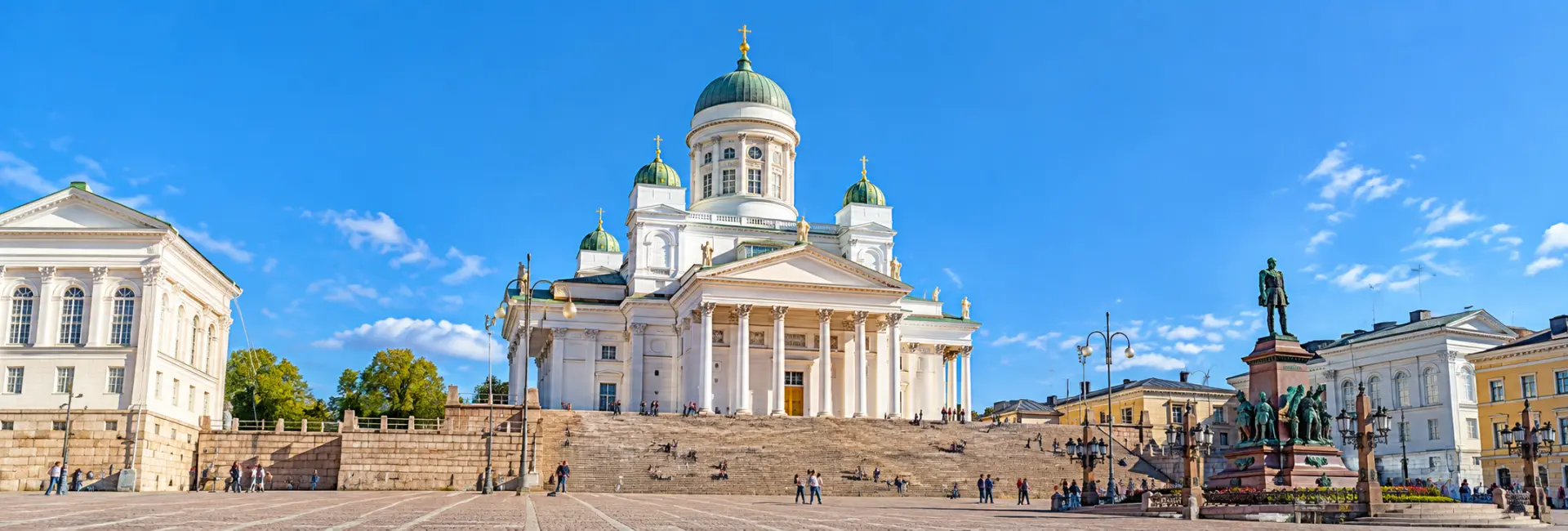
Helsinki Cathedral is the white, green-domed church that most people picture when they think of the Finnish capital. It stands on the northern side of Senate Square, at the top of a wide flight of steps, and it is easy to spot from the sea long before a ferry reaches the harbor.
The building is the main church of the Evangelical Lutheran Diocese of Helsinki. It is a working place of worship first and a landmark second, hosting Sunday services, weekday prayers, organ recitals and national ceremonies alongside a steady stream of visitors.
Its style is neoclassical: calm, symmetrical and carefully proportioned, with a large central dome and four smaller ones around it. Inside, the mood is deliberately plain, which can surprise people who expect the richness of a Catholic or Orthodox church. That restraint is part of the point.
With room for around 1,300 people, the cathedral is best understood as a piece of civic design as much as a religious building. It was created to show how a newly promoted capital wanted to present itself, and nearly two centuries later it still does that job better than any other building in Helsinki.
History
A Capital Takes Shape
Helsinki was a modest town until 1812, when it became the capital of the Grand Duchy of Finland under Russian rule. City planner Johan Albrekt Ehrenström and architect Carl Ludvig Engel set about giving it the look of a proper seat of government, and Senate Square became the centerpiece of their plan. A great church on its northern edge was meant to anchor the whole composition.
Building the Cathedral
Engel drew up the first designs in 1818, but the site was still occupied by the small Ulrika Eleonora church, dating from 1727. The old church could only be demolished once its congregation had a new home, so building did not begin until 1830. Engel worked on the project for the rest of his life and died in 1840, with the walls still unfinished.
Architect Ernst Lohrmann took over and saw the job through. The church was consecrated in 1852, twelve years after its designer's death and more than three decades after the first drawings. It was the longest project of Engel's career.
A Change of Name
The building was first called St. Nicholas' Church, in honor of Tsar Nicholas I, who ruled Finland as Grand Duke. After Finland became independent in 1917 the imperial dedication was dropped and the church became known as Suurkirkko, the Great Church. It only received its present name in 1959, when the Diocese of Helsinki was founded and the church became a cathedral.
A major renovation of the cathedral and its crypt was completed in 1998, restoring much of its original look.
Architecture & Design
Engel's Original Idea
Engel planned a Greek cross layout under a single dome, a clean and severe design inspired by the classical tradition. Kazan Cathedral in St. Petersburg is often named as a model for the overall look. The central dome rests on strong corner pillars and rises to more than 80 meters above sea level, while tall windows let daylight in from several directions.
The interior is plain on purpose. White walls, simple lines and very little ornament reflect a Lutheran outlook that puts the sermon and the congregation ahead of decoration.
What Lohrmann Added
Many people are surprised to learn that the cathedral looks quite different from Engel's first vision. After his death, Lohrmann added the four smaller domes at the corners, giving the roofline its layered silhouette. The twelve apostles, cast in zinc, were placed along the roof edges and corners. Two pavilions were also built beside the main steps, and the western one serves as the bell tower.
The Great Staircase
The wide granite staircase leading up to the church was not part of the earliest plans. A guardhouse originally stood at the foot of the building, but it was removed and replaced by steps roughly 60 meters wide by order of the emperor. The change turned the cathedral to face Senate Square, although the main entrance still sits on the Unioninkatu side.
Cultural & Religious Significance
Helsinki Cathedral belongs to the Evangelical Lutheran Church of Finland, the country's largest religious community. That makes it a natural stage for occasions that matter to the whole nation, from festive academic services connected with the nearby university to ceremonies around Independence Day.
For most Finns the building is also a symbol in its own right. It appears on postcards, posters and souvenirs, and it is the shape people look for when they arrive in the city by sea. Very few European capitals are so closely tied to a single religious building.
The story behind it adds another layer. The cathedral was born from an imperial commission, yet it now stands for Finnish identity and independence. Its name changed twice as the political landscape shifted, but the building itself barely did. Visitors who take a moment to think about that will find the place more interesting than its calm exterior suggests.
The cathedral remains a lively parish church. Services, prayers and concerts are held throughout the week, with programs offered in several languages, so a visit can be a chance to see how the building is still used today.
Notable Features
Some of the best details are easy to walk past. Here are the ones worth looking for:
- The twelve apostles: The zinc statues along the roofline are best seen from Senate Square, where they seem to keep watch over the city.
- Luther and Melanchthon: Two statues of leading Reformation figures stand inside. They are enlarged plaster copies of a monument in Worms, Germany, and arrived in Helsinki in 1886. The enlargements came out smaller than planned because of a measuring error, so sculptor Karl Magnus von Wright added pedestals to raise them.
- Mikael Agricola: A statue by sculptor Ville Vallgren honors the Finnish reformer who is regarded as the father of the written Finnish language.
- The crypt: Beneath the church, the restored crypt hosts exhibitions and concerts and has a summer café. It also offers step-free access to the main floor.
- The bell tower pavilion: The western pavilion beside the steps holds the bells of the cathedral and, for visitors, the entry point for tickets.
- The organ: Regular organ recitals give a chance to hear the sound of the building itself, which is worth planning around if you enjoy music.
Ways to Experience It
Step Inside
A walk through the main hall takes only a short time, but the space rewards slow looking. Take in the height of the dome, the way light moves across the white walls and the contrast between the plain interior and the grand exterior.
Attend a Service or Recital
Sunday worship is held in the morning, and short organ recitals and daily prayers are part of the weekly rhythm. Attending one is a quiet way to experience the cathedral as a living church rather than a monument. In summer there is also a short introduction to the building in English on some weekdays.
Visit the Crypt
The crypt is entered from street level on Kirkkokatu and is often the easiest and cheapest way in. Depending on the day it may show an exhibition or host an event.
Climb the Steps
Many visitors never go inside and simply sit on the steps to watch Senate Square. The terrace gives a fine view over the square and down toward the harbor, and it is one of the classic photo spots in the city.
Visiting Etiquette & Tips
- Sightseeing is not possible during services or other ceremonies, and opening hours can change for special events. Check the official cathedral website before you go.
- Entry to the main church may carry an admission fee at certain times of year, while the crypt is normally free. Because fees and hours are updated regularly, confirm the current details rather than relying on an older guidebook.
- The main entrance is on the Unioninkatu side. The address is Unioninkatu 29.
- Step-free access is available through the crypt entrance at Kirkkokatu 18. It is wise to call the church warden ahead of time to make sure the door is open.
- Keep your voice low and dress sensibly, as this is an active place of worship. Photography of the interior is generally fine, but be considerate when a service or prayer is under way.
- An information stand near the main entrance provides leaflets and service programs in several languages, and a small shop sells souvenirs and Christian items.
Best Time to Visit
Time of Year
Summer brings long daylight hours, extended visiting times and a busy atmosphere on Senate Square, with the cafe in the crypt open. It is also the most crowded period. Winter is quieter, and the white facade looks especially crisp against snow and the early dark.
Time of Day
Weekday mornings tend to be the calmest for a look inside. For photos of the exterior, late afternoon is a good bet, when lower sunlight lights up the white walls and the green dome. If you want a musical experience, aim for one of the recitals. Sunday mornings are reserved for worship, so plan sightseeing for another day.
Special Dates
Independence Day on December 6 and other national occasions bring ceremonies to the cathedral. These can be moving to witness, though access for sightseeing is limited.
Nearby Attractions
The cathedral sits in the middle of Helsinki's neoclassical core, so plenty of things can be reached on foot.
- Senate Square: The square itself is framed by the Government Palace, the main building of the University of Helsinki and the National Library of Finland, all part of the same 19th-century plan. A statue of Emperor Alexander II stands in the middle.
- Sederholm House: Dating from 1757, this is the oldest building in central Helsinki and stands at a corner of the square.
- Market Square: A short walk downhill brings you to the harbor, where stalls and boat departures line the waterfront.
- Uspenski Cathedral: This red-brick Orthodox cathedral on the Katajanokka peninsula makes an interesting contrast to the Lutheran calm of Helsinki Cathedral.
- Helsinki Old Church: The city's older wooden church has a place in the story of the cathedral, since it had to be completed before the earlier church on the cathedral site could be pulled down.
- Temppeliaukio Rock Church: Carved directly into solid rock, this church makes a good third stop for anyone interested in the city's religious architecture.
FAQs about visiting Helsinki Cathedral
What is Helsinki Cathedral known for? +
It is the neoclassical, green-domed Lutheran church on Senate Square and the most recognizable symbol of Helsinki. It was designed by Carl Ludvig Engel and completed in 1852.
Who designed Helsinki Cathedral? +
Carl Ludvig Engel drew the original plans in 1818 and worked on the project until his death in 1840. Ernst Lohrmann then finished it and added features such as the four corner domes.
Is Helsinki Cathedral free to enter? +
The crypt is normally free, while entry to the main church may carry a fee at certain times of year. Fees and opening hours change, so check the official cathedral website before you go.
How long should I spend at Helsinki Cathedral? +
Around 30 to 45 minutes is enough for the interior and crypt. Add extra time if you want to sit on the steps, catch a recital or explore the rest of Senate Square.
How do I get to Helsinki Cathedral? +
It is a short walk from Market Square and the railway station, and trams stop close to Senate Square. The address is Unioninkatu 29, and the University of Helsinki metro station is also within walking distance.
Is the cathedral wheelchair accessible? +
Yes, step-free access is available through the crypt entrance at Kirkkokatu 18. Calling the church warden in advance to confirm that the door is open is a good idea.
Can I attend a service or concert? +
Yes, everyone is welcome at services, prayers and concerts. Sunday morning worship and short organ recitals are part of the regular schedule, and programs are available in several languages.
What is the difference between Helsinki Cathedral and Uspenski Cathedral? +
Helsinki Cathedral is white, neoclassical and Lutheran, and it stands on Senate Square. Uspenski Cathedral is a red-brick Orthodox church on the Katajanokka peninsula, built in a Russian-inspired style.