Table of Contents
Overview
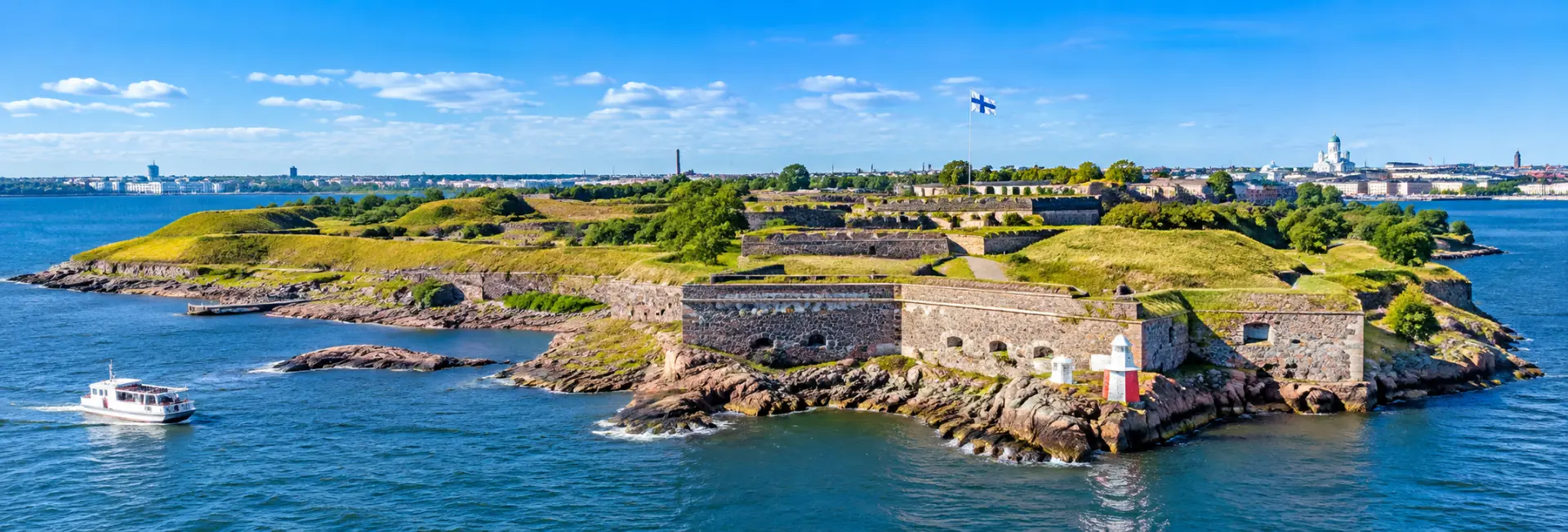
Suomenlinna is a sea fortress scattered across a cluster of rocky islands just off the coast of Helsinki. Around four kilometers southeast of the city center, it feels like a different world, yet the ferry from Market Square gets you there in a short crossing.
The complex was begun by Sweden in the middle of the 18th century, taken over by Russia in 1808, and handed to an independent Finland after 1917. Each era left its own layer of walls, barracks, churches and cannons, which is why a walk here covers nearly three centuries of northern European history in a single afternoon.
It is also a living neighborhood. Roughly 800 people call the islands home, and the grassy ramparts, cobbled lanes and pastel-painted buildings are as much part of daily life as of the sightseeing route. Locals come to picnic and swim, visitors come for the views and the museums, and the fortress copes with both surprisingly well. With around a million visitors a year, it ranks among the most visited places in Finland.
History
A Swedish Stronghold
In 1747 the Swedish parliament decided to build a great naval base and fortress off Helsinki, meant to counter growing Russian power in the Baltic. Work started in 1748 under the young officer Augustin Ehrensvärd, and by the early 1750s thousands of workers, mostly soldiers, were busy on the islands. The fortress was named Sveaborg, meaning the Fortress of Sweden, and it soon became the base of Sweden's archipelago fleet.
Russian Rule
Sveaborg was nicknamed the Gibraltar of the North, but that reputation did not hold. During the Finnish War, Russian forces besieged it, and the commander surrendered on May 3, 1808. The loss helped open the way for Russia to take Finland the following year. The new rulers added barracks, extended the dockyard and strengthened the defenses, and in August 1855 an Anglo-French fleet shelled the fortress for about 47 hours during the Crimean War.
Finnish Suomenlinna
After independence in 1917 the fortress was renamed Suomenlinna, the Fortress of Finland, on May 12, 1918. In the aftermath of the Civil War the islands briefly held a prison camp, a grim chapter that is remembered on site. The Finnish military stayed on until 1973, when most of the area passed to civilian administration and restoration began in earnest.
Recognition / Status
Suomenlinna was inscribed on the UNESCO World Heritage List in 1991 as an outstanding example of European military architecture. The listing recognizes how the fortress applied the bastion principles of the age to a difficult island setting, and how it reflects the changing fortunes of three different nations.
The site is protected and managed by a dedicated governing body, which looks after the buildings, the walls and the public spaces. Restoration is a permanent job here, since salt air, frost and heavy foot traffic keep the old stone and timber under constant strain.
Suomenlinna is also an official district of Helsinki. That makes it unusual among heritage sites: it is not a museum behind a gate, but part of a working city, with a school, a church, shops and homes inside the historic walls.
Architecture & Fortifications
Ehrensvärd's Island Plan
The design drew on the ideas of the French military engineer Vauban and the star fort tradition, but it had to be bent to fit an archipelago. Instead of a single walled citadel, the plan linked several islands with bastions, batteries and waterways so that enemy ships could be caught in crossfire. At its heart sat a naval dockyard.
Walls, Bastions and Guns
Around six kilometers of walls survive, along with more than a hundred cannons. Many of the walls sit right on the shoreline, and the stone facing was built to be seen from the sea as well as defended. Inside the ramparts, casemates and tunnels once housed troops and supplies.
A Baroque Ambition
The builders also wanted the fortress to look like a proper town. Officers' houses follow the lines of the defenses, and the planned baroque square on the main island, partly inspired by Place Vendôme in Paris, was left only half finished. Later Russian buildings added a neat, orderly look of their own, so the architecture is a real mix of styles.
Key Areas of the Islands
Suomenlinna is made up of eight islands, six of them fortified. Five are linked by bridges or a sandbar, so most visitors can cover the main parts on foot.
- Iso Mustasaari: the largest island and the arrival point. The main quay, Jetty Barracks, the Visitor Centre, the church and the Great Courtyard are all here.
- Susisaari: home to the fortress commander's old residence, the Ehrensvärd Museum and the heavily fortified Kustaanmiekka side, with its long lines of cannons facing the sea.
- Kustaanmiekka: often described as Gustav's Sword, it carries some of the most impressive bastions and a favorite walking route along the water.
- Pikku Mustasaari: mostly occupied by the Finnish Naval Academy, with only a small civilian area, so it is not a sightseeing stop.
- Länsi-Mustasaari: the quieter western island, reached by bridge from the others, popular for calm views and picnics.
Notable Sights & Museums
Most of the highlights sit along the well-marked Blue Route, which runs from the main quay to the King's Gate. Here are the ones to prioritize:
- King's Gate: the grand sea entrance to the fortress and its most recognizable symbol, best appreciated from the water or from the ramparts above it.
- Jetty Barracks: the pink barracks by the ferry quay, built between 1868 and 1870, now home to the Visitor Centre, a restaurant and a small gallery.
- Suomenlinna Church: built in 1854 as an Orthodox garrison church, later converted into a Lutheran church, and fitted with a lighthouse beacon that still works.
- The dry dock: dating from the 1750s and still used for ship repairs, making it one of the oldest working docks of its kind.
- Suomenlinna Museum: the best place to start, tracing the story of the fortress with models and original objects. It is the museum that stays open all year.
- Ehrensvärd Museum: set in the former commander's home, it honors the fortress designer, who is buried on the island.
- Vesikko: the last surviving Finnish submarine, open to the public in the warmer months.
- Smaller museums: including a toy museum, the Military Museum's Manege and a customs museum, all good options for families.
Life on the Islands
What surprises many first-time visitors is how normal life feels here. Children go to school inside the fortress, residents cycle between buildings, and the ferry doubles as the daily commuter link to the mainland. Somewhere between 400 and 500 more people work on the islands, depending on the season.
The islands also have a strong artistic side. A Nordic arts center was founded here in the 1980s, several old buildings have become artists' studios, and a summer theater and children's art school add to the calendar. Small cafes, a brewery restaurant and shops give you plenty of places to pause between sights.
Being respectful matters. People live in many of the historic buildings, so please keep noise down, stay on marked paths and avoid walking into private yards. Suomenlinna is a car-free zone, and that quiet is a big part of its charm.
Ways to Experience It
Follow the Blue Route
The Blue Route is a simple way to see the essentials without a map app. It begins at the main quay in front of the Jetty Barracks and ends at the King's Gate, passing the church, the Great Courtyard, the dry dock and the bastions.
Join a Guided Walk
Guided tours run in several languages and add stories that signs do not cover. They are a good pick if you want the political backdrop explained, from the Swedish planning to the surrender of 1808.
Picnic and Wander
Plenty of visitors skip the museums entirely and spend the day on the grass. Bring food and find a sheltered spot on the ramparts, or eat at one of the island's restaurants.
Arrive by Water
The regular city ferry is the everyday option. In the warmer months a water bus also runs from Market Square and stops at a second pier closer to the King's Gate, which lets you plan a one-way route through the fortress.
Best Time to Visit
Summer
From May to September the islands are at their liveliest. Museums, cafes and restaurants are open, the water bus runs, and long evenings make it easy to stay late. This is also the busiest time, so arriving early on a weekday helps.
Autumn and Spring
Shoulder seasons bring thinner crowds and soft light, which many photographers prefer. Some attractions have shorter hours or are closed, so check before you go.
Winter
Winter is quiet and atmospheric, especially when snow settles on the ramparts or ice forms along the shore. The Visitor Centre and Suomenlinna Museum stay open, but wear warm, waterproof shoes, because the cobbles and paths can be slippery.
Visitor Tips
- There is no entrance fee for the fortress area itself. You pay for the ferry or water bus, and separately for each museum.
- Start at the Visitor Centre in the Jetty Barracks. It offers a free introductory exhibition and a free map in nine languages.
- Wear comfortable, sturdy shoes. Many of the roads are cobblestone, and the terrain is uneven.
- The islands are challenging for wheelchairs and strollers. The Visitor Centre can advise on the best routes before you travel.
- Dogs are welcome on a leash, but they should be kept away from beaches and playgrounds.
- Bring a jacket, even in summer, since the sea breeze can be cool. Pack water and snacks if you plan a long stay.
- The ferry runs from early morning until very late, but check the last departure before you settle in for the evening.
- The service tunnel is not open to visitors. Only marked tunnels along the routes can be explored.
Nearby Attractions
Suomenlinna pairs well with a few of Helsinki's classic sights, all close to the ferry departure point.
- Market Square: the waterfront square where the ferry leaves, lined with food stalls and boat tours.
- Old Market Hall: a historic covered market beside the harbor, good for lunch before or after the crossing.
- Uspenski Cathedral: the red-brick Orthodox cathedral on the nearby Katajanokka peninsula, a short walk from the harbor.
- Helsinki Cathedral and Senate Square: the city's neoclassical heart, a short uphill walk from Market Square.
- Esplanadi Park: a tree-lined promenade running inland from the harbor, ideal for a relaxed stroll and a coffee.
FAQs about visiting Suomenlinna Sea Fortress
What is Suomenlinna? +
It is an 18th-century sea fortress built across a group of islands off Helsinki, originally known as Sveaborg. It is a UNESCO World Heritage Site and also a residential district of the city.
Is Suomenlinna free to visit? +
Entry to the fortress area is free, so you only pay for the ferry or water bus. Individual museums charge their own admission fees, and prices change, so check the official Suomenlinna website.
How do I get to Suomenlinna from central Helsinki? +
Take the HSL ferry from Market Square, which runs all year and takes around 15 minutes. In the warmer months a private water bus also runs from the harbor, with its own separate ticket.
How long should I spend at Suomenlinna? +
Half a day is enough for the main sights along the Blue Route. If you want to visit several museums or enjoy a long picnic, plan for a full day.
Is Suomenlinna worth visiting in winter? +
Yes, if you dress warmly. The fortress is quieter and very atmospheric in snow, and the Visitor Centre and Suomenlinna Museum stay open, though many other attractions close for the season.
Do people really live in Suomenlinna? +
Yes, about 800 people live in the historic buildings, and the island has a school, a church, shops and restaurants. Please respect residents' privacy while exploring.
Is Suomenlinna accessible for wheelchairs and strollers? +
It can be difficult because of cobblestones, slopes and uneven ground, and not every building has step-free access. Contact the Visitor Centre before your trip for current advice on the best routes.
Can I bring my dog to Suomenlinna? +
Dogs are allowed as long as they are kept on a leash. They are not permitted on beaches or playgrounds.