Table of Contents
Overview
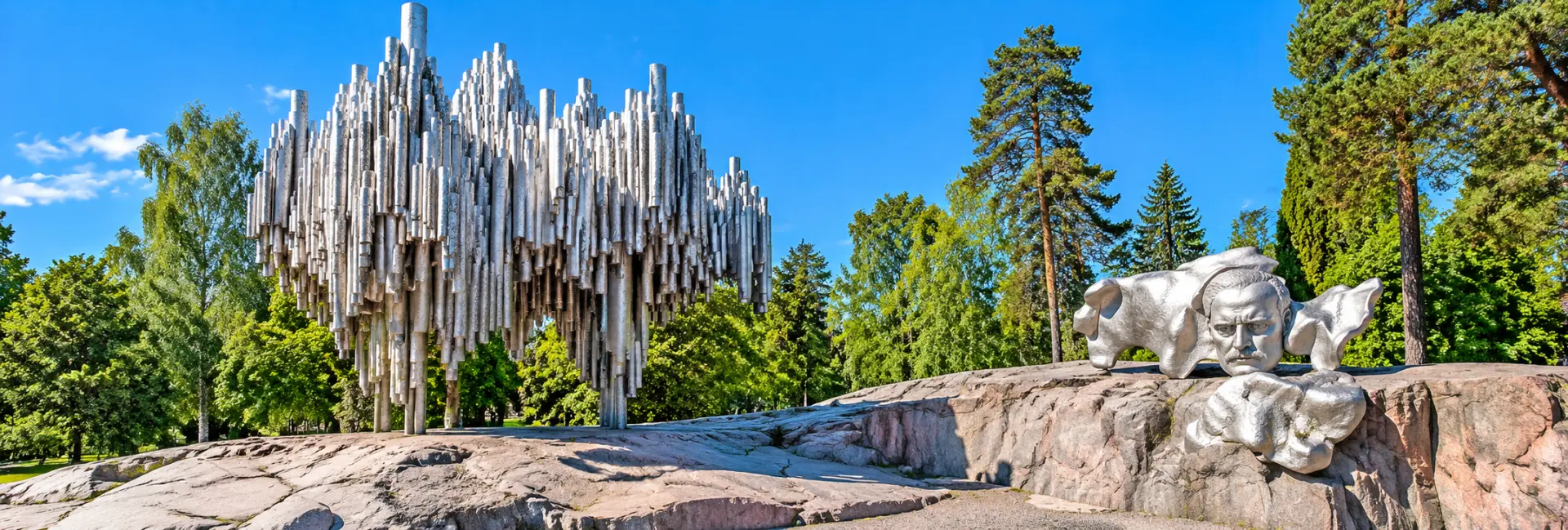
In a quiet corner of Sibelius Park on Helsinki's western shore stands one of Finland's most photographed works of public art: a cluster of more than 600 welded steel pipes rising and dipping like a frozen wave, dedicated to the country's most celebrated composer, Jean Sibelius. Unveiled in 1967, a decade after the composer's death, the monument, titled Passio Musicae, is the work of sculptor Eila Hiltunen and remains one of the most visited sites in the city.
Unlike the seated or standing statues that honour composers elsewhere in Europe, the Sibelius Monument makes no attempt at a literal likeness. Its abstract, organ-like form was meant to evoke the character of Sibelius's music rather than his physical appearance, a choice that provoked fierce debate before becoming one of Helsinki's defining landmarks.
The Competition for a Monument
A Society Formed to Honour the Composer
Jean Sibelius died on 20 September 1957, and ten days later Finland gave him a state funeral at Helsinki Cathedral. Later that year the Sibelius Society of Finland was founded to curate his legacy, and in late 1959 it invited Finnish sculptors to compete for a permanent memorial, one that would convey both the composer's personality and his music.
Two Contentious Rounds
Fifty proposals arrived by the May 1961 deadline. The jury initially awarded first prize to a figurative-abstract hybrid by Toivo Jaatinen, but was dissatisfied enough with every entry that it ordered an unplanned second round among six finalists, among them a young sculptor named Eila Hiltunen, whose abstract entry, Credo, had placed only sixth. For the second round Hiltunen reworked her design into Passio Musicae, a wave-like cluster of textured steel pipes, partly inspired, she later said, by Milan Cathedral. In September 1962 the jury voted unanimously in her favour, though members disagreed sharply over whether the abstract sculpture needed a more recognisable portrait of the composer added to it.
The Sibelius Society's board ultimately sided with the critics, and in November 1962 it approved Hiltunen's design only on condition that she add a figurative portrait of Sibelius. The compromise did little to quiet public anger: Hiltunen later described the reaction to her design as a public campaign bordering on hysteria, and critics dismissed her sculpture as everything from a tin can to the work of "a madwoman".
Design and Construction
Welding a Monument by Hand
Hiltunen built the monument in an unheated industrial hall in the Lauttasaari district of Helsinki, the same space where the equestrian statue of Marshal Mannerheim had been welded a few years earlier. Working with an assistant, the 21-year-old tradesman Emil Kukkonen, she personally welded the majority of the pipes into fourteen sections between 1964 and 1967, a process that exposed her to toxic metal fumes and left her with lasting respiratory problems.
Assembly in the Park
The finished sections were trucked to Sibelius Park and assembled on site starting in May 1967. Because the sculpture needed to withstand coastal winds, workers dug foundations 1.5 metres deep and reinforced them with steel and concrete. The figurative portrait required its own solution: no natural vertical rock face existed at the right height, so the landscape architect Juhani Kivikoski had a granite wall blasted specifically to hold it.
The completed monument was unveiled at a ceremony on 7 September 1967 attended by President Urho Kekkonen and Sibelius's five daughters, at which the Sibelius Society formally donated the sculpture to the City of Helsinki; it remains part of the city's public art collection, managed today by the Helsinki Art Museum.
The Pipe Cluster and the Portrait
The main sculpture is a welded cluster of roughly 600 hollow, acid-resistant stainless steel pipes (a 2015 digital count put the figure at 569), each hand-textured and some pierced with fissures to catch light and shadow. It weighs 24 tonnes and measures 8.5 by 10.5 by 6.5 metres, standing on three legs with an open cavity that visitors are free to walk into. Though Hiltunen intended the form to represent Sibelius's music in the abstract, viewers have long read it as anything from a pipe organ to a stand of birch trees or reeds along a Finnish shore, and the pipes genuinely do produce sound, humming and echoing with wind, rain, and passing voices.
About fifteen metres away, set into the blasted granite wall, is the second element the Sibelius Society insisted on: a high-relief cast portrait of the composer in his forties, framed by three free-form steel shards. At roughly a metre high, it is easy to miss beside the much larger pipe cluster, and some critics have called it visually disconnected from the main work, though it remains part of the same commission.
Reception and Legacy
Public opinion shifted dramatically in the decades after 1967. What was once condemned as an insult to a national hero is now widely regarded as one of the defining works of Finnish modern sculpture, and one of the first Finnish monuments to fully embrace abstraction over the conservative, figurative style that had dominated the country's public art until then.
The monument's fame turned it into a tool of Finnish cultural diplomacy: a small-scale replica was donated to UNESCO's Paris headquarters in 1967, a full-scale partial study went to the city of Montreal the same year (and later went missing), and another was presented to the United Nations Headquarters in New York in 1983. Hiltunen herself became one of Finland's best-known sculptors, though she often said the monument's fame overshadowed the rest of her long career.
In 2002 the Finnish Post Office issued a postage stamp depicting the pipe cluster, and in 2015 an audio project for Helsinki's Ateneum art museum digitally mapped the sculpture's pipes to reconstruct the sounds they could produce, formalising an effect visitors had long noticed on site.
Sibelius Park
The park surrounding the monument has its own history. Laid out on the shore of Humallahti bay in the 1930s as Humala Park, it was renamed Sibelius Park in November 1945 to mark the composer's eightieth birthday, more than a decade before his death made a monument to him a reality. The park's rocky, wooded terrain, with its birch trees and sea views, suited the abstract sculpture that would eventually stand there.
Visiting Today
The monument sits in open parkland with no fence, ticket booth, or admission fee, and can be visited at any hour of the day or night. It draws an estimated half a million visitors a year, making it one of the most-visited sights in Helsinki despite its location outside the historic city centre.
Best Time to Visit
The steel pipes change character with the light and the seasons: they read starkly silver against snow in winter and blend more softly into the surrounding birch woods in summer. Early mornings tend to be quietest, before tour buses and cruise-ship groups arrive, and a clear day offers the sharpest reflections off the polished steel.
Visitor Tips
- Combine a visit with a walk through the rest of Sibelius Park, which has views over Töölö Bay and the Baltic shoreline
- Step inside the pipe cluster's open cavity for the best sense of its scale and acoustics
- Look for the smaller figurative portrait of Sibelius on the granite wall a short distance from the main sculpture; it is easy to walk past without noticing
- Visit on a windy or rainy day if possible, since the pipes are known to hum and resonate with the weather
- The monument is a short bus or tram ride from the city centre rather than a walkable distance, so plan transport in advance
Nearby Attractions
- Sibelius Park's wider grounds and Töölö Bay waterfront, immediately surrounding the monument
- Finlandia Hall, the Alvar Aalto-designed concert venue a short walk away
- Helsinki Olympic Stadium, within walking distance in the Töölö district
- Kiasma Museum of Contemporary Art and the city centre, a short tram ride from the park
FAQs about visiting the Sibelius Monument
What is the Sibelius Monument? +
It is a public sculpture in Helsinki's Sibelius Park, made of over 600 welded stainless steel pipes, created by Eila Hiltunen and unveiled in 1967 to honour composer Jean Sibelius.
Why does the monument look like organ pipes rather than a statue of Sibelius? +
The sculptor intended the abstract form to evoke Sibelius's music rather than his likeness; a smaller figurative portrait of the composer was added nearby only after public and jury pressure.
Is there an admission fee? +
No, the monument stands in open parkland with no fence or ticket booth and can be visited at any time, free of charge.
How do I get to the Sibelius Monument? +
It is located in Sibelius Park in the Töölö district, reachable by tram or bus from central Helsinki; it is too far from downtown for most visitors to comfortably walk.
How long does a visit take? +
Most visitors spend fifteen to thirty minutes at the monument itself, often extending the trip with a longer walk through Sibelius Park and along the nearby bay.
Is the monument the same one shown in photos at UNESCO or the UN? +
Not exactly; smaller studies related to the Helsinki sculpture were separately donated to UNESCO's Paris headquarters and the United Nations Headquarters in New York as acts of Finnish cultural diplomacy.
What should I look for besides the main pipe cluster? +
Look for the smaller high-relief portrait of Sibelius set into a granite wall a short distance away, the second element the Sibelius Society required alongside the abstract sculpture.