Table of Contents
Overview
Amos Rex is Helsinki's most talked-about art museum, a set of domed underground galleries hidden beneath the undulating public square in front of Lasipalatsi, the city's best-preserved building of 1930s Finnish functionalism. Opened in 2018, it combines a restored, nearly century-old cinema and pavilion above ground with more than 2,000 square metres of technologically sophisticated exhibition space carved out of the rock below.
The museum continues the work of the Amos Anderson Art Museum, itself Finland's largest private art museum, and takes its name by combining "Amos," for its founding patron, with "Rex," the name of the Lasipalatsi building's historic cinema.
History
From Newspaper Fortune to Art Museum
Amos Rex traces its roots to Amos Anderson (1878-1961), a Finnish newspaper publisher, art collector and philanthropist whose bequest established the Amos Anderson Art Museum in 1965. Anderson was one of early twentieth-century Finland's most prominent newspaper publishers and a major collector of Finnish and international art; his will left both his collection and funding for a museum bearing his name, a bequest the Amos Anderson Art Museum honoured for more than fifty years before its move to Lasipalatsi.
For more than five decades the museum operated from converted newspaper offices on Yrjönkatu, building a collection centred on Finnish and Swedish art of the 19th and 20th centuries and becoming one of the most respected names in Scandinavian temporary exhibitions.
A New Home Underground
By the 2010s the museum's trustees concluded that its existing premises could no longer meet the technical demands of contemporary art, and in 2013 they announced plans for a new, larger venue beneath the plaza of the nearby Lasipalatsi building. The Helsinki City Board reserved the site that December, the Finnish-Swedish arts foundation Konstsamfundet agreed to fund the roughly 50-million-euro project, and the Helsinki City Council approved the plan in May 2014.
Construction began in January 2016 under the Helsinki architecture firm JKMM, and the new museum opened to the public on 30 August 2018 under its new name, Amos Rex, drawn from the museum's founder and from Bio Rex, the historic cinema inside Lasipalatsi. It attracted more than 10,000 visitors within its first few weeks.
Lasipalatsi: The Glass Palace
Amos Rex's above-ground entrance runs through Lasipalatsi, Finnish for "Glass Palace," a functionalist pavilion built in 1936 and considered one of the best-preserved examples of 1930s Finnish modernism. It was designed by three young architects, Viljo Revell, Heimo Riihimäki and Niilo Kokko, as temporary mixed-use premises for shops, restaurants and a cinema intended to serve visitors to the 1940 Helsinki Olympics, a Games that were ultimately postponed by the Second World War and did not take place in the city until 1952.
The building included Finland's first external neon lighting and housed the Bio Rex cinema, which JKMM restored as part of the museum project to roughly 590 seats. It remains a working cinema today, screening both arthouse and mainstream films and hosting festivals in partnership with the arts organisation Korjaamo, alongside the museum's shop, café, restaurant and administrative offices.
Architecture of the Underground Galleries
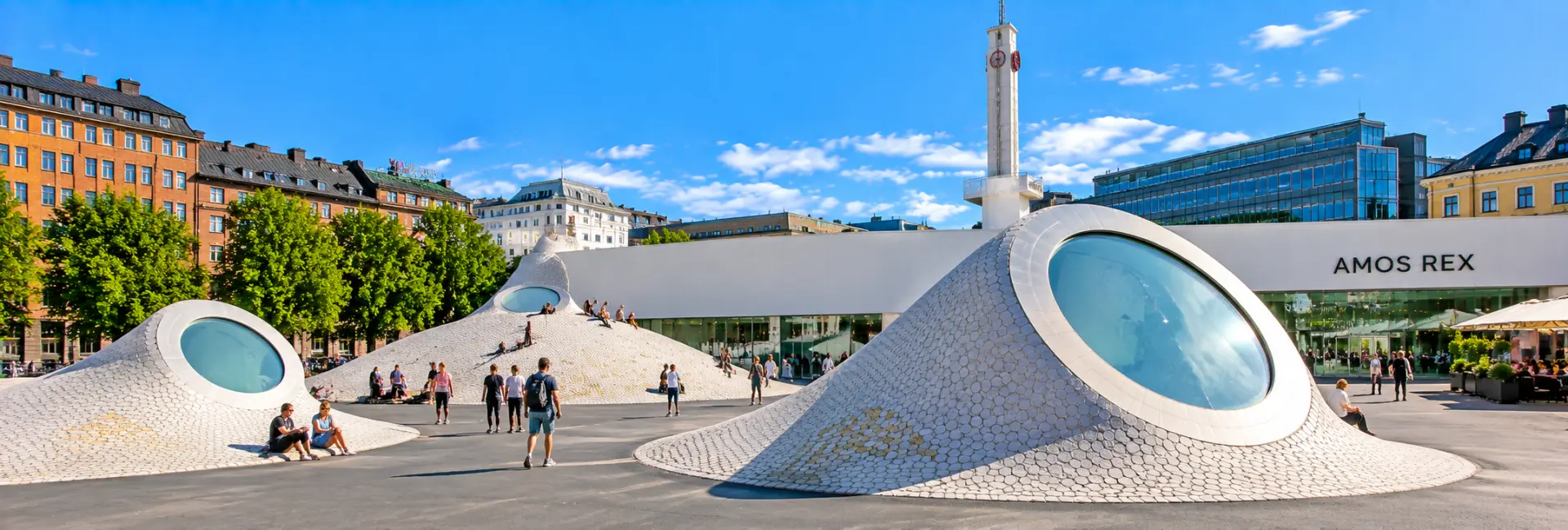
Rather than expand upward or alongside Lasipalatsi, JKMM's design excavated roughly 13,000 cubic metres of rock beneath the square directly behind the building to create around 2,200 square metres of column-free gallery space. The galleries are topped with a series of large concrete domes fitted with angled skylights, which bring natural daylight into the exhibition halls below while framing views of the surrounding city above.
The project was led by JKMM's Asmo Jaaksi, working with a design team that also drew on the firm's experience with the Turku Main Library and Finland's pavilion at the 2010 Shanghai World Expo, both large public projects that combined historic material with contemporary construction.
Visitors descend from Lasipalatsi's restored foyer down a sloping staircase, passing a picture window overlooking the square, before reaching the underground halls, a sequence designed to connect the historic pavilion physically and visually to the new museum beneath it.
Collections and Exhibitions
Amos Rex's collection is built largely on the holdings of the former Amos Anderson Art Museum, weighted toward Finnish and Swedish post-impressionist painting, alongside a rotating display drawn from the post-impressionist collection of the architect and critic Sigurd Frosterus. The museum's temporary exhibition programme, however, leans heavily toward international contemporary and technologically experimental art.
Its opening exhibition, Massless, was an immersive, interactive digital installation by the Japanese collective teamLab, which used the domed galleries' unusual geometry to project shifting, responsive visuals around visitors as they moved through the space. Later exhibitions have ranged from surveys of Belgian surrealist René Magritte to shows built around Frosterus's own collection and the Dutch collective Studio Drift.
Because so much of its programming is temporary and experiential, Amos Rex is best approached expecting to see whatever happens to be on show rather than a fixed permanent display, with the Frosterus collection serving as one of the only consistently exhibited elements.
Lasipalatsi Square
Above the galleries, the domes push up through the ground to form the undulating topography of Lasipalatsi Square, a public plaza that has become a Helsinki landmark in its own right. Locals use its curved concrete mounds for sitting, walking and skateboarding, regardless of whether they are visiting the museum below, and the square regularly hosts open-air events and gatherings through the summer months.
Visiting Today
Amos Rex sits directly across from the Parliament House and diagonally opposite the Steven Holl-designed Kiasma Museum of Contemporary Art, placing it at the centre of one of Helsinki's densest concentrations of cultural institutions. The museum charges an admission fee, with free entry for visitors under 18 and with the Helsinki Card, and its accessible entrance, wheelchair loans and autism-friendly arrangements are designed to accommodate a wide range of visitors.
Best Time to Visit
Advance online booking is recommended, since ticket lines at the entrance hall can grow long, particularly on weekends. Early weekday afternoons tend to be the quietest time to visit, and late-opening hours on selected evenings offer a way to see the galleries away from the busiest daytime crowds.
Visitor Tips
- Book tickets online in advance to avoid queuing at the entrance during busy periods
- Spend time in Lasipalatsi Square itself, not just the galleries below; its domed landscape is part of the design
- Check the Bio Rex cinema schedule if classic or independent film is of interest during the same visit
- Use the accessible entrance on the Lasipalatsi Square side if travelling with a wheelchair or pushchair
- Visit on a weekday afternoon for a quieter experience, since weekends draw the largest crowds
Nearby Attractions
- The Parliament House (Eduskuntatalo), directly across the street from Lasipalatsi
- Kiasma Museum of Contemporary Art, a short walk diagonally across the same area
- Oodi Central Library, part of the same Kansalaistori cultural cluster
- Helsinki Central Railway Station and Kamppi metro station, both within easy walking distance
FAQs about visiting Amos Rex
What is Amos Rex known for? +
It is Helsinki's leading contemporary art museum, known for its domed underground galleries beneath the undulating Lasipalatsi Square and for technologically experimental, immersive exhibitions.
Is Amos Rex the same as the Amos Anderson Art Museum? +
Yes, Amos Rex continues the work of the Amos Anderson Art Museum, which operated from 1965 until its 2018 move to the current underground galleries beneath Lasipalatsi.
Is there an entrance fee? +
Yes, the museum charges admission, though entry is free for visitors under 18 and for Helsinki Card holders.
Do I need to book tickets in advance? +
Booking online in advance is recommended, since queues at the entrance hall can be long, especially on weekends.
What can I expect to see inside? +
Exhibitions are largely temporary and experimental, often involving digital and immersive art, alongside a rotating display from the Sigurd Frosterus post-impressionist collection.
Is Amos Rex accessible for wheelchairs and strollers? +
Yes, the museum has an accessible entrance with automatic doors, accessible elevators and toilets, and wheelchairs available to borrow during a visit.
What is Lasipalatsi Square, and is it part of the museum? +
It is the rippling public plaza formed by the museum's underground domes; it sits directly above the galleries and is free and open to the public at all times, whether or not visitors enter the museum itself.