Table of Contents
Overview
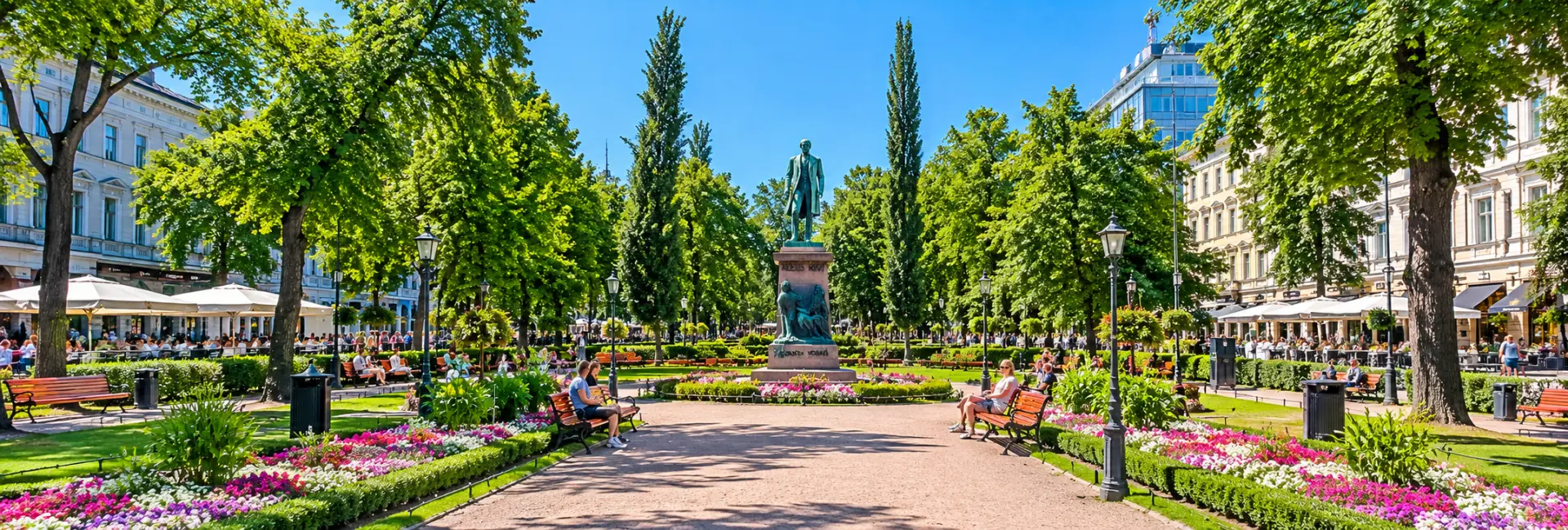
Running for about half a kilometre between Erottaja Square and Market Square, Esplanadi, known to locals simply as "Espa," is Helsinki's best-loved park and the closest thing the city has to a public living room. A narrow strip of lawns, flowerbeds and linden-tree alleys flanked by two one-way streets, it has served since the early nineteenth century as the place where Helsinki comes to walk, sit, perform and be seen.
The park takes its name from the French "esplanade," and its bordering streets, Pohjoisesplanadi (North Esplanadi) and Eteläesplanadi (South Esplanadi), run the full length of the green strip between them, with Aleksanterinkatu running parallel just to the north.
The park sits at the heart of the city's shopping district, with the design boutiques, cafés and restaurants of Pohjoisesplanadi and Eteläesplanadi lining it on either side, and it connects directly to Market Square at its eastern end, making it one of the easiest and most natural walks for a first-time visitor to Helsinki.
History
From Foul-Smelling Bay to City Park
Before it became a park, the site was low-lying wetland at the edge of the foul-smelling Kluuvi Bay, which once extended south almost as far as where the park now runs. After Helsinki was named capital of the Grand Duchy of Finland in 1812, the city's principal architect, Carl Ludvig Engel, incorporated an open esplanade into his plan for the new centre, and substantial landfill was required through the 1850s to firm up the ground before the park could take its final shape.
The two halves of the park carried older, informal names before Esplanadi took hold: the eastern stretch nearest the harbour was known as the Chapel Esplanade, or "Small Calf Hook," while the central and western sections were called the "Large Calf Hook." The park itself opened to the public in 1818.
Layout and Design
Engel divided the roughly 1.75-hectare strip into a network of straight, symmetrical alleys running its full length, with rows of linden trees on either side forming a corridor that visitors often compare to a green hall in high summer. Helsinki's first city gardener, Svante Olsson, later refined the planting scheme, and the park's most recent major renovation, completed in 1998, was designed by landscape architect Leena Iisakkila.
A Stage for the Nation
Esplanadi has long doubled as a civic stage as much as a garden. Its long, open lawns and central location have made it a natural site for protests, national celebrations and political demonstrations throughout Finland's modern history, a role that continues today alongside its everyday use as a place to relax. In 2025 the park served as one of the main venues of the Helsinki Biennial, an international contemporary art event that drew several hundred thousand visitors across the park, Vallisaari Island and the HAM Helsinki Art Museum.
Landmarks and Monuments
The Runeberg Statue
At the centre of the park stands a bronze statue of Johan Ludvig Runeberg, the poet whose verses form the basis of Finland's national anthem, unveiled in 1885. The statue was sculpted by the poet's own son, Walter Runeberg, and depicts his father at the age of fifty-five in an overcoat. At the base of the pedestal sits a separate bronze figure, the Maiden of Finland, wrapped in a bearskin and holding a laurel wreath alongside an inscription bearing verses of the national anthem in Runeberg's native Swedish.
Engel's Theatre and Other Sculpture
In 1827, the same architect who laid out the park, Carl Ludvig Engel, built a small wooden theatre, Engels Teater, in one corner of the grounds. It was Helsinki's first purpose-built theatre and the direct predecessor of today's Swedish Theatre, and though the original building is long gone, it marked Esplanadi's early role as a centre of the city's cultural life. Elsewhere in the park, sculptures by artists including Viktor Jansson, Gunnar Finne and Lauri Leppänen add to a collection of public art that has grown steadily since the Runeberg statue's unveiling, including a statue of the poet Eino Leino toward the park's western end.
The Kiosks
A row of ornate wooden kiosks lines the park's southern side, the oldest dating to 1893 and 1909, while a set of plainer, functionalist kiosks on the northern side were designed in 1928 by City Architect Gunnar Taucher. Several still operate as coffee and ice cream stands today, among the least expensive places in central Helsinki to buy a cup of coffee.
Kappeli and the Espa Stage
At the park's eastern end, closest to Market Square, stands Kappeli, one of Helsinki's most storied restaurants. Designed by the architect Hampus Dahlström and opened in 1867, its name is said to descend from a series of increasingly permanent buildings on the site, each nicknamed "the chapel" by locals after an original booth used to sell milk, culminating in the stone building that opened that year.
Facing the restaurant is the Espa Stage, an outdoor bandstand that hosts live concerts through the summer months, typically from the beginning of May to the end of August, drawing both scheduled performers and buskers throughout the season. A pair of ornamental pools flanking the stage carry sculptural work by Viktor Jansson, adding a further layer of public art to this corner of the park.
Shopping and Cafés Along the Esplanadi
The streets bordering the park, Pohjoisesplanadi to the north and Eteläesplanadi to the south, form one of Helsinki's principal shopping streets, lined with Finnish design houses, jewellers, and long-established cafés and restaurants. A stroll along either side takes in Finnish design boutiques and flagship stores alongside more modest kiosks and outdoor terraces, giving the park a rare combination of green space and genuine city-centre commerce on both flanks.
Restaurant Olo, a fine-dining address on Pohjoisesplanadi, and the historic Savoy Restaurant on Eteläesplanadi are among the more notable names overlooking the park, giving the streets around Esplanadi as much culinary reputation as retail appeal.
Best Time to Visit
Esplanadi is at its liveliest from late spring through summer, when Helsinki's long daylight hours fill the lawns with picnickers, the Espa Stage runs its full concert programme, and the park's cafés open their terraces. Vappu, the first of May, is one of the busiest days of the year here, as graduating students and revellers gather across the lawns.
Outside summer the park is quieter and more subdued, though it remains a pleasant, well-maintained route for a short walk between the city's shopping streets and Market Square at any time of year.
Visitor Tips
- Combine a walk through the park with a visit to Market Square at its eastern end and Erottaja Square at its western end
- Check the Espa Stage's summer schedule in advance if live music is part of the appeal, since performances run only from May to August
- Grab a coffee from one of the historic wooden kiosks along the southern side rather than a café, for one of the cheapest options in the city centre
- Visit around Vappu (1 May) for a lively, distinctly Finnish atmosphere, but expect large crowds
- Look closely at the base of the Runeberg statue for the Maiden of Finland figure and the national anthem inscription, easy to overlook from a distance
Nearby Attractions
- Market Square (Kauppatori), directly adjoining the park's eastern end
- Erottaja Square and the surrounding shopping streets, at the park's western end
- The Swedish Theatre, descendant of Engel's original Esplanadi theatre
- Senate Square and Helsinki Cathedral, a short walk north of the park
FAQs about visiting Esplanadi Park
What is Esplanadi Park known for? +
It is Helsinki's most famous city-centre park, known locally as "Espa," lined with design shops and cafés and home to the Runeberg statue, the historic Kappeli restaurant and the outdoor Espa Stage.
Is there an entrance fee? +
No, the park is a free, open public space and is accessible at any time of day.
When do the summer concerts at Espa Stage take place? +
The stage runs a concert programme roughly from the beginning of May to the end of August, with performances scheduled throughout the summer season.
How long does it take to walk through the park? +
Walking end to end takes about ten to fifteen minutes, though most visitors spend longer browsing the shops, kiosks and cafés along the way.
Is Esplanadi connected to Market Square? +
Yes, the park's eastern end leads directly into Market Square on Helsinki's South Harbour, making the two easy to combine in one walk.
What is the best time of year to visit? +
Late spring through summer is liveliest, with full concert programming, open café terraces and crowds of picnickers, especially around the 1 May Vappu holiday.
Who was Johan Ludvig Runeberg? +
He was Finland's national poet, whose verses form the text of the Finnish national anthem; his statue at the centre of the park was sculpted by his son, Walter Runeberg, and unveiled in 1885.