Table of Contents
Overview
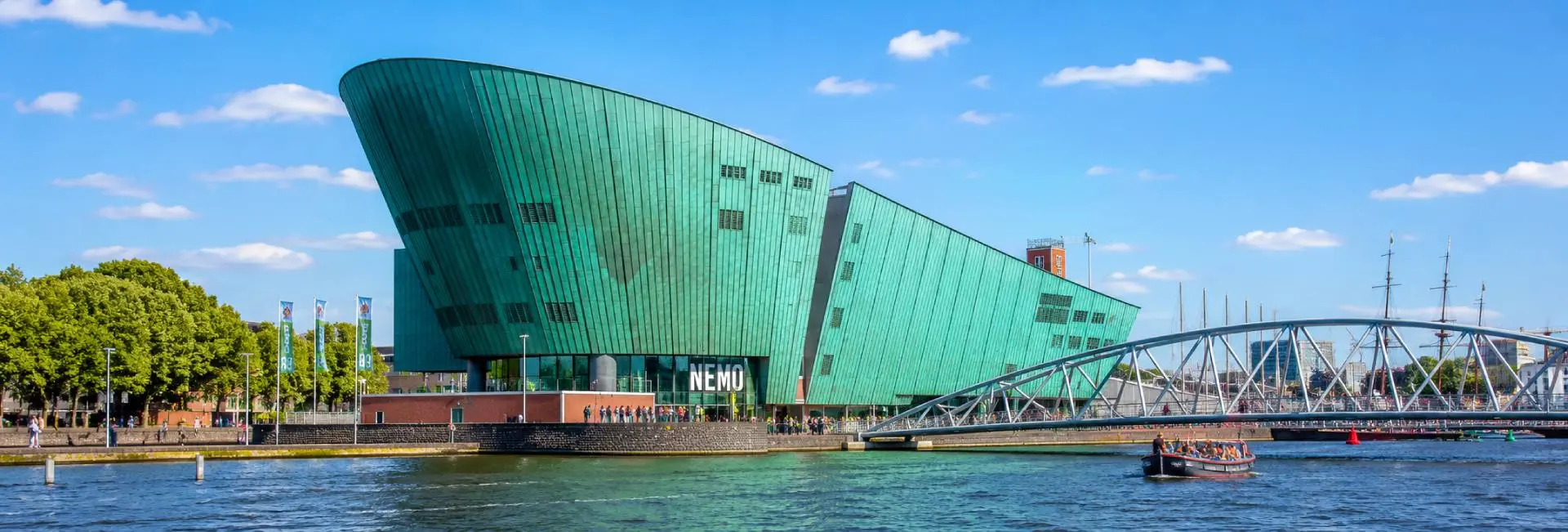
NEMO Science Museum is the largest science center in the Netherlands, occupying a dramatic copper-green building that rises above Amsterdam's Oosterdok like the hull of a ship. Inside, five floors of hands-on exhibits invite visitors to blow giant soap bubbles, spin a gyroscope, run their own chemistry experiments, and explore everything from static electricity to the human body.
Aimed primarily at children but genuinely enjoyed by adults, NEMO turns scientific concepts into physical, playable experiences rather than static displays. A rooftop square open to the public tops it all off, offering panoramic views over Amsterdam's harbor and city skyline.
History
Origins as the Labour Museum
NEMO's story began in 1923, when artist Herman Heijenbrock founded the Labour Museum in Amsterdam, housed across sites on Rozengracht and Tolstraat. The museum was dedicated to showing the public how industry and labor shaped everyday life.
From NINT to NewMetropolis
In 1954, the institution was renamed the Netherlands Institute for Industry and Technology (NINT), broadening its focus toward technology and innovation. In 1997, after years of planning, the museum relocated to a bold new home on Oosterdok and reopened as NewMetropolis, an interactive space designed to teach visitors new skills through games and exhibits. The concept won widespread praise, but significant operating deficits within its first 18 months forced a rethink of its approach.
Becoming NEMO Science Museum
Michiel Buchel took over as director in 2003 and sharpened the museum's focus squarely on science, renaming it NEMO Science Centre and later NEMO Science Museum. Since then it has become one of the country's most visited museums, expanding its reach with events, a journalism platform, and its historical collection. In 2023, NEMO marked its centenary, with Géke Roelink now leading the museum into its next chapter.
Architecture & Design
NEMO's building is one of Amsterdam's most recognizable landmarks, designed by celebrated Italian architect Renzo Piano - also known for the Centre Pompidou in Paris, Potsdamer Platz in Berlin, and the Shard in London. Completed in 1997, the structure sits directly on top of the IJ tunnel, its sloping, copper-clad walls forming a shape widely read as a ship's hull rising out of the water.
The design is more than decorative: it bridges Amsterdam's historic city center and its working harbor, echoing the maritime heritage of a city built on trade and seafaring. Beneath the eye-catching exterior, the interior is kept deliberately minimal, letting the interactive exhibits take center stage.
Exploring the Five Floors
Fenomena (Floor 1)
Fenomena introduces the basics of physics through play, covering light, sound, static electricity, and optical illusions. Signature exhibits include a giant soap-bubble station, a spinning gyroscope chair, and a Tesla lightning globe, alongside a recreation of the museum's earlier incarnation.
Technium (Floor 2)
Technium looks at the technology shaping daily life, with a strong Dutch focus on water management - including how flood barriers work and how drinking water is purified - alongside exhibits on logistics and e-commerce.
Elementa (Floor 3)
Elementa explores the building blocks of the universe, from the Big Bang to planets and stars. Highlights include a 4.6-billion-year-old meteorite and an interactive globe for exploring the solar system, plus the NEMO Laboratory, where visitors can put on a lab coat and run simple chemistry experiments.
Humania (Floor 4)
Humania examines what it means to be human, covering the body, evolution, ageing, memory, and identity. A colossal 8.5-metre handstand sculpture by Dutch artist Florentijn Hofman marks the entrance. Some themes, including sexuality and death, are aimed at visitors aged 12 and up and are clearly signposted.
Energetica & the Rooftop
NEMO's fifth floor spills out onto its sloping rooftop square, home to Energetica, an open-air exhibition of interactive sculptures exploring sun, wind, and water power. Solar-powered seating and wind-driven artworks sit alongside one of the best panoramic viewpoints in Amsterdam.
Unlike the museum floors below, the rooftop square is free and open to everyone, museum ticket or not, making it a popular stop even for visitors just passing by the harbor. A rooftop restaurant serves food and drinks with a view over the IJ.
Ways to Experience It
Beyond browsing the exhibits at your own pace, NEMO runs several live experiences throughout the day that add structure to a visit.
- Chain Reaction show - a live demonstration on the internal balcony, running several times daily
- NEMO Laboratory - hands-on chemistry experiments using everyday household items, guided by staff
- Rooftop Energetica trail - self-guided exploration of the renewable-energy sculptures and installations
- Seasonal and temporary exhibitions supplementing the five permanent floors
Best Time to Visit
NEMO is busiest with school groups in the morning and with local families on weekends, so timing a visit well makes a real difference to the experience.
- Arrive right at opening and head to the upper floors first to get ahead of the crowds
- Visit after 2:30 PM, once school groups have typically left for the day
- Tuesday, Wednesday, and Thursday tend to be the quietest weekdays
- Save the rooftop terrace for a clear, sunny day to make the most of the view
Visitor Tips
A little preparation goes a long way at NEMO, since several practical details differ from a typical museum visit.
- Tickets are sold exclusively online with a timed entry slot - none are sold at the door
- Plan for roughly 2–3 hours to see the museum properly
- Lockers are available for coats and bags
- Bring a change of clothes for kids if they'll be near the water-based exhibits
- The rooftop square is free to enter even without a museum ticket, but closes in wet weather
- Humania (Floor 4) includes content on sexuality and death recommended for ages 12 and up
Nearby Attractions
NEMO sits on Oosterdokseiland, just a short walk from Amsterdam Centraal station, which makes it easy to combine with other harborside sights.
- Amsterdam Centraal station - around 5 minutes on foot, with tram and bus connections across the city
- National Maritime Museum (Het Scheepvaartmuseum) - a short walk along the harbor, covering Dutch seafaring history
- Amsterdam's historic city center canals - walkable from NEMO for a change of pace after the museum
FAQs about NEMO Science Museum
What is NEMO Science Museum known for? +
It's the largest science center in the Netherlands, known for its hands-on exhibits and its distinctive ship-shaped building designed by Renzo Piano, which sits on top of the IJ tunnel in Amsterdam's harbor.
How much time should I set aside for a visit? +
Most visitors spend around 2 to 3 hours exploring the five floors properly, though families with young children often stay longer.
Do I need to book tickets in advance? +
Yes. Tickets are sold exclusively online with a timed entry slot, and none are available for purchase at the entrance.
Is NEMO suitable for adults without kids? +
Yes, though it's primarily designed for children aged 6 to 16; adults tend to particularly enjoy the Humania floor, the chemistry lab, and the rooftop terrace.
Is the rooftop free to visit? +
Yes, the rooftop square and its Energetica exhibition are open to the public free of charge, even without a museum ticket, though it closes in rainy weather.
What's the best time to avoid crowds? +
Arrive right at opening and head to the upper floors first, or visit after 2:30 PM once school groups have left; Tuesday to Thursday tend to be quieter than weekends.
Is any part of the museum not suitable for young children? +
The Humania floor covers themes like sexuality, ageing, and death, and is recommended for visitors aged 12 and up, with sensitive areas clearly marked.
How do I get to NEMO from Amsterdam Centraal? +
It's about a 5-minute walk from Amsterdam Centraal station across the harbor to Oosterdokseiland, where NEMO is located.