Table of Contents
Overview
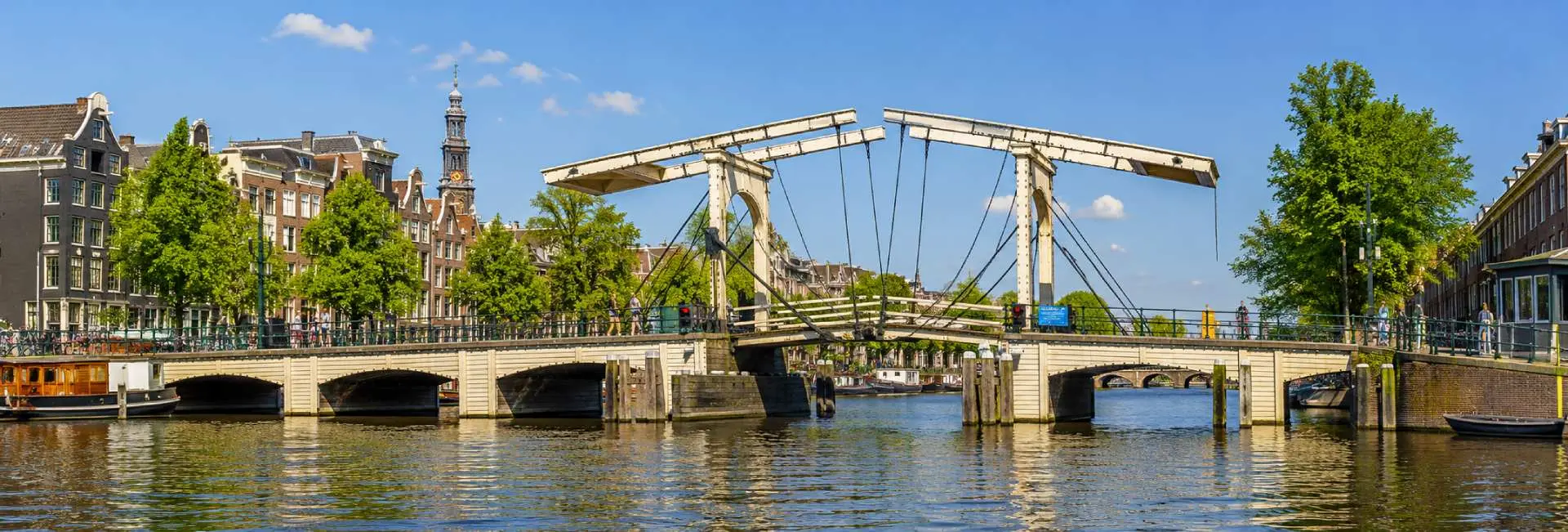
The Magere Brug, known in English as the Skinny Bridge, is one of Amsterdam's most photographed landmarks. This white-painted wooden drawbridge crosses the Amstel River at Kerkstraat, linking the Keizersgracht and Prinsengracht neighborhoods in the heart of the city.
Its double-leaf design, delicate silhouette, and evening light display have made it a favorite for locals and visitors alike, whether they're strolling past, cycling over it, or watching it rise from a canal cruise below.
History
Early Origins
A wooden footbridge is believed to have first crossed the Amstel at this spot around 1670. By 1691, it had been formalized as the Kerkstraatbrug, a structure with thirteen small arches. The bridge was so narrow that two pedestrians could barely pass each other, and locals began calling it "magere brug," meaning skinny bridge, a nickname that eventually replaced its original name entirely.
Growth and Rebuilding
As traffic along the Amstel increased through the 19th century, the original structure deteriorated. It was demolished in 1871 and replaced with a wider, nine-arched wooden bridge to keep pace with the city's growth.
The Modern Bridge
Half a century later, that bridge also needed replacing. Architect Piet Kramer was asked to design a new crossing, and rather than switching to steel and stone, the city chose to preserve the traditional look. The current bascule bridge dates to 1934, with a major renovation following in 1969. Until 1994, bridge keepers raised and lowered it by hand; it now operates automatically.
Recognition & Heritage Status
- Listed as a Rijksmonument (Dutch national heritage site) since 2002
- Sits within Amsterdam's historic canal district, part of the city's UNESCO-recognized canal ring area
- Registered as a protected municipal monument
- Featured in the 1971 James Bond film "Diamonds Are Forever," cementing its status as an international film location
Architecture & Design
The Magere Brug is a traditional Dutch bascule bridge, meaning its central span lifts to let boat traffic through. Unlike most Amsterdam bridges, where only one leaf rises, the Magere Brug is a double-leaf design: both sides lift simultaneously in a balanced, seesaw-like motion.
Built from white-painted wood, the bridge keeps the historic character of the original 17th-century design even though the current structure dates to 1934. At night, around 1,200 light bulbs outline its frame, giving it a soft glow that reflects across the Amstel and makes it one of the city's most recognizable nighttime silhouettes.
- Traditional double-leaf bascule mechanism
- White-painted wooden construction
- Illuminated by roughly 1,200 light bulbs each evening
- Opens multiple times daily for river traffic
Local Legend
The bridge's name has inspired more than one story over the centuries. The most common explanation is simply practical: the original 17th-century crossing was so narrow that "skinny bridge" was an obvious nickname.
A more romantic legend persists alongside it. According to local tradition, two sisters from the Mager family lived on opposite banks of the Amstel and had a narrow wooden bridge built so they could visit one another more easily. Whether or not the tale is historically accurate, it has helped turn the bridge into a popular spot for proposals, and many visitors still believe a kiss on the Magere Brug brings lasting love.
Ways to Experience It
- Walk or cycle across, since the bridge has been reserved for pedestrians and cyclists since 2003
- Watch it open for passing boats, which happens several times a day
- View it from a canal cruise passing along the Amstel, since sightseeing boats are low enough to pass beneath it when closed
- Photograph it after dark, when its light bulbs are switched on and reflect across the water
Best Time to Visit
The Skinny Bridge is worth seeing at any hour, but the light changes its character considerably. During the day, it's easiest to appreciate the mechanics of the drawbridge and watch it open for boat traffic on the Amstel.
In the evening, once its light bulbs switch on, the bridge takes on a softer, more romantic feel, especially during blue hour just after sunset when there's still some color left in the sky. Early mornings tend to be quieter, with fewer crowds and calmer water for photos.
Visitor Tips
- Crossing the bridge is free and open at all hours
- The bridge can get busy with cyclists, so pedestrians should stay alert while crossing or stopping for photos
- For the best night photos, arrive around blue hour rather than well after dark
- Combine a visit with a canal cruise for a different perspective from the water
- Exact opening times for boat traffic vary, so don't plan a visit purely around seeing it open
Nearby Attractions
The Magere Brug sits close to several other well-known Amsterdam sights, making it easy to combine with a longer walk through the canal district.
- Hermitage Amsterdam, an extension of the State Hermitage Museum in Russia with rotating art exhibitions
- Theater Carré, a historic theater venue directly along the Amstel
- Rembrandtplein, a lively square known for its restaurants and nightlife
- The Amstel River waterfront, popular for walking and cycling routes through central Amsterdam
FAQs about The Skinny Bridge (Magere Brug)
What does Magere Brug mean? +
It translates to "Skinny Bridge," a nickname that stuck because the original 17th-century crossing was so narrow that two people could barely pass each other on it.
Is it free to visit the Skinny Bridge? +
Yes, crossing the bridge is completely free and it's accessible at any hour of the day.
When was the current bridge built? +
The bridge standing today dates to 1934, a faithful redesign by architect Piet Kramer that replaced an earlier 1871 version, with a major renovation completed in 1969.
What's the best time of day to visit? +
Daytime is best for watching the drawbridge mechanism in action, while evening, especially around blue hour, is best for photos once its roughly 1,200 lights are switched on.
How long does it take to see the bridge? +
Most visitors only need 10 to 15 minutes to cross, take photos, and watch it if it happens to open, though many linger longer to enjoy the atmosphere along the Amstel.
Can you drive across the Skinny Bridge? +
No, the bridge has been limited to pedestrians and cyclists since 2003.
Is the Skinny Bridge suitable for wheelchairs or strollers? +
Yes, it's a flat, step-free crossing, though the wooden surface and cyclist traffic mean it's worth crossing with a bit of extra care.
What's the legend behind the bridge? +
Local tradition says two sisters from the Mager family, living on opposite banks of the Amstel, had the bridge built so they could visit each other more easily, and it's said that couples who kiss on the bridge stay together for life.
Has the bridge appeared in any films? +
Yes, it appeared in the 1971 James Bond film "Diamonds Are Forever," which helped raise its profile as an international landmark.
What's nearby the Skinny Bridge worth visiting? +
The Hermitage Amsterdam, Theater Carré, and Rembrandtplein are all within easy walking distance along the Amstel.