Table of Contents
Overview
The Stedelijk Museum Amsterdam is the Netherlands' leading museum for modern and contemporary art and design. Set on the city's Museumplein, it sits within easy walking distance of the Rijksmuseum and the Van Gogh Museum, forming one of the densest concentrations of art in Europe.
Inside, the Stedelijk holds tens of thousands of works spanning painting, sculpture, photography, video, and design, ranging from 19th-century masters to living artists. It's known both for its depth in early 20th-century movements like De Stijl and for a building that pairs a 19th-century brick façade with a striking contemporary extension.
History
Founding and Early Years
The Stedelijk was established in 1874, when a group of private citizens in Amsterdam, backed by patron Sophia Adriana de Bruyn and the Van Eeghen family, donated funds and art collections to create the city's first museum dedicated to contemporary art. The collection was initially housed at the Rijksmuseum before moving into its own building on Museumplein in 1895.
In its early decades, the museum's holdings were broad and somewhat eclectic, including period rooms, historical objects, and militia banners alongside contemporary paintings.
Focusing on Modern Art
From around 1920 onward, the collection was gradually narrowed to concentrate on modern and contemporary art, along with design and photography. For years the museum was also known for its Van Gogh paintings, many of which were later transferred to the newly established Van Gogh Museum nearby.
The Sandberg Era and Beyond
The Stedelijk's international reputation took shape under director Willem Sandberg, who led the museum from 1945 to 1963 and built up its avant-garde credentials with bold acquisitions and exhibitions, including an early showing of the CoBrA group. Later directors continued to expand the collection, and by the early 1970s the museum's focus had shifted fully to modern and contemporary art.
Architecture: Old Building and "The Bathtub"
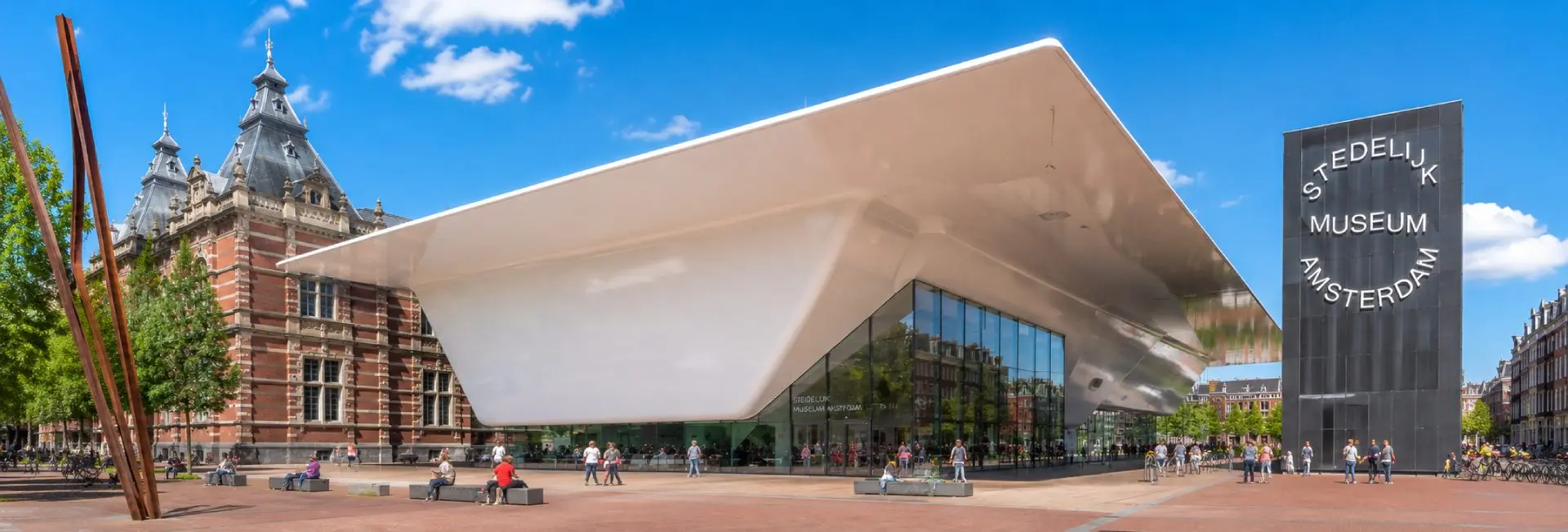
The museum's original building, completed in 1895, was designed by Amsterdam city architect Adriaan Willem Weissman in a Neo-Renaissance style, with a striped brick façade and decorative sculptural details.
Between 2004 and 2012, the museum underwent a major renovation and expansion, reopening in September 2012 with a large new wing designed by Dutch architect Mels Crouwel. The addition's smooth white composite exterior and rounded form quickly earned it the nickname "the Bathtub" among locals, and it now houses the museum's main entrance beneath its raised structure, opening directly onto Museumplein.
The Collection
The Stedelijk's collection includes roughly 90,000 objects spanning painting, sculpture, drawing, prints, photography, video, and applied arts and design. It is particularly strong in art from the late 19th century to the present, with especially deep holdings in Dutch modernism.
- One of the most complete collections of Piet Mondrian's work anywhere, tracing his shift from early landscapes to pure geometric abstraction
- A major Kazimir Malevich collection, among the largest outside Russia, including key Suprematist works
- Significant Henri Matisse cut-outs, including large-scale late works
- Strong representation of De Stijl, CoBrA, and post-war American and European art
- An active design collection covering furniture, graphic design, and industrial design
Key Artists & Highlights
Beyond its core strengths in Mondrian and Malevich, the Stedelijk's galleries feature work by artists including Vincent van Gogh, Pablo Picasso, Marc Chagall, Karel Appel, Gerrit Rietveld, Andy Warhol, Jackson Pollock, and Yayoi Kusama, among many others.
The museum regularly rotates its permanent collection displays and pairs them with ambitious temporary exhibitions, so the specific works on view can vary between visits. A rotating program of design installations and site-specific commissions also runs throughout the building, including in less obvious spots like the museum café.
Ways to Experience It
Most visitors explore the Stedelijk at their own pace, moving between the permanent collection in the historic Weissman wing and temporary exhibitions in the newer Crouwel extension. A free audio guide is included with admission and covers the permanent collection in several languages.
- Self-guided visit through the permanent collection and current exhibitions
- Free included audio tour, available on-site or via a smartphone app
- Guided group tours, bookable in advance for a more curated overview
- Family-oriented activities and trails, which change periodically
Best Time to Visit
The Stedelijk is open daily and tends to be noticeably quieter than its Museumplein neighbors, the Van Gogh Museum and the Rijksmuseum, making it a comfortable option even without off-peak planning.
For the smallest crowds, weekday mornings between opening and midday, especially Tuesday to Thursday, are ideal. On weekends, arriving right at opening or after mid-afternoon tends to avoid the busiest stretch. Summer months bring more visitors overall, so booking ahead is worthwhile during that period or around major temporary exhibitions.
Visitor Tips
A typical visit takes between one and three hours depending on how much of the permanent collection and temporary exhibitions you want to cover; art enthusiasts can easily spend half a day.
- Book tickets online in advance, since walk-in availability can be limited during busy periods and popular exhibitions
- Combination tickets with the nearby Van Gogh Museum or Amsterdam Museum can offer savings if visiting more than one
- Photography for personal use is generally allowed, though flash and selfie sticks are not, and some temporary exhibitions restrict photography
- The museum is wheelchair accessible, with accessible entrances and elevators throughout
- Food and drink are not permitted inside the galleries, but the on-site café is available for breaks
- Opening hours, current ticket prices, and exhibition schedules should always be checked on the museum's official website before visiting, as these details change over time
Nearby Attractions
The Stedelijk sits on Museumplein, one of Amsterdam's main cultural squares, putting several other major sights within a short walk.
- Van Gogh Museum, directly adjacent, home to the world's largest collection of Van Gogh's work
- Rijksmuseum, a short walk away, covering Dutch art and history from the Middle Ages to the present
- Concertgebouw concert hall, on the opposite side of Museumplein
- Vondelpark, Amsterdam's best-known city park, within easy walking distance
FAQs about Stedelijk Museum
What is the Stedelijk Museum known for? +
It's the Netherlands' leading museum for modern and contemporary art and design, known especially for its deep collections of Piet Mondrian and Kazimir Malevich, alongside works by artists like Matisse, Chagall, and Warhol.
How much time should I plan for a visit? +
Most visitors spend between one and three hours; a focused visit to the highlights can take around 60–90 minutes, while art enthusiasts often spend half a day exploring the full collection and any temporary exhibitions.
Do I need to book tickets in advance? +
Yes, tickets are typically sold online with a specific entry approach, and advance booking is recommended, especially on weekends, in summer, and during major temporary exhibitions, since walk-in availability can be limited.
Is the Stedelijk Museum busy compared to other Amsterdam museums? +
It's generally quieter than the neighboring Van Gogh Museum and Rijksmuseum, though weekday mornings still tend to be the calmest time to visit.
Is the museum accessible for visitors with disabilities? +
Yes, the building has wheelchair-accessible entrances, elevators, and adapted facilities throughout.
Is the Stedelijk Museum suitable for children? +
Yes, the museum offers family-friendly activities and trails that change periodically, though very young children may find the collection more geared toward older kids and adults.
What else can I see near the Stedelijk Museum? +
It sits on Museumplein alongside the Van Gogh Museum, Rijksmuseum, and Concertgebouw, with Vondelpark also within easy walking distance, making it easy to combine with other sights in a single day.
Can I take photos inside the museum? +
Personal photography is generally permitted, but flash photography and selfie sticks are not allowed, and some temporary exhibitions have their own photography restrictions.