Table of Contents
Overview
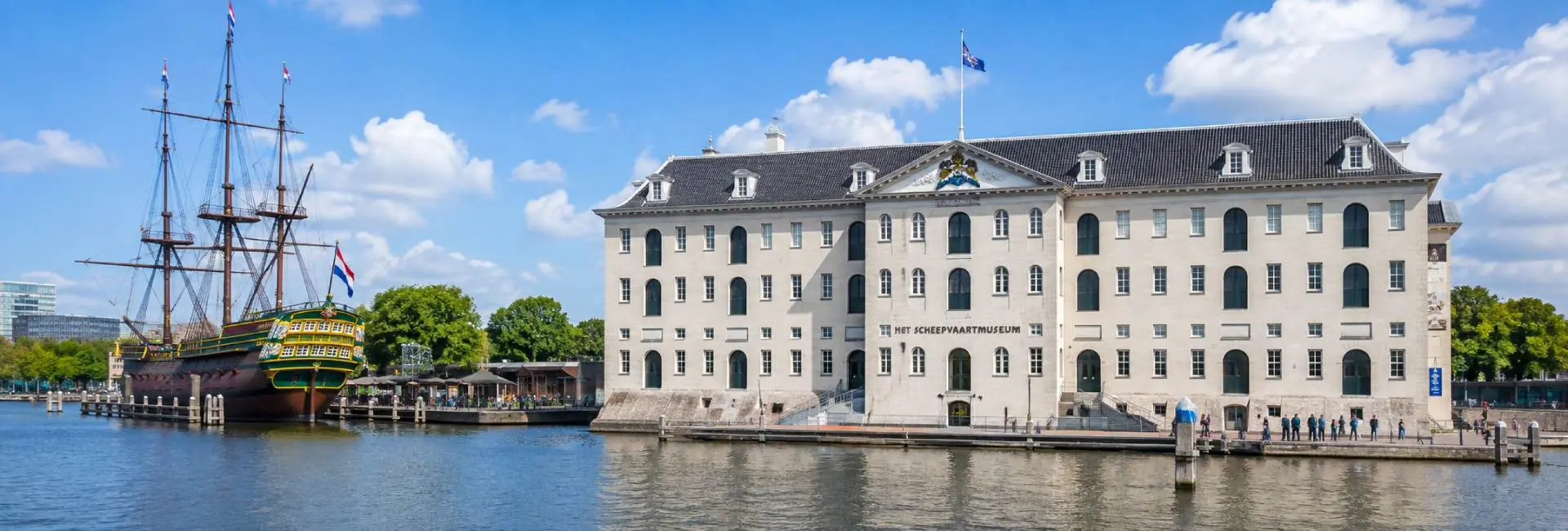
Het Scheepvaartmuseum, known in English as the National Maritime Museum, sits on Amsterdam's eastern docklands in a former naval storehouse that is itself a monument to the city's seafaring past. Inside, five centuries of Dutch maritime history unfold through paintings, ship models, navigational instruments, and nautical charts, forming one of the largest maritime collections in the world.
The museum's centerpiece experience lies just outside its walls: a full-size, sailable replica of the VOC ship Amsterdam, moored at the jetty and open for visitors to climb aboard. Inside, the story is told with equal attention to the era's triumphs and its darker legacy, including the Dutch role in the colonial and slave trades, making it a museum built for genuine reflection as much as spectacle.
History
A Naval Storehouse, Not a Museum
The building predates the museum by more than two and a half centuries. It was constructed in 1656 as het Zeemagazijn, the Arsenal, a storehouse for the Amsterdam Admiralty where sails, ropes, cannons, and other naval supplies were kept. It was designed by city architect Daniel Stalpaert, who gave the warehouse the grand, Venetian-inspired proportions still visible today.
The building remained in naval use for centuries, continuing to serve as a Dutch Navy storehouse well into the 20th century.
Becoming a National Museum
In 1973, the former arsenal was formally converted into the Netherlands' national maritime museum. It operated for decades under the name Nederlands Scheepvaartmuseum Amsterdam before later adopting the shorter Het Scheepvaartmuseum.
Closure and Renovation
The museum closed its doors between 2007 and 2011 for a comprehensive renovation. The most striking result was a new glass roof covering the building's central courtyard, made up of roughly 1,200 individual glass panels arranged in a pattern inspired by the compass lines found on old nautical charts. The museum reopened in 2011 as a modernized, interactive space built around its historic shell.
The Building & Architecture
The museum occupies what was once the largest warehouse in the Netherlands, a monumental stone structure built around a central courtyard in a style often compared to Venetian arsenal buildings of the same period. Thick stone walls, deep archways, and whitewashed interiors reflect its 17th-century military origins as much as any modern museum design.
- The glass roof over the courtyard, added during the 2007–2011 renovation, is composed of about 1,200 glass pieces patterned after compass lines on antique sea charts.
- The building is organized into wings, commonly referred to as the North, South, East, and West Wings, each hosting different galleries and exhibitions.
- A basement tunnel beneath the courtyard connects sections of the museum and houses visitor facilities such as lockers.
Key Exhibitions & Collections
Republic at Sea
The museum's main permanent exhibition occupies the ground-floor gallery and traces how the Dutch Republic rose to become a dominant naval and trading power in the 17th and 18th centuries. Around 50 masterworks, including naval paintings, portraits, model warships, globes, and weaponry, tell this story, and the exhibition does not shy away from the harder chapters, addressing the Dutch role in colonial expansion and the slave trade alongside its accounts of naval victory.
Cartography, Navigation & the Port
Elsewhere in the museum, exhibitions focus on the tools and trade routes that shaped Dutch seafaring. Displays of historic navigational instruments sit alongside rotating exhibitions of nautical charts, while a large-scale exhibit on the Port of Amsterdam uses ship models, raw materials, and a vast video screen to show the city's continued role as one of Europe's busiest ports.
Maritime Gamechangers
This gallery highlights turning points in maritime technology, including a full-size, conjectural replica of the wooden submarine built by inventor Cornelis Drebbel in 1620, believed to be the world's first navigable submarine.
Family & Interactive Exhibits
Several exhibitions are designed specifically with younger visitors in mind, blending storytelling with hands-on and multimedia elements.
- Voyage at Sea, an immersive, multimedia recreation of a historic sea journey
- Dare to Discover, a virtual reality exhibition set aboard ship
- The Tale of the Whale, exploring whaling history for younger audiences
- See You in the Golden Age, an interactive look at 17th-century Dutch life
The VOC Ship Amsterdam & Other Vessels
Moored at the museum's own jetty is the undisputed highlight for many visitors: a full-size, functioning replica of the East Indiaman Amsterdam, a Dutch East India Company (VOC) trading ship roughly 48 meters long and armed with 16 cannons. The original vessel wrecked in a storm off Hastings, England, in 1749 on its maiden voyage to Asia; preserved for centuries in mud, the wreck was excavated in the 1980s and provided detailed insight into 18th-century Dutch shipbuilding, which informed the replica's construction.
Visitors can walk the decks, climb into the crew's hammocks, and step into the captain's cabin, with a short film inside recreating the atmosphere of Amsterdam's historic harbor.
- De Koningssloep (The Royal Barge) – an ornately decorated ceremonial vessel commissioned by King William I in the early 19th century
- Christiaan Brunings – a steamship built in 1900 that served as both an executive vessel and an icebreaker
Ways to Experience It
A free multilingual audio tour is available in 11 languages and covers the collection's highlights in about an hour, making it an easy way to get oriented without needing to read every label. Most visitors combine the indoor galleries with time aboard the Amsterdam replica outside, since the ship experience and the museum's exhibitions are designed to complement one another.
- Self-guided visit through the permanent and temporary galleries
- Free audio tour, available in Dutch, English, French, German, Italian, Portuguese, Russian, Spanish, Chinese, Japanese, and Korean
- Boarding and exploring the VOC ship Amsterdam replica at the jetty
- Family-oriented interactive and VR exhibitions aimed at children
Best Time to Visit
Because a large part of the experience involves walking the outdoor decks of the moored ships, a dry, mild day makes for a noticeably better visit, so spring and early autumn tend to be comfortable choices. The museum's indoor galleries make it a solid option in poorer weather too, since the majority of the collection is under the glass-roofed courtyard and surrounding wings.
Weekday mornings are generally quieter than weekend afternoons and school holiday periods, when the museum's family-friendly exhibits draw larger crowds.
Visitor Tips
- Set aside at least two to three hours to see the main galleries and the ship replica without rushing; some visitors easily spend three to four hours.
- Take the free audio tour early in the visit; it helps prioritize which galleries to slow down in.
- Wear comfortable shoes for the ship, as the decks, stairs, and hold involve some climbing and ducking through low doorways.
- The VOC ship Amsterdam is only partially wheelchair accessible: an elevator on the jetty reaches the upper deck, but the hold and top deck are not accessible.
- Lockers are available on the lower ground level beneath the courtyard for visitors who want to explore hands-free.
- The Netherlands Museum Pass (Museumkaart) is accepted and can also be purchased on-site.
Nearby Attractions
The museum sits in Amsterdam's Oosterdok (Eastern Docklands) area, within easy walking distance of several other landmarks worth combining with a visit.
- NEMO Science Museum, a large interactive science center overlooking the harbor
- ARCAM Architecture Centre, focused on Amsterdam's architecture and urban design
- Amsterdam Centraal Station and the surrounding historic city center
FAQs about The National Maritime Museum
What is Het Scheepvaartmuseum famous for? +
It's best known for its full-size, sailable replica of the VOC ship Amsterdam moored right outside the museum, along with its Republic at Sea exhibition covering the Dutch Golden Age of seafaring.
Is the museum housed in a historic building? +
Yes. The museum occupies a former naval storehouse called het Zeemagazijn, built in 1656 by city architect Daniel Stalpaert to hold supplies for Amsterdam's Admiralty, long before it became a museum in 1973.
How much time should I plan for a visit? +
Most visitors need two to three hours to see the main galleries and board the ship replica comfortably; history enthusiasts often stay three to four hours.
Is the museum suitable for kids? +
Yes, it's designed with families in mind, offering several interactive and VR exhibits, hands-on ship exploration, and themed galleries created specifically for younger visitors.
Do I need to book tickets in advance? +
Ticket and opening-hour details can change, so it's worth checking the museum's official website shortly before your visit to confirm current prices, hours, and whether advance booking is recommended.
Is the VOC ship replica accessible for wheelchair users? +
Only partially. An elevator on the jetty reaches the ship's upper deck, but the hold and top deck involve stairs and are not wheelchair accessible.
What's nearby that I can combine with a visit? +
The NEMO Science Museum and ARCAM Architecture Centre are both a short walk away, and the museum sits within easy reach of Amsterdam Centraal Station and the historic city center.
Does the audio tour cost extra? +
No, the audio tour is free and available in 11 languages, covering the collection's highlights in about 60 minutes.
Does the museum address the darker side of Dutch maritime history? +
Yes. Alongside its celebration of Dutch naval and trading power, the museum directly addresses the colonial exploitation and slave trade tied to that history, particularly within the Republic at Sea exhibition.