
Table of Contents
Overview
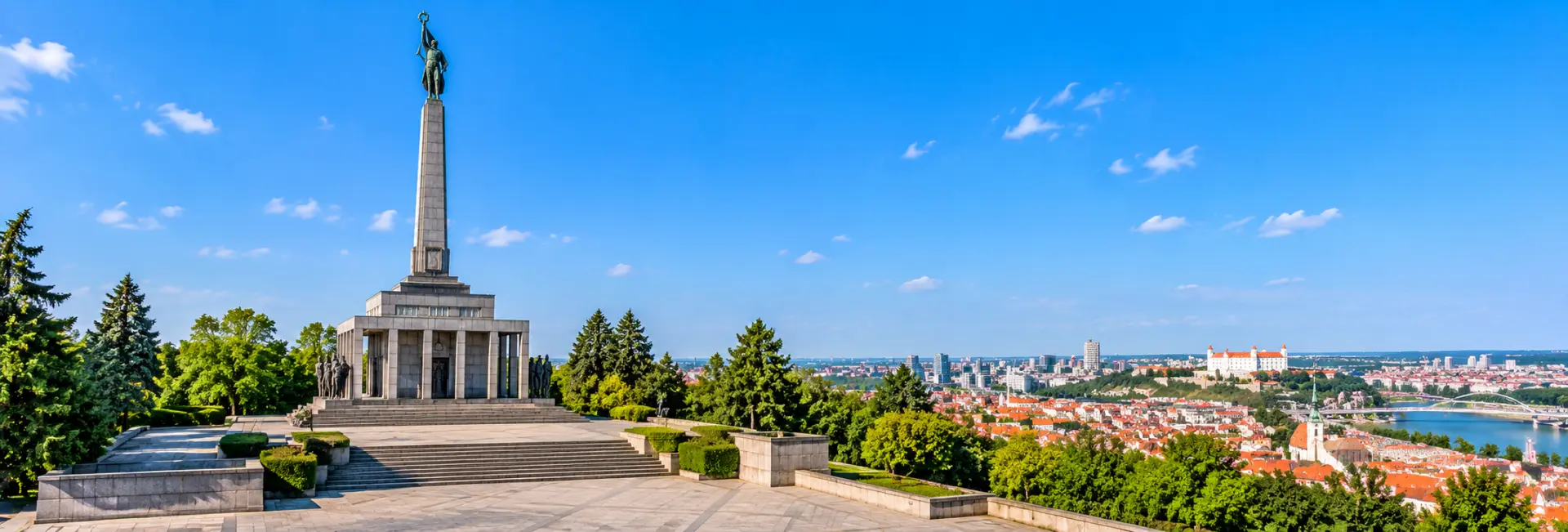
Slavín is a large war memorial and military cemetery on a wooded hill above Bratislava's Old Town. It honors the Soviet soldiers who died in the fighting for the city and the surrounding region in the final weeks of the Second World War, and it is the resting place of 6,845 of them. A tall granite obelisk crowned with a statue of a soldier holding a flag makes it visible from many parts of the city.
For visitors, Slavín offers two things at once. It is a solemn place of remembrance, with graves, terraces and ceremonial spaces designed to be approached with respect. It is also one of the best viewpoints in Bratislava, with a sweeping outlook over the castle, the Danube and the red rooftops of the historic center.
The memorial is also a striking example of monumental Soviet-era design, which adds architectural and historical interest for anyone curious about how the 20th century shaped Central Europe. This page covers its history, design, meaning and practical details for planning a visit.
History
The Liberation of Bratislava
Bratislava was taken by Soviet forces in early April 1945, with the city's liberation marked on 4 April. The battle for the city formed part of the larger Bratislava-Brno operation, which ran from late March to early May 1945. Fighting around the city and in the region cost thousands of lives, among them many Soviet soldiers who were buried on the hillside that later became the memorial site.
From Field Cemetery to Monument
The hill began as the location of a cemetery for fallen soldiers. Between 1957 and 1960 it was transformed into a grand memorial complex, with a ceremonial hall, terraces and a monumental obelisk. The design is credited to Slovak sculptor and architect Ján Svetlík, and the soldier statue at the top is the work of sculptor Alexander Trizuljak.
Opening in 1960
The memorial was opened in early April 1960, timed to the 15th anniversary of the liberation of the city. It was soon recognized as a national cultural monument, and it has remained one of the most prominent landmarks of the capital ever since. Slovak media have described it as the largest war memorial in Central Europe.
A Continuing Place of Ceremony
Each year around 4 April, officials and delegations gather at Slavín to lay wreaths and mark the anniversary of the city's liberation. Outside of those occasions it is a quiet place, used by local residents for walks and by visitors looking for views.
Architecture and Design
A Monument in the Socialist Realist Style
Slavín was built in the late 1950s, when socialist realism was the officially accepted artistic direction. It follows the monumental Soviet tradition, with strong vertical lines, formal symmetry and heroic sculpture. Its style is often compared with other grand postwar landmarks of the same era, such as the Palace of Culture and Science in Warsaw.
The Obelisk and Statue
The central feature is a granite obelisk about 39.5 meters high, standing above a ceremonial hall. At its summit rises a statue of a Soviet soldier about 11 meters tall, holding a victory flag and trampling a swastika underfoot. Because it sits on a hilltop, the whole composition is silhouetted against the sky from far away.
Terraces, Hall and Graves
Below the obelisk, the complex is organized around a main axis that leads visitors from the entrance toward the monument. Wide terraces and steps give the site a ceremonial character, while the cemetery area contains six mass graves and 278 individual graves. A bronze door to the memorial hall is decorated with reliefs, and inscriptions around the base list Slovak towns liberated during the Soviet advance in 1944 and 1945.
Placed for the View
The memorial was positioned to be seen from the city and to look back over it. A secondary axis opens toward a panoramic view of the central districts, which is why the east terrace is such a popular spot with photographers.
Historical and Cultural Significance
Remembrance and Gratitude
For many people Slavín is first of all a war cemetery. The soldiers buried here died far from their homes in the last weeks of a war that ended Nazi occupation in the region, and the site is treated as a place of mourning, with graves tended and wreaths laid on anniversaries.
Complicated Memories
The memorial also carries mixed meanings for Slovaks. There is genuine gratitude for the sacrifice of Soviet soldiers who helped defeat Nazi Germany. At the same time, the monument was built during the communist era and is associated by some with decades of political control, including the 1968 invasion of Czechoslovakia by Warsaw Pact forces. Visitors will find that opinions vary, and a respectful, open-minded approach suits the place.
A Place for Locals Too
Historians have pointed out that Slavín has become both a place of remembrance and a popular recreation area for Bratislava residents. The surrounding park and quiet streets make it a favorite for walks, jogging and sunset views, which is part of its everyday character today.
What to See There
Key Features
- The obelisk and soldier statue: the focal point of the complex and a city-wide landmark.
- The ceremonial terraces: wide steps and platforms that frame the monument and lead toward the viewpoints.
- The graves: six mass graves and individual graves arranged symmetrically around the central axis.
- The memorial hall: located beneath the obelisk, with a bronze door decorated with reliefs.
- The inscriptions: names of Slovak towns liberated in 1944 and 1945, carved around the monument.
- The east terrace view: an open outlook over the Old Town, Bratislava Castle, the river and the city beyond.
The Hill Itself
Slavín stands about 260 meters above sea level, which places it higher than Bratislava Castle. The hill belongs to the Small Carpathians range, and the trees and villas around it give the site a calm, leafy atmosphere that contrasts with the busy Old Town below.
Ways to Experience It
A Quiet Visit
The simplest way to visit is to walk up, spend time at the graves and terraces, and enjoy the view. Most visitors spend between 30 and 60 minutes, depending on how long they linger at the viewpoints.
On Foot From the Old Town
The walk uphill from the Old Town is pleasant and not especially long, passing through a residential area of villas and embassy buildings. It works well as a half-day outing combined with Bratislava Castle, which lies a little more than a kilometer away.
By Bus or Car
Several bus lines run toward Slavín from the main railway station and the central bus station, and the site can also be reached by car along Pažického street. Parking is limited, so public transport or walking is usually easier. Routes and timetables change, so check a current journey planner.
For Photography and Sunsets
Sunset is a favorite time for photography, when the light warms the rooftops and the castle. The paths along the edge of the hillside also lead to quieter corners with different angles on the city.
Best Time to Visit
By Time of Day
Morning is peaceful and good for reflective visits, while late afternoon and sunset give the best light for photographs and city views. Because the grounds are open at all hours, you can choose the time that suits you.
By Season
- Spring: fresh greenery and mild weather make it comfortable for a walk up the hill. The anniversary ceremonies around 4 April bring official events to the site.
- Summer: long evenings are ideal for sunset views, though midday can be hot with little shade on the terraces.
- Autumn: colorful leaves and clear air often give the sharpest views.
- Winter: the site is quiet, and cold, clear days can offer very far views, but paths may be slippery.
Visitor Tips
Practical Information
- Entry is free, and the grounds are generally open around the clock, all year.
- Wear comfortable shoes, as the approach involves hills, steps and stone paving.
- There are few services on the hill itself, so bring water and plan any food stops in the Old Town.
- Allow 30 to 60 minutes for the memorial and more if you plan to explore the surrounding park.
Etiquette
- Remember that this is a cemetery and speak quietly near the graves.
- Do not sit or climb on monuments, graves or statues.
- Avoid loud music, drones or large group activities that might disturb other visitors.
- If a ceremony is taking place, keep a respectful distance and follow any instructions from organizers.
Accessibility
The site includes steps and sloping paths, so some areas may be difficult for wheelchair users or people with limited mobility. If this matters for your visit, consider arriving by car or taxi to reduce the uphill walk.
Nearby Attractions
Slavín sits in a green, upscale part of the city, so it combines easily with other stops.
- Bratislava Castle: about 1.3 kilometers away, with a scenic downhill walk toward the historic core.
- Horský Park: a nearby park where you can rest on a bench or take a longer stroll in shade.
- Old Town: the historic center, including the Main Square and Old Town Hall, lies a short distance below.
- Villa quarter: the streets around Slavín are lined with villas and embassy residences, which are pleasant to walk through.
FAQs about visiting the Slavín Memorial
What is the Slavín Memorial? +
It is a war memorial and military cemetery in Bratislava dedicated to Soviet soldiers who died in the fighting for the city and region in April 1945. It holds the graves of 6,845 soldiers.
When was Slavín built? +
Construction took place between 1957 and 1960, and the memorial was opened in early April 1960 on the 15th anniversary of the city's liberation.
Is Slavín free to visit? +
Yes, entry is free and the grounds are generally open around the clock, although it is best to visit during daylight hours for comfort and safety.
How tall is the monument? +
The granite obelisk is about 39.5 meters high and is topped by a statue of a Soviet soldier roughly 11 meters tall.
Why do people visit Slavín besides the memorial itself? +
The hill offers some of the best panoramic views in Bratislava, taking in the castle, the river and the Old Town. It is also popular for sunset walks.
How long should I spend at Slavín? +
Most visitors spend 30 to 60 minutes, or longer if they want to explore the surrounding park and enjoy the views.
How do I get to Slavín? +
You can walk uphill from the Old Town, take one of several bus lines from the railway or bus station, or drive along Pažického street. Check a current journey planner for routes.
Is Slavín suitable for children and people with limited mobility? +
Children can visit, though they should be reminded that it is a cemetery. The site has steps and slopes, so people with limited mobility may find some parts challenging.
