
Table of Contents
Overview
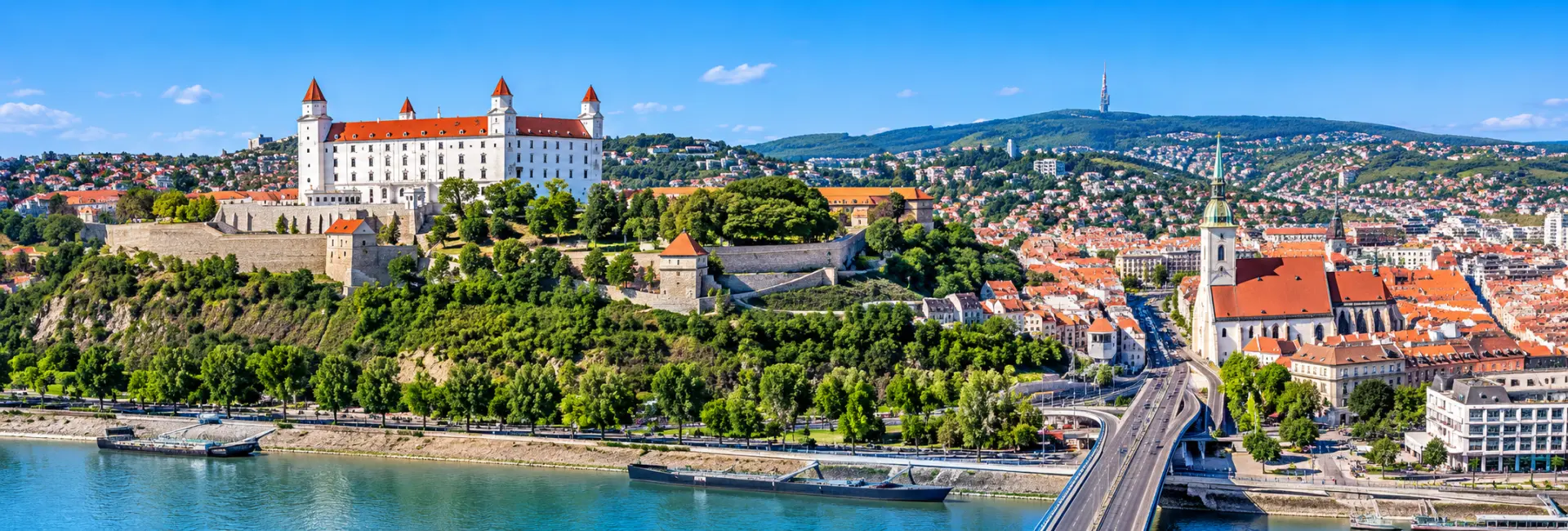
Bratislava Castle (Bratislavský hrad) is the most recognisable building in the Slovak capital. It stands on an isolated rocky hill, the southernmost spur of the Little Carpathians, directly above the Danube and the red roofs of the Old Town. Its massive rectangular form, with a tower at each corner, makes it a dominant feature of the skyline from almost any direction.
The castle has been many things over the centuries: a fortified hilltop settlement, a Gothic stronghold, a Renaissance and Baroque royal residence, a barracks, a ruin and, after a long reconstruction, a museum and a venue for official state functions. Today it houses the history exhibitions of the Slovak National Museum, a treasury of archaeological finds, a music hall and parts of the representative spaces used by the National Council of the Slovak Republic.
Whether you come for the museum, the wide views over three countries or simply a relaxed walk through the Baroque garden, the castle is one of the best ways to understand Bratislava's role in Central European history. It is within easy reach of the Old Town and is a natural centrepiece for any visit to the city.
History
From Prehistoric Hill to Medieval Fortress
The castle hill was settled long before any stone castle existed. People lived here in Celtic times, and the frontier of the Roman Empire ran through the area for centuries. Later, during the Great Moravian period, the hill continued to serve as a fortified centre. Bratislava Castle appears in written records in 907, in an account of a battle fought beneath its walls between Bavarian and early Hungarian forces.
During the Middle Ages a stone palace and defensive structures developed on the hilltop. The oldest part still standing is the Crown Tower, which dates from the 13th century and originally served as a defensive tower.
The Gothic Fortress of Sigismund
In the first half of the 15th century, Sigismund of Luxembourg commissioned a major reconstruction, creating a Gothic fortress in the form of a four-winged castle around an inner courtyard. It was built partly as a stronghold in the age of the Hussite threat, and the older tower was absorbed into its southwestern corner. A deep well, about 85 metres in depth, was dug to guarantee water in time of siege. Parts of the 15th-century fortifications, including Sigismund's Gate and the Luginsland tower, still survive.
Renaissance and Baroque Splendour
After Ottoman advances in Hungary pushed the royal seat northward, Bratislava became a coronation city and the castle a residence of the monarch. A Renaissance rebuilding in the 1550s added new wings, and a further reconstruction in the 1630s and 1640s, associated with the Pálffy family and an early Baroque design, gave the palace a new character.
The castle's golden age came under Empress Maria Theresa, who had it transformed into a stately Baroque residence between 1761 and 1766. Gardens, a winter riding hall and an orangery were added at this time.
Decline, Fire and Rebirth
The castle later served as a seminary and then as an army barracks. Napoleonic troops bombarded the city in 1809, and on 28 May 1811 a fire started accidentally by garrisoned soldiers destroyed most of the buildings. For well over a century the castle stood in ruins, and in the 1930s there were proposals either to rebuild it or to demolish it entirely.
The ruins were opened to the public after the Second World War, and a systematic reconstruction began in the 1950s. The main works ran until 1968, with later repairs continuing into the 21st century. The reconstruction was ambitious, and historians still debate how faithfully it recreated the historic castle, but it returned the building to its place at the heart of the city.
Architecture & Notable Rooms
A Four-Towered Palace
The castle is a rectangular, trapezoid-like block with four corner towers. Only one of them, the Crown Tower in the southwest, is a true tower in the medieval sense. At roughly 47 metres tall, it is the largest and oldest, and its upper level offers one of the best viewpoints in the city. The other three corner structures were adapted or built later as part of the palace's evolution.
Baroque Interiors and Staircase
Behind the entrance, an arcaded passage leads to a grand Baroque staircase that rises to the museum's exhibitions. The interiors reflect the 18th-century Baroque style associated with Maria Theresa, even though much of what you see is the result of 20th-century reconstruction.
Courtyard and Surrounding Buildings
The inner courtyard remains the castle's social heart, framed by the palace wings. Around the complex stand other historic structures, including a long 17th-century building that now houses part of the parliamentary representative facilities and a Baroque stable that serves as a restaurant. To the north, a lengthy 18th-century Baroque building holds museum offices and castle administration.
The Music Hall
In the northern wing, a former Baroque chapel has been turned into the Music Hall, where concerts are held. It shows how the castle has found a modern cultural purpose within its historic fabric.
Grounds & Gardens
Castle Hill
The hill around the castle blends historic, communist-era and contemporary landscaping. Its terraces and paths offer changing views across the Danube, the Old Town and the open country beyond, and in clear conditions you can see across the border into Austria and even parts of Hungary.
The Baroque Garden
One of the most pleasant spots on the site is the French-style Baroque garden, restored to evoke the formal gardens that once belonged to the castle. Its symmetrical layout, clipped hedges and gravel paths provide a quiet counterpoint to the stonework above, and it is open to the public without charge.
Statues and Viewpoints
As you walk the grounds, look for the modest statue of St. Elizabeth, who according to tradition was born at Bratislava Castle in 1207. The many viewing terraces make the walk around the castle as rewarding as the interior visit, especially around sunset when the Old Town and river light up.
Cultural Significance & Royal Ties
A Royal and Coronation Setting
From the mid-16th century, Bratislava served as the coronation city of the Hungarian kings for roughly two centuries. The castle was the seat of the monarch and a meeting place for the Hungarian parliament, and its Crown Tower housed the Hungarian coronation jewels for about two hundred years. This royal past gives the castle a significance well beyond its architecture.
A Symbol of the Capital
Today, Bratislava Castle is both a national cultural monument and a symbol of the Slovak capital. Parts of the complex are used for official purposes by the National Council of the Slovak Republic, and the site continues to serve ceremonial functions. Its role as both museum and political venue illustrates how the building has been adapted to each era's needs.
Legends and Memory
Many legends are connected with the castle's long history, and its dramatic hilltop position has helped keep them alive. Together with the story of its destruction and rebirth, they have made the castle a living part of the city's identity rather than just a historic monument.
Ways to Experience It
There are several ways to enjoy the castle, depending on how much time you have and what you want to see.
- Grounds only: walk the courtyard, terraces and Baroque garden, which are free to enter and open for longer hours than the museum.
- Museum visit: explore the Slovak National Museum's Museum of History, including the exhibition on the history of Slovakia, displays of furniture and clocks, music exhibits and the treasury of archaeological finds.
- Crown Tower: climb to the top for a panoramic view over Bratislava, the Danube and, on a clear day, as far as Austria and Hungary.
- Temporary exhibitions and concerts: check what is on in the Music Hall and exhibition spaces, as the programme changes through the year.
- Guided tours: museum tours bring the collections to life, though they focus on the exhibits more than on the castle's building history.
There is also a café inside the castle, and several restaurants stand around the hill, so it is easy to turn the visit into a half-day outing.
Best Time to Visit
The castle can be visited all year, but conditions vary by season. Late spring through early autumn is the most comfortable time for walking the grounds and enjoying the garden, when trees are in leaf and the views are clear and bright.
Early morning is usually the quietest time, particularly in summer when tour groups arrive later in the day. Late afternoon and early evening are excellent for photography, as the low sun lights the façade and the Danube.
In winter, the castle's silhouette over a frosty Old Town can be strikingly atmospheric, though paths can be cold and windy. The museum offers a welcome indoor option on those days. Because clear skies make a big difference to the views from the Crown Tower, it is worth checking the weather before you climb.
Visitor Tips
The castle sits on a hill above the Old Town, so a little preparation makes the visit smoother.
- Check the official Slovak National Museum website for current opening days, hours and ticket prices, as the museum and the grounds follow different schedules and details can change by season.
- Entry to the grounds and Baroque garden is free, while the museum requires a ticket and usually has reduced rates for certain groups.
- Allow about an hour for the grounds alone and two to three hours if you want to see the museum exhibitions and climb the Crown Tower.
- You can walk up from the Old Town on foot, and public buses also stop near the castle, with a public garage located beneath the complex.
- The museum is wheelchair-friendly with elevator access, and the grounds are accessible through the Vienna Gate approach.
- Wear comfortable shoes, since the approach is uphill and some surfaces are cobbled.
- Bring a light jacket, as the hilltop can be breezy even on warm days.
Nearby Attractions
The castle makes a good starting or ending point for exploring the historic centre.
- The Old Town, immediately below the hill, with its pedestrian streets, cafés and squares
- St. Martin's Cathedral, the historic coronation church, topped by a gilded replica of the Hungarian crown on its tower
- Michael's Gate, the last surviving gate of the medieval town walls, rebuilt in Baroque style in the 18th century
- The Slovak National Museum's Archaeological Museum near the riverfront
- The Danube embankment, a pleasant walk after descending from the hill
- Devín Castle, a more ruined and rugged fortress a few kilometres away at the confluence of the Danube and Morava rivers
A classic half-day route starts at the castle, drops down through the Old Town past St. Martin's Cathedral and Michael's Gate, and finishes along the river.
FAQs about visiting Bratislava Castle
What is Bratislava Castle known for? +
It is the main castle of the Slovak capital, standing on a hill above the Danube. It is known for its four-towered shape, its royal and coronation history, its views and its museum exhibitions.
Is Bratislava Castle free to visit? +
The castle grounds and Baroque garden are free to enter. The museum exhibitions, including the Crown Tower, require a paid ticket, so check the official site for current prices.
How long should I spend at the castle? +
Plan on about an hour if you only want to walk the grounds and garden. If you want to see the museum and climb the Crown Tower, allow two to three hours.
How do I get to Bratislava Castle? +
You can walk up from the Old Town on a short but steep climb. Buses also stop near the castle, and there is a public garage beneath the complex for drivers.
Can I go inside the castle? +
Yes. The interior is open as part of the Slovak National Museum's Museum of History, which includes exhibitions on Slovak history, furniture, clocks, music and archaeological finds.
What can I see from the Crown Tower? +
The tower offers a panoramic view over Bratislava, the Danube and the surrounding countryside. On clear days you can see into Austria and parts of Hungary.
Is the castle suitable for people with limited mobility? +
The museum has elevator access and is considered wheelchair-friendly, and the grounds can be reached through the Vienna Gate approach. The hill itself is steep, so it is worth planning your arrival route in advance.
Why was the castle in ruins for so long? +
A fire in 1811, started accidentally by soldiers stationed there, destroyed most of the buildings. Restoration efforts only began in earnest in the 1950s, and the main reconstruction was completed in 1968.
