
Table of Contents
Overview
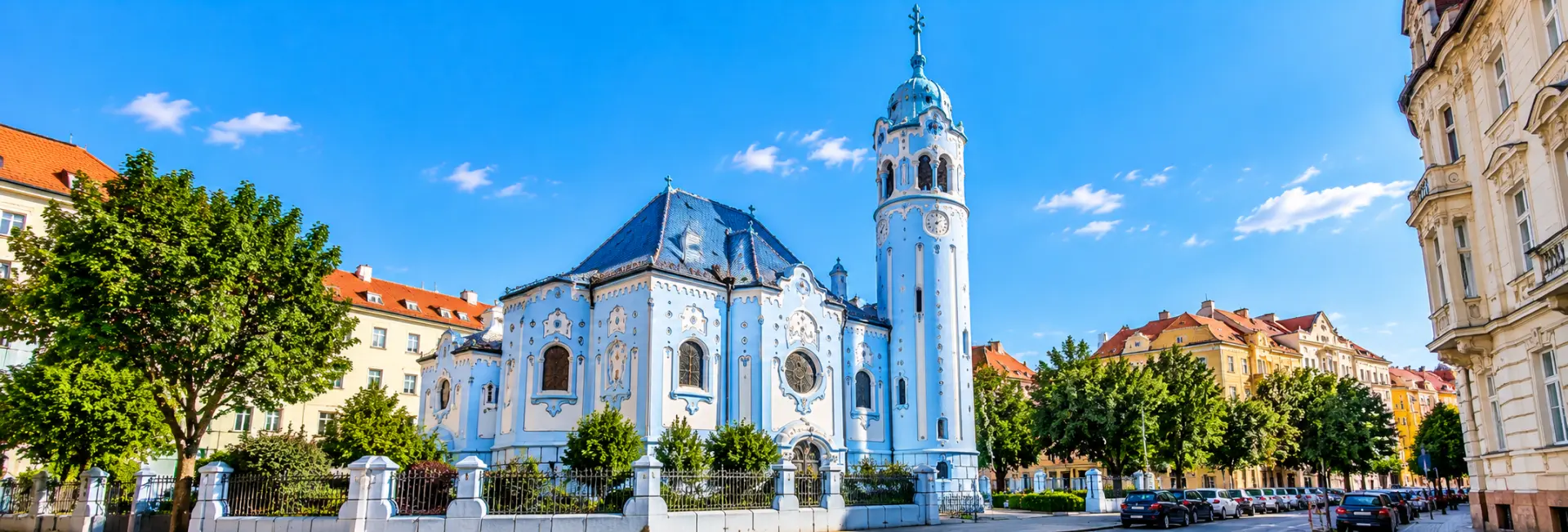
The Blue Church, officially the Church of St. Elizabeth and known in Slovak as Modrý kostolík, is one of the most photographed buildings in Bratislava. It stands on the eastern side of the Old Town, a short walk from the Main Square, and it looks unlike anything else in the city. Its walls are painted in soft pastel blue, its roof is covered in blue glazed tiles, and its ornament is picked out in ceramic, mosaic and white plaster.
The church was designed by Ödön Lechner, the Budapest architect often described as the founder of Hungarian Art Nouveau. The style used here is called Hungarian Secession, a regional take on the Art Nouveau movement that mixes flowing curves, floral motifs and decorative ceramics with touches of folk and Eastern inspiration.
Despite its fairy-tale look, this is a working parish church, not a museum. It is small, quick to see from the outside and rewarding to study up close, which makes it an easy and memorable addition to almost any walk through the city.
History
A Church for a Saint's Anniversary
The church was commissioned to honor St. Elizabeth of Hungary on the 700th anniversary of her birth. Elizabeth was the daughter of King Andrew II of Hungary, and local tradition holds that she was probably born in the castle of Pressburg, the older name of Bratislava, in 1207. Building her a church in the city therefore linked the new landmark to a figure with real local roots.
A School Chapel Becomes a Landmark
The church was conceived together with the neighboring grammar school, and both were designed by Lechner. At first it served as the chapel for the school's students, and only later was it opened to the wider public as a parish church. This shared origin explains why the school building on nearby Grösslingová Street echoes the church's colors and decorative language.
Construction and Consecration
Construction took place in the years leading up to 1913, with sources placing the main building work between roughly 1909 and 1913. The church was consecrated on 11 October 1913, just before the First World War reshaped the region.
A Landmark Rediscovered
For much of the 20th century the church was admired mainly by locals and architecture enthusiasts. In recent decades its unmistakable color, along with the growth of city tourism and social media, has made it one of the best-known symbols of modern Bratislava. A model of the church even represents Slovakia at Mini-Europe, the miniature park in Brussels.
Architecture and Design
Hungarian Secession in Practice
Lechner's design avoids the straight lines and heavy stone of most older churches in the city. The building has a single nave on an oval ground plan, with curved lines and arched openings that give it a soft, almost sculpted outline. A slender cylindrical tower rises to a height of about 36.8 meters and is capped with a blue glazed roof that echoes the rest of the building.
Blue as a Design Idea
The color is the building's calling card. The facade is painted in pastel blue and white, and bands of blue tiles and wave-shaped strips run around the church like a ribbon. The roof is covered in blue ceramic, and majolica ornaments and mosaics add small bursts of brighter color. Blue is often read here as a reference to the sky and to heaven, which suits a church dedicated to a saint known for her gentle charity.
Decorative Details
Floral and leaf patterns spread across the facade, softening the structure and tying it to the Art Nouveau interest in natural forms. The main and side entrances are framed by paired columns joined by an arch, and above the main door a mosaic shows St. Elizabeth, reminding visitors who the church honors. Glass and metal roses appear as ornaments, referencing the best-known legend about her.
Why It Feels So Different
Most historic churches in Bratislava belong to the Gothic or Baroque traditions, with stone walls and austere lines. The Blue Church comes from a different moment, when architects across Central Europe were experimenting with color, ceramics and organic shapes. Seen next to its neighbors, it feels lighter and more playful, which is a large part of its appeal for visitors who are tired of gray stone.
A Matching Ensemble
The nearby grammar school and the church were conceived as a pair, and the school shares its architect, color scheme and decorative character. Walking from one to the other gives a clearer picture of how Lechner imagined a single, harmonious corner of the city.
Cultural and Religious Significance
Who Was St. Elizabeth?
Elizabeth of Hungary was born into royalty in the early 13th century but became known for humility and generosity toward the poor. She is remembered as a patron saint of Christian charity, and her story is still widely told across Central Europe.
The Miracle of Roses
The best-known legend about Elizabeth says that when she was caught carrying bread to the poor in her cloak, the bread turned into roses. This tale is the reason roses appear so often in images of the saint, and it is echoed in the entrance mosaic and in the glass and metal roses that decorate the facade.
A Living Parish
The Blue Church remains an active place of worship, where regular Catholic services are held. It is also a popular venue for weddings, which means visitors may find the steps and surroundings busy with wedding guests and photographers on weekends in the warmer months.
For residents, the church is both a symbol of the city and a neighborhood parish, and respecting its everyday role is part of enjoying it.
Notable Features Outside and Inside
On the Outside
- The blue glazed ceramic roof, which catches the light and is visible from the street long before you arrive.
- The mosaic above the main entrance, showing St. Elizabeth.
- Blue majolica tiles and wave-shaped bands that wrap around the facade.
- Glass and metal roses, floral relief patterns and decorative arches around the entrances.
- The cylindrical tower, one of the most unusual church towers in the Old Town.
On the Inside
Inside, the color scheme continues in blue, white and gold. The pews, walls and ceiling carry the same theme as the exterior, so the space feels like a single, complete design rather than a plain interior behind a decorated front.
The altar holds a large painting of St. Elizabeth sharing alms with the poor and is traditionally associated with relics of the saint. The compact, oval interior feels intimate, and its curved lines make the room seem gentler than a typical nave.
Photography and Details Worth a Closer Look
The best details are small ones: the texture of the glazed tiles, the curve of the entrance arch and the way the mosaic catches the light. A short walk around the building shows how the facade changes from every angle, and the tower looks especially graceful from the side streets.
Seen Through the Doors
When the church is closed to visitors, it is often possible to look through the glass doors at the interior. This gives a good impression of the colors even if you cannot step inside.
Visiting Etiquette and Tips
Access and Opening Times
Because this is a working parish, the interior is generally open only at limited times, usually around services, and hours can change. The exterior can be admired at any time of day. Check the church's official information before you visit if seeing the inside matters to you.
Etiquette
- Dress modestly and speak quietly when you go inside.
- Avoid walking around or taking photographs during a service.
- Be mindful of wedding parties, who may be using the steps and entrance.
- Donations are welcome, and entry is typically free.
Practical Tips
- The entrance has a ramp, though the interior may have slight changes in level.
- A visit is brief, so most travelers spend 15 to 30 minutes here, longer if photographing the details.
- The church is a pleasant stop on foot, about ten minutes from the Main Square.
- Opening hours, services and entry arrangements can change, so confirm current details before planning your visit around the interior.
Best Time to Visit
Time of Day
Morning is usually the best moment, as the soft light brings out the pastel blue of the facade and crowds are lighter. Late afternoon can also be pleasant, with warmer tones on the ceramics and tower.
Season
- Spring: blossoms around the church add color, and the weather is mild for walking.
- Summer: bright light suits photography, though midday can be hot and wedding activity is common.
- Autumn: calmer crowds and soft light make it a comfortable time to visit.
- Winter: the blue tones stand out against gray skies, and a visit is short enough to fit between indoor stops.
Planning Around Services
If you want to see the interior, aim for a time when the church is open and not in use for a service. For photographs of the exterior, there are no gates or barriers, so daylight hours are all you need.
Nearby Attractions
The Blue Church sits on the eastern edge of the Old Town, so it is easy to combine with the city's central sights.
- Main Square (Hlavné námestie): the historic heart of the Old Town, roughly a ten-minute walk away, with the Roland Fountain and the Old Town Hall.
- The Grammar School on Grösslingová Street: the sister building designed by the same architect, worth a look from the street for its matching style.
- Bratislava Castle: the hilltop landmark above the Old Town, reachable on foot through the historic streets.
- Old Town streets and cafés: the quiet lanes around the church offer places to pause after your visit.
FAQs about visiting the Blue Church (Church of St. Elizabeth)
Why is the Blue Church called the Blue Church? +
The nickname comes from its blue facade, blue glazed roof and blue ceramic details, with the same color theme carried through the interior. Its official name is the Church of St. Elizabeth.
Who designed the Blue Church? +
It was designed by Ödön Lechner, a Budapest architect often called the father of Hungarian Art Nouveau. He also designed the nearby grammar school, which shares its colors and style.
When was the Blue Church built? +
It was built in the years leading up to 1913, with the main work generally dated to about 1909 to 1913, and it was consecrated on 11 October 1913.
Is it free to visit the Blue Church? +
Yes, the church is generally free to enter, and donations are welcome. Because it is a working parish, the interior is open only at limited times, so check current hours before you go.
Can I go inside the Blue Church? +
Usually only at certain times, often around services, so the interior may be closed when you arrive. The exterior can be seen at any time, and you can often look through the glass doors when the church is closed.
How long does a visit take? +
Most visitors spend 15 to 30 minutes, which is enough to see the facade, the entrance mosaic and, if open, the interior.
How do I get to the Blue Church from the Main Square? +
It is about a ten-minute walk east of the Main Square through the Old Town, so most visitors walk. The street address is Bezručova 2.
Is the Blue Church accessible for wheelchair users? +
The entrance has a ramp, although there may be slight level changes inside. If accessibility is important, it is wise to confirm arrangements with the parish beforehand.
