
Table of Contents
Overview
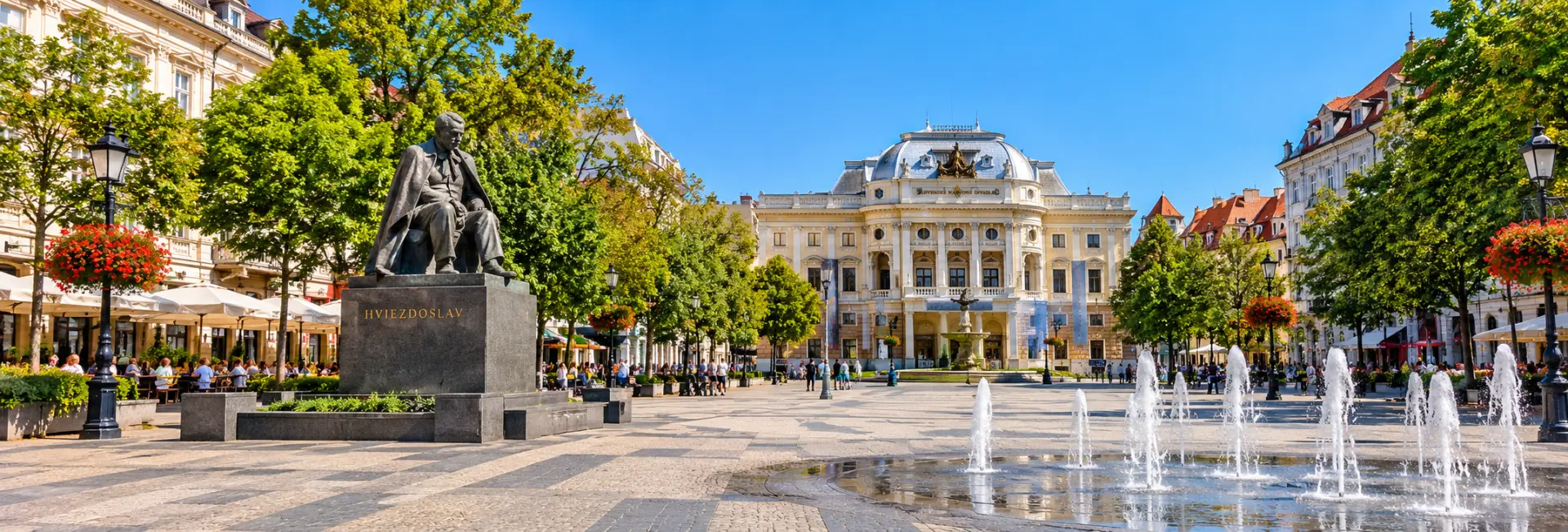
Hviezdoslav Square (Hviezdoslavovo námestie) is one of Bratislava's most inviting public spaces, stretching across the southern edge of the historic Old Town. Its broad pedestrian promenade links the area near the SNP Bridge with the historic Slovak National Theatre. Mature trees, public art, fountains and café terraces make it both a useful walking route and a destination in its own right.
Unlike the compact medieval squares deeper in the Old Town, Hviezdoslav Square feels open and linear. Its proportions encourage visitors to stroll slowly, stop for a drink or sit beneath the trees. The surrounding buildings range from historic cultural institutions to elegant hotel façades, giving the square a distinctly urban character without losing its relaxed atmosphere.
The square is named for Pavol Országh Hviezdoslav, a major figure in Slovak literature. His monument, together with the theatre and the ornamental fountains, gives the promenade an identity rooted in the city's artistic life. For first-time visitors, it is an easy place to orient themselves before exploring the nearby lanes or continuing toward the Danube.
History and Evolution of the Square
From the Edge of the Old Town to a Civic Promenade
The square occupies an area associated with the historic city's southern side, where the compact built environment gradually opened toward the river. As Bratislava developed beyond its medieval defensive layout, this corridor became part of a more spacious urban setting. The square's present character reflects successive efforts to turn central public space into a pleasant place for walking and gathering.
Bratislava was long known as Pressburg in German and Pozsony in Hungarian, reflecting its multilingual past within the Kingdom of Hungary and later the Habsburg monarchy. The architecture around the square carries traces of that Central European setting. Rather than belonging to a single building campaign, the square brings together different periods of civic and commercial development.
The Theatre Changes the Square
A defining moment came in 1886, when the building now known as the historic Slovak National Theatre opened as the city's municipal theatre. Designed by the Viennese architectural partnership Ferdinand Fellner and Hermann Helmer, it introduced a grand cultural landmark at one end of the promenade. The theatre helped establish the area as a place associated with performance, evening outings and formal public life.
The nearby Ganymede Fountain followed in 1888, adding a sculptural focus in front of the theatre. Its mythological imagery and carefully modeled figures demonstrate the ambition invested in civic decoration during that period.
Modern Pedestrian Life
In more recent decades the square has been maintained and adapted as a pedestrian-friendly public space. Its walking areas and water features support everyday use as well as seasonal gatherings. The result is not a frozen historical exhibit: residents cross it on ordinary errands, visitors use it as a meeting point and outdoor terraces bring activity to its edges.
Urban Design and Streetscape
A Long Green Corridor
The square's most distinctive feature is its elongated plan. Instead of concentrating movement around one central monument, it offers a sequence of places to pause along a broad walkway. Trees soften the hard surfaces of the city center, and the open pedestrian layout makes it easier to appreciate the façades on both sides.
Its form is particularly useful for exploring Bratislava on foot. Visitors can enter from the river-facing side, walk toward the theatre and then turn into the smaller streets leading to Main Square or other Old Town sights. The contrast between the broad promenade and the surrounding narrow lanes is part of the experience.
Water and Stone
Modern water features reinforce the promenade's linear character. A long water-flow fountain incorporates stone paving and design references to the movement of the Danube. The fountain was implemented in 2002 and later modified, illustrating how contemporary landscape design has been woven into an older urban setting.
The square's paving, planted areas and seating create several different moods along the same route. Some stretches feel like a shaded park walk, while others are animated by restaurant tables and passing pedestrians. These varied spaces make the square appealing even without a planned activity.
Buildings Along the Edges
The surrounding façades form a continuous architectural backdrop. The historic theatre provides the most ceremonial endpoint, while the Carlton hotel building is another familiar landmark. Looking along the street frontages reveals the mixture of decorative styles and commercial uses typical of Bratislava's central districts.
Monuments, Fountains and Architectural Highlights
Historic Slovak National Theatre
The historic Slovak National Theatre building is the square's most imposing structure. Opened in 1886, its richly articulated exterior includes sculptural decoration associated with theatre and music. Even when the building is not accessible for a performance or visit, its façade is worth viewing from the square.
The theatre's operational arrangements can change, including periods of reconstruction, so visitors hoping to attend a performance should consult the Slovak National Theatre's current programme and venue details rather than assume an event takes place in the historic building.
Ganymede Fountain
Standing before the theatre, the Ganymede Fountain is among the square's most detailed works of public art. Sculptor Viktor Tilgner designed it in 1888. Its upper group represents the young Ganymede being carried by an eagle, a subject from classical mythology, while lower figures include children and fish associated with the Danube.
The fountain rewards close observation because much of its character lies in the smaller figures rather than only its overall silhouette. Water operation may be seasonal, but the sculptural composition remains visible throughout the year.
Monument to Hviezdoslav
The square honors Pavol Országh Hviezdoslav, whose poetry and writing occupy an important place in Slovak cultural history. His monument provides a focal point for visitors interested in the country's literary heritage. It also gives the square a recognizably Slovak identity within a setting shaped by several historical languages and traditions.
Carlton Hotel and Its Fountain
The Carlton building is another architectural anchor. A modern fountain in front of the hotel uses a clock-like arrangement to refer to episodes in the square's history. The work connects decorative water effects with the memory of public events, demonstrating how newer public art can add meaning to a historic setting.
Literary and Cultural Significance
A Square Named for a Poet
Pavol Országh Hviezdoslav was a prominent Slovak poet, dramatist and translator. Naming such a visible city square after him places literature in everyday public life: even visitors who arrive simply to walk or eat encounter his name and monument. The tribute is especially fitting beside one of the country's major theatrical landmarks.
The square's literary identity is not limited to a single statue. Its role as a place to gather, observe and converse is closely connected with the civic culture of a capital city. The setting invites visitors to think about the relationship between public spaces and the artists whose work helps define national culture.
Theatre and Public Performance
The historic theatre has long given this part of Bratislava a performing-arts association. Its exterior serves as an architectural reminder of the city's opera and drama traditions, even as performances and productions use different venues. The surrounding square provides a natural place for audiences and other visitors to meet.
A Place for Public Memory
Hviezdoslav Square has also served as a setting for civic gatherings. Near the Carlton, the clock-inspired fountain includes references to significant moments associated with the location, including the Candlelight Demonstration and the Velvet Revolution period. These reminders make the square more than an attractive urban promenade: it is also a place where Bratislava's public history can be read in its monuments and design.
Ways to Experience It
Walk the Full Promenade
The simplest way to appreciate Hviezdoslav Square is to walk from one end to the other. Start near the SNP Bridge side and move toward the theatre, taking time to look at the trees, fountains and buildings. Walking in the opposite direction offers a different perspective, with the riverfront area gradually drawing closer.
The square itself does not require a long dedicated visit. Around 20 to 30 minutes is enough for a relaxed walk and a few photographs, while a café stop or closer examination of the monuments can easily extend the experience to an hour.
Pause at a Café
Cafés and restaurants around the promenade make it an appealing break between more structured sightseeing stops. Sitting outdoors, when weather permits, offers a chance to watch the rhythm of the Old Town. Choose a table according to shade, noise and the atmosphere you prefer rather than expecting every terrace to offer the same experience.
Explore the Sculpture and Fountains
Visitors interested in public art can make a short themed walk of the Hviezdoslav monument, Ganymede Fountain and newer water features. Their different styles illustrate how the square has evolved over time. The Ganymede Fountain is especially rewarding for detail photography, while the wider promenade works well for architectural views.
Use It as a Walking Hub
The square makes an excellent starting or finishing point for an Old Town route. From here, visitors can head toward Main Square and Michael's Gate, reach the Danube embankment or continue toward the Slovak Philharmonic. Because these attractions are close together, a walking itinerary usually makes more sense than using a vehicle between them.
Best Time to Visit
Spring and Summer
Late spring and summer are particularly pleasant when the trees provide greenery and outdoor terraces are active. Longer daylight hours make it easy to include the square before or after other attractions. In hot weather, the shaded portions of the promenade are more comfortable than exposed stretches at midday.
Autumn and Winter
Autumn brings a quieter atmosphere and changing foliage along the walkway. Winter can be atmospheric too, especially when seasonal decorations or events are scheduled, although outdoor seating is less appealing in cold conditions. Event arrangements vary, so visitors should check current local listings rather than assume a particular market or programme is operating.
Morning, Afternoon or Evening?
Morning is well suited to photographs of the buildings and a relatively calm stroll. Afternoon brings more activity from pedestrians and café visitors. In the evening, illuminated façades and restaurant terraces create a different urban mood, although the square is also enjoyable as a straightforward daytime stop.
Visitor Tips
- The square is a public pedestrian space and normally requires no admission ticket to walk through.
- Use the Slovak name Hviezdoslavovo námestie when searching local maps or transit directions.
- For a convenient sightseeing route, combine the square with the historic theatre, Main Square and the Danube riverfront.
- Wear comfortable shoes: the square is easy to traverse, but surrounding Old Town streets often have stone paving.
- Allow extra time if you plan to photograph fountain details or stop at a café.
- Fountain operation may vary with weather, maintenance and season; do not rely on seeing running water during every visit.
- The main promenade is generally easier to navigate than steep or narrow historic streets, but check specific routes and surfaces if step-free access is essential.
- For performances, confirm the correct Slovak National Theatre venue because the historic building and the newer theatre complex are separate places.
- During public events, expect some sections to be busier and normal walking routes to change.
Nearby Attractions
Hviezdoslav Square sits within easy walking distance of many central Bratislava sights. It is especially useful as a connection between the Old Town's interior and the riverfront.
- Historic Slovak National Theatre: the landmark theatre building at the square's eastern end, with an ornate nineteenth-century façade.
- Main Square (Hlavné námestie): the historic civic heart of the Old Town, known for the Old Town Hall and Maximilian Fountain.
- Primate's Palace: a neoclassical palace near Main Square, associated with important diplomatic history and decorative interiors.
- Michael's Gate: a surviving medieval city gate reached by walking through the Old Town's pedestrian streets.
- Slovak Philharmonic at the Reduta: a concert venue near Ľudovít Štúr Square, a short walk from the promenade.
- Danube embankment: riverside paths and views that offer a change from the historic streets.
- SNP Bridge and UFO Observation Deck: a distinctive bridge and elevated viewpoint near the western approach to the square.
- Bratislava Castle: the prominent hilltop landmark above the Old Town, reachable on foot via an uphill route.
FAQs about visiting Hviezdoslav Square
Where is Hviezdoslav Square in Bratislava? +
It is in the historic Old Town, between the area near the SNP Bridge and the historic Slovak National Theatre.
Is Hviezdoslav Square free to visit? +
Yes. It is a public square and visitors can walk through it without buying a ticket. Nearby venues and events may have separate charges.
How long should I spend at Hviezdoslav Square? +
Allow 20 to 30 minutes for a relaxed stroll, or about an hour if you plan to take photographs and stop for refreshments.
What is Hviezdoslav Square famous for? +
It is known for its tree-lined promenade, historic Slovak National Theatre, Ganymede Fountain and monument to Slovak poet Pavol Országh Hviezdoslav.
Can I visit the historic Slovak National Theatre from the square? +
You can see its exterior from the square. Interior access and performances depend on current venue arrangements, so check the theatre's official programme.
Is Hviezdoslav Square suitable for families? +
Yes. Its pedestrian layout and open walking areas make it convenient for families, though children should be supervised around fountains and nearby roads.
What is the best time to visit? +
Spring through early autumn is comfortable for strolling and outdoor cafés. Mornings are generally good for a quieter visit, while evenings offer a lively atmosphere.
What attractions can I visit nearby? +
Main Square, Primate's Palace, the Slovak Philharmonic, Michael's Gate, the Danube embankment and the SNP Bridge are all practical additions to a walking route.
Does Hviezdoslav Square have a Christmas market? +
The square has hosted seasonal activities, but locations and dates can change. Check the current Bratislava event programme before planning around a particular market.
