
Table of Contents
Overview
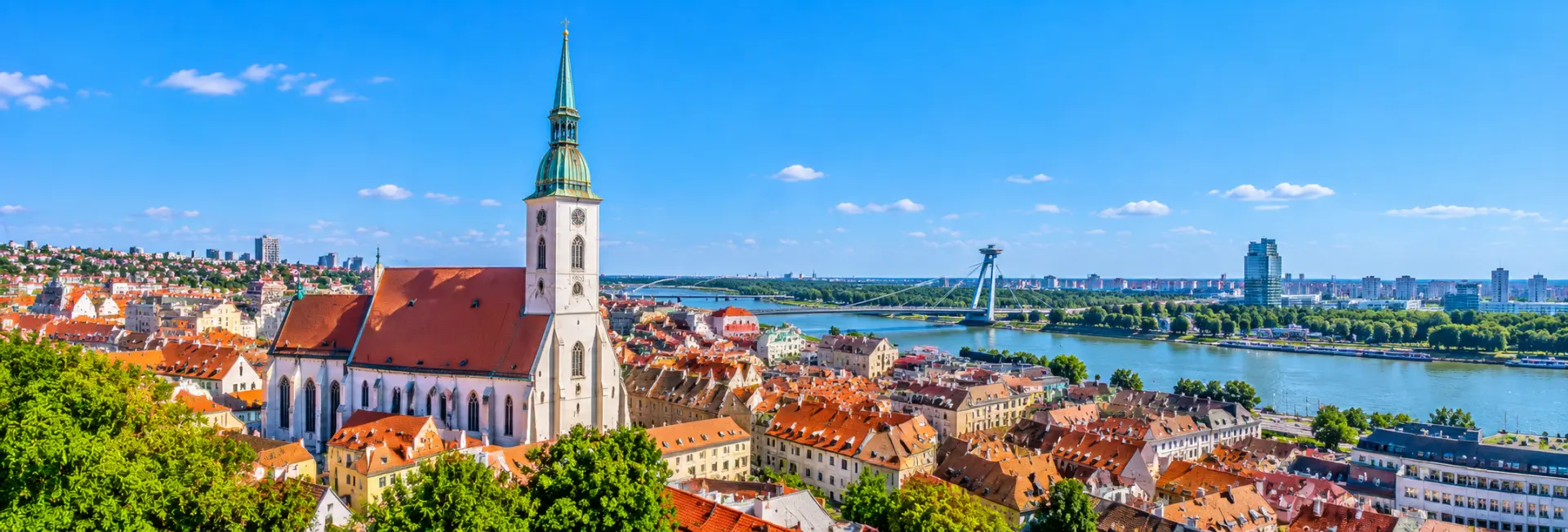
St. Martin's Cathedral (Dóm svätého Martina) is the largest and most historically important church in Bratislava. It stands at the western edge of the Old Town, beneath the castle hill, and its slender 85-metre tower is one of the defining features of the city skyline. Crowning that tower is a large gilded replica of the Hungarian royal crown, a reminder of the cathedral's most famous role.
For more than two centuries, from 1563 to 1830, this was the coronation church of the Kingdom of Hungary. Kings and queens received the crown here during a period when Bratislava, then known as Pressburg, served as the kingdom's ceremonial capital. Today the building is the seat of the Roman Catholic Archdiocese of Bratislava and remains an active place of worship.
Visitors come for its soaring Gothic interior, its royal history and its notable artworks, including a striking lead sculpture of St Martin on horseback. Even a short stop inside gives a clear sense of how faith, politics and architecture have been intertwined in this part of Central Europe.
History
From Romanesque Church to Gothic Cathedral
The site was home to an earlier Romanesque church dedicated to the Holy Saviour, built in the early 13th century. After Bratislava received town privileges in 1291, the growing city needed a larger parish church. A new Gothic building was begun in the early 14th century and was integrated into the town's defensive walls, with its tower serving as part of the fortifications.
The church was consecrated in 1452, and further expansion followed in the late 15th century, when it grew to roughly the size seen today. The design drew on architectural ideas from Vienna and Prague, reflecting the city's position between major cultural centres.
The Coronation Church
The cathedral's royal role began after Ottoman advances forced the Hungarian crowning tradition away from its historic home at Székesfehérvár. The first coronation here took place on 8 September 1563, and the last was held on 28 September 1830. In total, ten kings, one queen and several royal consorts from the Habsburg dynasty were crowned in the cathedral. The most famous of these was Maria Theresa, crowned in the 18th century.
The first ruler crowned here was Maximilian II, and the final ceremony in 1830 crowned Ferdinand V. Local accounts say that the sovereigns received the Crown of St Stephen close to the lead statue of St Martin, so the artwork you see today stood near the heart of these historic rituals. After 1830 the cathedral kept its importance as the city's principal church.
Baroque Additions and Rebuilding
The 18th century brought Baroque additions, including the elegant Chapel of St John the Almsgiver, commissioned by Archbishop Imre Esterházy, and the monumental sculptural work of Georg Raphael Donner. The tower also changed over time: lightning struck the Gothic top in 1760, and the Baroque replacement was later lost to fire in the 1830s. The tower was rebuilt in neo-Gothic style, and the gilded crown was installed in 1847.
A Modern Cathedral
Pope John Paul II visited the cathedral on 30 June 1995. It served as a co-cathedral for a time, and in 2008 it became the metropolitan cathedral of the newly founded Archdiocese of Bratislava.
Architecture & Design
A Three-Nave Gothic Church
The cathedral is built in the Gothic style, with a spacious three-nave interior and high vaults. Its lines are strong and fairly stark, giving it a sober, imposing character that suits its position beneath the castle. The overall design reflects influences from major Gothic centres in the region.
The Tower and Crown
The tower rises about 85 metres and is the cathedral's signature feature. At its summit sits a gilded cushion roughly two metres square, bearing a replica of the Hungarian royal crown that is about one metre tall and weighs around 300 kilograms. The crown and cushion are reported to contain around 8 kilograms of gold in total, which helps explain how brilliantly they catch the light.
Portals and Exterior
The building has three entrances, with a neo-Gothic main portal added in the 1890s. Because the cathedral was built into the old fortifications, its exterior still shows how closely religious and defensive architecture were linked in the medieval city.
Chapels
Inside, several chapels reflect different periods. They include a canons' chapel, the Gothic Chapel of Sophia of Bavaria, the Chapel of St Anne and the Baroque Chapel of St John the Almsgiver, which is considered one of the finest artistic monuments in the city.
Cultural & Religious Significance
St. Martin's Cathedral is both a living church and a monument to Hungarian royal history. Its dedication to St Martin of Tours, the soldier-saint famous for sharing his cloak with a beggar, gives the building a strong theme of charity that is echoed in its artwork.
As a coronation church, it served as the stage for some of the most important ceremonies in the kingdom. The crown replica on the tower still marks that role, and the memory is kept alive each year when Bratislava stages Coronation Days, a festival that recreates the pomp of the royal ceremonies in the streets of the Old Town.
The building's position adds to its meaning. It stands between the castle, which was the seat of the monarch, and the old town, which was the home of merchants and townspeople, so it has long been a meeting point between royal and civic life. That symbolism helps explain why so many visitors treat it as a natural centrepiece of any walk through historic Bratislava.
The cathedral is also tied to the city's religious life. It was built on a former cemetery, and beneath it lie crypts holding archbishops, Jesuits and members of the noble Pálffy family. Notable figures associated with the cathedral include Cardinal Péter Pázmány, who played a key role in strengthening Catholic life in the region. Visiting the building today offers a glimpse of how deeply Catholic tradition shaped Bratislava's history.
Notable Features
Donner's Lead Statue of St Martin
The most celebrated artwork inside is Georg Raphael Donner's equestrian group depicting St Martin dividing his cloak with a beggar. Made of lead in the 1730s and 1740s, it is regarded as an important early example of monumental lead sculpture in Central Europe. The saint is shown in the dress of a Hungarian hussar, and according to a local bishop, his face reflects that of Archbishop Esterházy, who commissioned the work.
The Chapel of St John the Almsgiver
This Baroque chapel was added in the early 18th century and ranks among the city's most valuable artistic treasures. Its rich ornament contrasts with the more austere Gothic nave, and it shows the wealth and ambition of the Church during the Baroque era.
The Crypts
The crypts beneath the cathedral include the archbishops' crypt, a Jesuit crypt and the Pálffy family crypt. They are not normally open to everyone, but they are made accessible to the public around 1 November, when the Church remembers the faithful departed.
Bells and Tower Details
The tower houses historic bells, among them an old bell known as the Wederin. Together with the crown, they make the tower a distinctive sight and sound in the Old Town.
Visiting Etiquette & Tips
St. Martin's is a working cathedral, so it is best to approach it with the respect due to a place of worship. A few simple points will help your visit go smoothly.
- Dress modestly, with shoulders and knees covered where possible, and remove hats when you enter.
- Keep your voice low and avoid walking through the nave during services or prayer.
- Check the opening hours before you go. Visiting times are limited and may be reduced around services, so they can change by day and season.
- Photography rules can vary, particularly during services, so look for signs or ask staff before using a camera or flash.
- Allow about 20 to 40 minutes inside, or longer if you want to look carefully at the chapels and sculpture.
- Look up as well as around you: the vaulting, the tower and the gilded crown are all part of the experience from the outside.
- If you are visiting around 1 November, ask about public access to the crypts.
Best Time to Visit
The cathedral can be seen from the outside at any time, but the interior is open only at set hours, so planning your visit around those times is important. Weekday mornings and early afternoons are usually calm, while weekends can be busier with tour groups.
Early September is a special time, when the Coronation Days festival brings costumed processions and ceremonies to the Old Town. If you want to see the city in a festive mood, this is a good moment to visit, though you should expect crowds and book accommodation early.
In summer, the surrounding streets are lively and the weather is ideal for combining the cathedral with a walk up to the castle. In winter, the interior offers a quiet, atmospheric refuge from the cold, and the lit tower stands out dramatically against the evening sky.
Nearby Attractions
The cathedral sits at a convenient junction between the Old Town and the castle hill, so it is easy to combine with other highlights.
- Bratislava Castle, reachable on foot along a path from the cathedral, with museum exhibitions, gardens and wide views
- Michael's Gate, the last surviving medieval gate, a short walk into the Old Town
- The Old Town's pedestrian streets, cafés and squares, including Michalská street
- The Danube embankment, a pleasant walk toward the river
- The SNP Bridge, a distinctive modern landmark close to the cathedral
A rewarding route begins at the castle, descends to the cathedral and then continues through the Old Town to Michael's Gate, linking the city's royal, religious and defensive history in a single walk.
FAQs about visiting St. Martin's Cathedral
What is St. Martin's Cathedral known for? +
It is Bratislava's main Gothic cathedral and the former coronation church of the Kingdom of Hungary. Its 85-metre tower, topped with a gilded crown replica, is one of the city's best-known landmarks.
When were kings crowned here? +
Coronations took place from 1563 to 1830. In that period, ten kings and one queen, along with several royal consorts, were crowned in the cathedral.
Can I go inside St. Martin's Cathedral? +
Yes, visitors are welcome at set times. Because it is an active church, opening hours can vary and may be limited during services, so check the schedule before you go.
Is there an entrance fee? +
Arrangements can change, so check the cathedral's official information before your visit rather than relying on older guidebooks.
Can I visit the crypts? +
The crypts beneath the cathedral are generally not open year-round, but they are made available to the public around 1 November, when the faithful departed are remembered.
What should I wear? +
Dress modestly and respectfully, as in any active church. Covered shoulders and knees are a safe choice, and hats should be removed inside.
How long does a visit take? +
Plan around 20 to 40 minutes for the interior. You will want a little extra time if you also want to photograph the exterior and tower.
What is the gold crown on the tower? +
It is a replica of the Hungarian royal crown resting on a gilded cushion. It was installed in 1847 to commemorate the cathedral's role as a coronation church.
