
Table of Contents
Overview
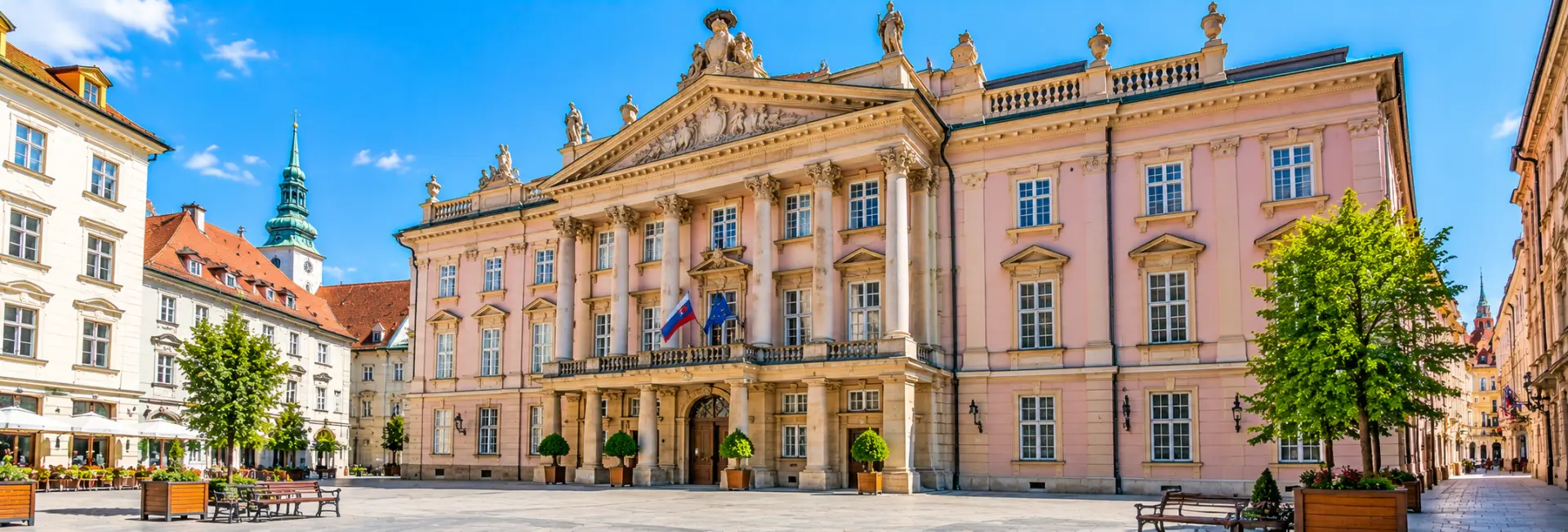
The Primate's Palace, known in Slovak as Primaciálny palác, is one of the most elegant buildings in Bratislava's Old Town. Its soft pink facade, symmetrical proportions and statue-topped roofline make it a standout example of late 18th-century neoclassical architecture. It stands on Primaciálne námestie, a small square tucked just behind the Old Town Hall and reached from the Main Square by one of the shortest streets in the city.
The name refers to the Primate of Hungary, the title held by the Archbishop of Esztergom, for whom the palace was built as a residence. Today the building has a very different role. It is the seat of the Mayor of Bratislava, and parts of it are open to visitors as a museum and gallery space.
The main reasons to visit are the Hall of Mirrors, where an important peace treaty was signed in 1805, and a set of six rare English tapestries that were hidden for centuries and rediscovered in 1903. Together they make the palace a compact but rewarding stop for anyone interested in history, art and architecture.
History
Built for an Archbishop
The palace was built between 1778 and 1781 for Cardinal József Batthyány, Archbishop of Esztergom and Primate of Hungary. It was designed by the architect Melchior Hefele and served as the archbishop's winter residence in the city, then known as Pressburg. At the time, Pressburg was a place where the Hungarian Diet met, so a grand residence for the country's leading churchman made practical as well as symbolic sense.
A Setting for Politics and Ceremony
The palace soon became a stage for important gatherings. The Hungarian Diet, which met in a nearby building, is recorded as having been ceremonially opened in the palace, and the Hall of Mirrors hosted formal receptions and signings. Its most famous event came on 26 December 1805, after the Battle of Austerlitz, when representatives of Austria and France signed the fourth Peace of Pressburg here.
Purchase by the City
In August 1903 the city of Bratislava bought the palace from the archbishopric after deciding to move its administration out of the neighboring Old Town Hall. Reconstruction work that year led to the discovery of the tapestries, which had been concealed behind the wallpaper and walls of the rooms beside the Hall of Mirrors.
Twentieth Century to Today
Between the two world wars the Hall of Mirrors was used for lectures and authors' evenings, drawing well-known writers of the period. For several decades the palace also housed the City Gallery of Bratislava, whose exhibitions took over its state rooms until a reconstruction in the 1980s. Today it is the mayor's seat, and the Hall of Mirrors continues to serve for city council meetings.
Architecture and Facade
A Classicist Landmark
The Primate's Palace is regarded as one of the finest classicist buildings in Slovakia. Its design favors order and restraint over the heavy ornament of the Baroque, with a clear central axis, regular rows of windows and carefully balanced proportions. The pale pink color gives the front a warm, welcoming look that stands out against the stone and plaster of its neighbors.
Details to Look For
- The tympanum above the entrance, which carries the coat of arms of Cardinal Batthyány, the palace's first resident.
- The statues and vases along the roofline, whose figures are often read as symbols of human virtues and achievements.
- The columns and symmetrical windows of the main facade, which frame the small square in front.
- The entrance hall, where a memorial tablet records the signing of the 1805 peace treaty.
A Palace and a City Hall
Because the palace is still used by the city administration, its architecture serves two purposes. The ceremonial spaces on the upper floor are designed to impress, while other parts of the complex work as offices. This mix of heritage and everyday use is part of what makes it feel alive rather than frozen in time.
Hall of Mirrors and State Rooms
The Hall of Mirrors
The Hall of Mirrors, called Zrkadlová sieň in Slovak, is the palace's most celebrated room. It is a formal reception space with tall mirrors, gilded detail, chandeliers and decorative friezes, designed for diplomacy and ceremony. Light moves through the room and multiplies in the glass, giving the hall its famous sparkle.
It is still used by Bratislava's city council, which means the room is occasionally unavailable to visitors on meeting days.
The Colored Salons
Next to the hall lie a series of salons known by their dominant colors, including green, blue, red, brown and gold. Each has its own character, with different wall coverings and furnishings that reflect the refined taste of the late 18th century. These rooms are used for exhibitions, and the color changes from room to room make the route through them especially pleasant.
The Chapel of St. Ladislaus
The palace also includes a chapel dedicated to St. Ladislaus. The tour route leads up to the archbishop's glazed oratory, a small enclosed gallery from which the archbishop could look down into the chapel while following services in private.
The English Tapestries and Collections
A Remarkable Rediscovery
The palace is best known for a set of six tapestries woven at the royal Mortlake workshops near London in the 17th century. They depict the ancient love story of Hero and Leander, in which a young man swims nightly across the Hellespont to meet a priestess and ultimately drowns. The tapestries were found in 1903 behind a wall in the anteroom of the Hall of Mirrors, and why and how they came to be hidden there remains a mystery.
A Rare Surviving Set
Once owned by the Hungarian archbishop Juraj Pohronec Szelepcsényi, the tapestries were long thought lost. They are among the few completely preserved sets of their kind from the 17th century and are considered a world-class rarity. Today they hang in rooms overlooking the square, where they are displayed as a permanent exhibition of the City Gallery of Bratislava.
Other Art on View
Smaller exhibitions drawn from the gallery's collections are shown in the palace's rooms, including 17th-century Dutch and Flemish genre paintings and Italian paintings from the 16th and 17th centuries. Official portraits of Habsburg monarchs can also be seen in the entrance hall.
Historic Events and Cultural Significance
The Peace of Pressburg
The signing of the fourth Peace of Pressburg on 26 December 1805 ended the War of the Third Coalition after Napoleon's victory at Austerlitz. The agreement forced Austria to make major concessions and helped set the stage for the end of the Holy Roman Empire in 1806. For historians, the Hall of Mirrors is therefore a place where European history visibly turned.
Hungarian Political Life
Pressburg was an important center of the Kingdom of Hungary for centuries, and the palace formed part of its political landscape. The building is linked to the ceremonial opening of the Hungarian Diet, and it is also associated with agreements of the 19th century, including those connected with the abolition of serfdom in 1848.
A Literary and Civic Venue
In the interwar years the hall hosted literary evenings and lectures attended by major writers, and later it was used for exhibitions and concerts. In every period, the palace has served as a meeting point for the city's public life, which is why it is so closely tied to Bratislava's sense of identity.
Ways to Experience It
A Self-Guided Gallery Visit
The most common way to visit is to buy a ticket at the box office, then walk through the gallery and the Hall of Mirrors at your own pace. The route usually takes between 45 minutes and an hour, depending on how long you spend with the tapestries.
With a Digital or Audio Guide
Visitors have been offered free audio guides in several languages, as well as a digital guide that can be opened on a smartphone. These make it easier to follow the story of the tapestries and the treaty without a live guide.
From Outside
Even if you do not go inside, the palace is worth a look from the square. The facade, the roofline statues and the Old Town atmosphere make it a pleasant stop on a walk through the center, and the exterior is free to admire at any time.
Events and Concerts
The Hall of Mirrors is also used for concerts and other events from time to time. Such events can change visiting hours, so check the official schedule if you hope to see a particular room.
Best Time to Visit
Day and Week
- Weekdays outside the main holiday periods tend to be quieter than weekends.
- Late morning or midday is a comfortable time for an unhurried visit.
- The palace is typically closed on Mondays, and opening hours can vary from week to week.
Season
Because most of the visit takes place indoors, the palace works well in any season. It is an especially good option on rainy or very hot days, and in winter it can be paired with the Christmas market on the nearby Main Square. Spring and autumn offer the most comfortable weather for walking between the palace and the other Old Town sights.
Visitor Tips
- Check the official website for current opening hours, ticket prices and any events that may close parts of the palace, since these details change.
- The box office is on the first floor, while the tapestry gallery and the Hall of Mirrors are on the second floor.
- Reduced or free admission is offered to certain groups, such as children, students, seniors and holders of the Bratislava Card, so ask at the box office.
- Photography rules can vary by room, so look for signs or ask staff.
- Remember that part of the building is still the mayor's office, so be quiet and respectful in areas used by staff.
- The upper floors involve stairs, so ask the palace about step-free options if you need them.
Nearby Attractions
The palace sits in the middle of the Old Town, so it is easy to combine with other sights on foot.
- Old Town Hall: right next door, with the Bratislava City Museum and a tower with panoramic views.
- Main Square (Hlavné námestie): the lively heart of the Old Town with the Roland Fountain, only a minute or two away.
- Apponyi Palace: a rococo palace from the early 1760s nearby, now home to a wine exhibition.
- Mirbach Palace and Pálffy Palace: two more historic buildings used by the City Gallery of Bratislava for art exhibitions.
- St. Michael's Gate: the last surviving gate of the medieval city walls, a short walk north.
- St. Martin's Cathedral and Bratislava Castle: the coronation church and the hilltop landmark, both within easy walking distance.
FAQs about visiting the Primate's Palace
What is the Primate's Palace known for? +
It is known for its pink neoclassical facade, the Hall of Mirrors where the 1805 Peace of Pressburg was signed, and a rare set of six English tapestries discovered in 1903.
Why is it called the Primate's Palace? +
The name refers to the Primate of Hungary, the title of the Archbishop of Esztergom, who had the palace built as his residence in the 1770s and early 1780s.
Is the Primate's Palace still used today? +
Yes, it is the seat of the Mayor of Bratislava, and the Hall of Mirrors is still used for city council meetings. Parts of the palace are open to visitors as a gallery.
Can I visit the Hall of Mirrors? +
Usually yes, as it is included in the gallery route, but it may be closed during council meetings or events. Check the official opening hours before you go.
How much does it cost to visit? +
There is an admission fee with reduced and free categories, for example for children and Bratislava Card holders. Prices change, so confirm them on the official website.
How long does a visit take? +
Most visitors need about 45 minutes to an hour to see the gallery, the tapestries and the Hall of Mirrors.
Who designed the Primate's Palace? +
The palace was designed by the architect Melchior Hefele for Cardinal József Batthyány and built between 1778 and 1781.
What are the English tapestries? +
They are six 17th-century tapestries woven in Mortlake near London that tell the story of Hero and Leander. They were found hidden behind a wall during reconstruction in 1903.
