
Table of Contents
Overview
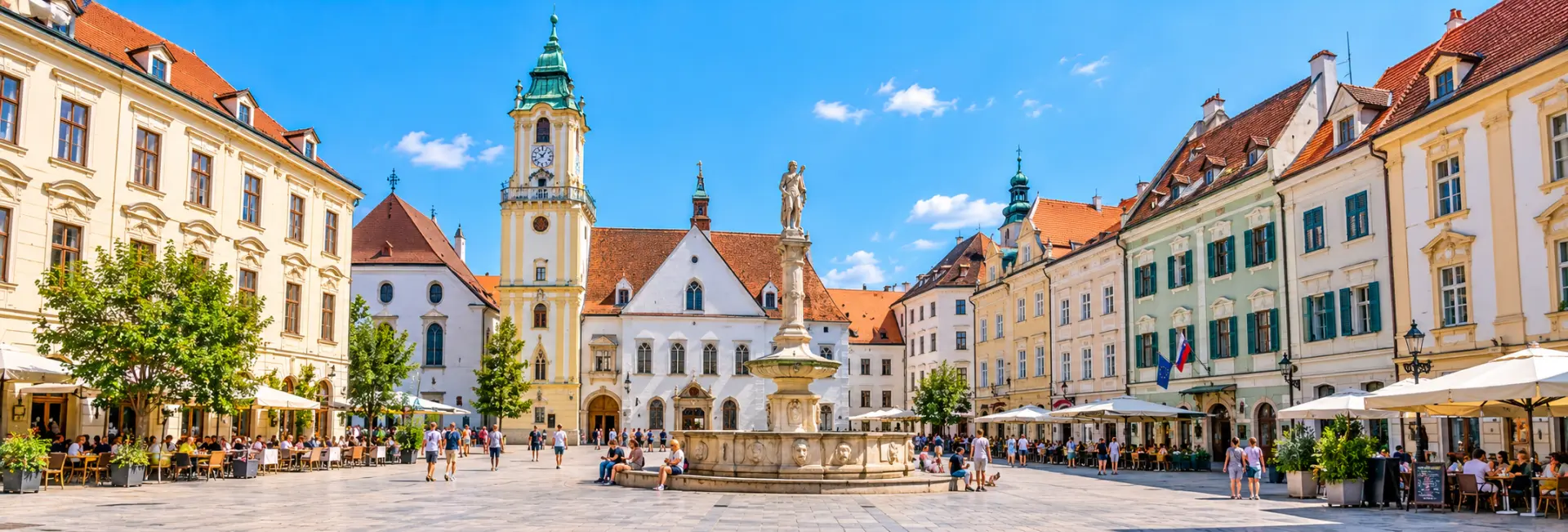
Hlavné námestie, known in English as the Main Square, is the social and historical core of Bratislava's Old Town. Almost square in layout and fully pedestrian, it has served for centuries as the place where the city trades, celebrates, welcomes guests and simply gathers. Today the same open space is ringed by café terraces, embassies, restored palaces and one of the oldest civic buildings in Slovakia.
At the center stands the Roland Fountain, a late Renaissance water monument crowned by an armored knight. On one side rises the Gothic tower of the Old Town Hall, home to the Bratislava City Museum and a lookout that gives a bird's-eye view of the surrounding streets. Narrow lanes lead away from the square toward St. Michael's Gate, the Primate's Palace and the Danube embankment.
For most first-time visitors this is where a walk through Bratislava naturally begins. The square is compact enough to absorb in a few minutes, yet detailed enough to reward a slower look at its facades, statues and small historical curiosities.
History
A Medieval Marketplace
The square grew up as the commercial heart of medieval Pressburg, the German name by which Bratislava was long known. Merchants, craftsmen and townspeople used it as the main marketplace, and the plots around it filled with the town houses of prosperous burghers. The oldest parts of the Old Town Hall complex, including its tower, reach back to the 13th and 14th centuries, which shows how early this spot became the center of civic life.
Ceremony and Civic Pride
As the city gained importance, especially in the centuries when Hungarian kings were crowned at nearby St. Martin's Cathedral, the square became a stage for official welcomes and public celebrations. The town hall was rebuilt in the 15th century by joining several neighboring houses into one administrative complex, and it was in full use by the 1430s. In 1572 a public fountain was added at the center of the square on the orders of King Maximilian II.
The 1809 Bombardment
During the Napoleonic Wars, French forces shelled the city in 1809. One cannonball from that episode is still lodged in the wall of the Old Town Hall tower, and it has become one of the square's best-loved curiosities. More than a hundred houses across the city were damaged, yet the historic core survived, and later generations kept the cannonball in place as a reminder.
A Square With Many Names
Like many public spaces in Central Europe, the square was renamed more than once as political systems changed. During the communist era it carried a name that referred to the date of the city's liberation in April 1945. Its present name, simply meaning Main Square, says exactly what the place has always been.
In recent decades the square has been restored as a pedestrian zone, and in 2019 the fountain at its center was returned to the look it had in the 16th century.
Architecture and Buildings
The Main Square does not follow a single architectural style. Instead it reads like a layered archive, with Gothic, Renaissance, Baroque, neoclassical and 19th-century historicist buildings standing shoulder to shoulder. Facades are painted in soft, varied colors, and many ground floors now hold cafés, restaurants and shops, while the upper floors still follow the proportions of the medieval and Baroque town houses behind them.
Notable Buildings
- Old Town Hall: a complex of joined buildings anchored by a Gothic tower, with Renaissance and Baroque additions layered on later.
- Palugyay Palace: a neo-baroque former palace whose ornate facade stands out among its older neighbors.
- Kutscherfeld Palace: a stately palace that adds to the formal character of the square.
- Former Hungarian exchange bank palace: a reminder that this was always a place of money, trade and deal-making.
- Embassy buildings: the French and Japanese embassies have premises on the square, which gives this busy tourist space a quietly diplomatic side.
What to Look For
Take a moment to look above the shop windows, where stucco ornament, carved window frames and decorative cornices tell more of the story than the street level does. Step through the passage into the Old Town Hall courtyard to see how the separate houses of the complex fit together, and look at the tower to spot its Gothic window and the embedded cannonball beside it.
Roland Fountain, Statues and Local Legends
The Roland Fountain
The fountain at the center of the square is known as both the Roland Fountain and Maximilian's Fountain. It was ordered in 1572 by Maximilian II, king of Royal Hungary, to provide the townspeople with a public water supply. Roland figures are a type of monument found in several European cities, and here the knight on top is traditionally understood to portray the king himself in full armor, standing on a column more than ten meters high.
The figure was carved by a master named A. Lutringer, and the fountain remains among the best-known monuments in the city. After careful restoration it was returned to its 16th-century appearance in 2019.
The New Year's Legend
Local stories gather thickly around the fountain, usually casting Maximilian as the protector of the town. The most famous tale says that at midnight on New Year's Eve the knight bows or turns, a small miracle that only people born in Bratislava and of good character are able to witness.
Statues and Small Details
- Napoleon's soldier: a statue tied to the local tale of a soldier from Napoleon's army who fell in love with a local girl and chose to stay in the city.
- Schöner Náci: a silvery statue at the edge of the square honoring Ignác Lamár, a well-known local character of the mid-20th century. It is the only statue in the Old Town's collection of street sculptures that is silver rather than bronze.
- The cannonball: embedded beside a Gothic window on the Old Town Hall tower and visible from the street at any time.
- The flood marker: a tablet on the town hall recording how high the Danube rose during the flood of 1850.
Old Town Hall and City Museum
A Complex Built Over Centuries
The Old Town Hall is not one building but a group of historic houses joined together over time. Its oldest elements go back to the medieval period, with the defensive tower generally dated to the 14th century or earlier. Through the centuries the complex served as much more than a seat of government: it has been used as a mint, a prison, a place of trade and celebration, an arsenal and a municipal archive.
Visually it is a blend of styles. The original Gothic character remains strong, while Renaissance and Baroque features were added in later centuries, which is why the courtyard and facades look so varied.
Bratislava City Museum
Since 1868 the building has housed the Bratislava City Museum, the oldest museum in the city. Its exhibitions explore the history of Bratislava, including displays on the feudal justice system with preserved court interiors and furnishings, as well as a section on historic torture devices that tends to fascinate older children and adults.
The Tower View
Climbing the tower is one of the best small rewards the square offers. From the top you can look down on the square itself, across the red rooftops of the Old Town and toward the castle on its hill. The inner courtyard is also used for concerts, festivals and seasonal markets.
Opening hours, ticket prices and current exhibitions change over time, so confirm them on the official museum website shortly before you visit.
Markets, Events and Café Life
Everyday life gives the Main Square its character. From spring through early autumn the edges of the square fill with outdoor tables, and it becomes one of the easiest places in the city to sit with a coffee and watch the crowd pass.
The Christmas Market
The square's most famous event is its Christmas market, which typically runs from late November until the end of December. Wooden stalls fill the open space, and the market also spills into the Old Town Hall courtyard. Warm drinks, seasonal food, crafts and small gifts are the main draws, and the old facades look particularly atmospheric in the evening lights.
Festivals and Cultural Events
Depending on the year, the square and the town hall courtyard also host festivals, concerts and other cultural events.
Ways to Experience It
A Self-Guided Stop
The simplest way to experience the square is on foot, at your own pace. A quick look at the fountain and the main facades takes only a few minutes, while a slower visit with photos, a coffee and a stroll through the courtyard fills about an hour.
With a Museum Visit
Adding the Bratislava City Museum and the tower climb turns the square into a half-morning or half-afternoon stop.
On a Guided Tour
Walking tours of the Old Town frequently begin or pause here, and many day tours from Vienna and Budapest include a stop at the square. A guide can help you spot the details that are easy to miss, such as the cannonball, the flood marker and the small statues.
As a Base for Exploring
Because the square sits right at the center of the Old Town, it works well as a starting point. From here the main sights, the pedestrian streets and the riverfront are all within a short walk.
Best Time to Visit
By Season
- Spring and autumn: mild weather makes these the most comfortable seasons for walking and sightseeing.
- Summer: long evenings and open terraces give the square its liveliest atmosphere, though it can be busy and warm in the middle of the day.
- Late November to December: the Christmas market transforms the square, but expect crowds and cold weather.
- Winter outside the market season: the square is quieter, and the Old Town Hall museum is a good indoor option.
By Time of Day
Early morning is the calmest time for photographs and for seeing the facades without crowds. Late afternoon and evening bring warmer light and a more social mood, especially when the terraces are full.
Visitor Tips
- Entry to the square is free, since it is an open public space. Only the museum and the tower have admission fees.
- Wear comfortable shoes, as the Old Town is paved with cobbles and stone.
- The square is generally friendly to wheelchairs and strollers, though some older buildings around it may have limited access.
- There are no public restrooms on the square itself, so plan ahead and use facilities in a café or on a nearby street.
- Check museum hours and ticket prices on the official website before visiting, since they can change by season.
- In busy periods such as the Christmas market, keep your bag closed and your belongings close, as crowded places attract pickpockets.
- Side streets near the square often offer quieter places to eat than the terraces directly on it.
- The Danube riverfront is about an eight-minute walk away, while the main railway station is roughly a 25-minute walk, so most visitors arrive on foot or by a short taxi or public transport ride.
Nearby Attractions
The Main Square sits in the middle of the Old Town, so many of the city's best-known sights are only a few minutes away.
- Primate's Square and the Primate's Palace: reached by one of the shortest streets in the city beside the town hall, this neoclassical palace dates from the late 18th century.
- Jesuit Church of the Holy Saviour: a 17th-century church just off the square.
- Franciscan Square and St. Michael's Gate: north of the square, leading to the last remaining gate of the original medieval city walls.
- St. Martin's Cathedral: the former coronation church where Hungarian kings were crowned between 1563 and 1830.
- Bratislava Castle: the hilltop landmark visible above the Old Town, reachable on foot from the center.
- Danube riverfront: a pleasant walk to the water, with views along the river.
FAQs about visiting the Main Square (Hlavné námestie)
What is the Main Square in Bratislava known for? +
It is the historic center of the Old Town, famous for the Roland Fountain, the Gothic Old Town Hall with its museum and tower, the surrounding palaces and its popular Christmas market.
Is the Main Square free to visit? +
Yes, the square is an open public space and costs nothing to enter. Only the Old Town Hall museum and tower have admission fees, so check the current prices before you go.
How long should I spend at the Main Square? +
A quick visit takes 15 to 30 minutes, while a coffee stop and a wander through the courtyard can fill an hour. Add the museum and tower climb and you will want a couple of hours.
When is the best time to visit? +
Spring and autumn offer mild weather, summer brings lively terraces and long evenings, and late November through December brings the Christmas market. Early morning is best for a quiet visit.
How do I get to the Main Square? +
The square is in the middle of the Old Town and is easiest to reach on foot. The Danube riverfront is about eight minutes away on foot, and the main train station is roughly a 25-minute walk or a short taxi ride.
Is the square suitable for children and wheelchair users? +
Yes, it is a flat pedestrian space that is generally comfortable for strollers and wheelchairs, although cobbles can make some stretches bumpy. Children usually enjoy the fountain, the statues and the cannonball on the tower.
Does the Roland Fountain statue really bow at New Year? +
According to local legend the knight bows or turns at midnight on New Year's Eve, but only people born in Bratislava and of good character can see it. It is a charming story rather than something visitors can verify.
What can I combine with a visit to the square? +
The Old Town Hall museum, the Primate's Palace, St. Michael's Gate, St. Martin's Cathedral and Bratislava Castle are all within an easy walk.
