Table of Contents
Overview
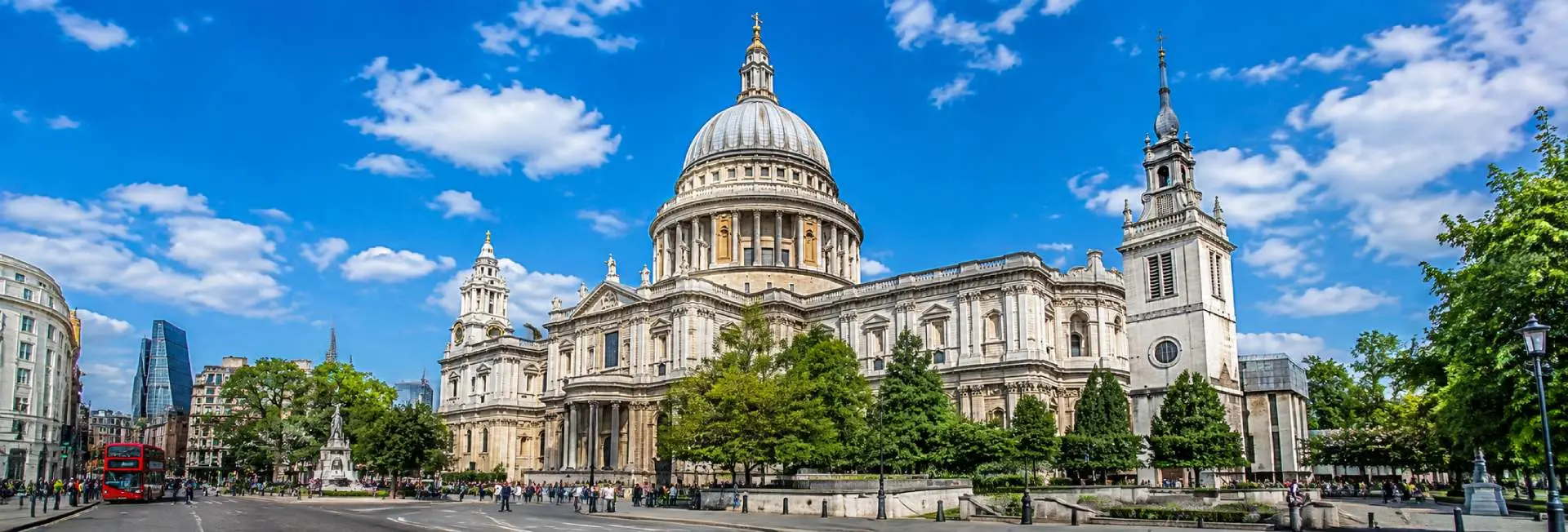
St Paul's Cathedral sits atop Ludgate Hill, the highest point in the City of London, and remains one of the most recognizable silhouettes on the London skyline. Designed by Sir Christopher Wren after the Great Fire of London destroyed its medieval predecessor, the cathedral has stood for over three centuries as a working place of worship, a stage for national history, and a masterpiece of English Baroque architecture.
Its towering dome, one of the largest in the world, has watched over the city through the Blitz, royal weddings, state funerals, and jubilee celebrations. For visitors, St Paul's offers a rare combination: a still-active cathedral, a crypt holding some of Britain's most famous tombs, and a dome climb rewarded with sweeping views across London.
History
Origins on Ludgate Hill
A cathedral dedicated to St Paul has stood on this site since 604 AD, making the current building the fourth or fifth church to occupy the spot, depending on how the earliest structures are counted. The medieval cathedral that preceded today's building, now referred to as Old St Paul's, was a vast Gothic structure that had fallen into disrepair after centuries of use and neglect.
The Great Fire and a New Cathedral
On 2 September 1666, the Great Fire of London swept through the city and left Old St Paul's structurally unusable. Christopher Wren, who had already been advising on repairs to the aging medieval cathedral before the fire, was appointed to design its replacement. His early proposals, including the ambitious "Great Model" design, were rejected as too radical by church officials, and Wren ultimately compromised with a more traditional cruciform plan that still allowed him room to innovate as construction progressed.
Building Wren's Masterpiece
Construction began in 1675 and continued for over three decades. Wren, working alongside mathematicians and scientists from the Royal Society, solved the engineering challenge of placing a monumental dome atop the crossing by designing it in three layers: a visible outer dome, a load-bearing inner brick cone hidden between the layers, and a decorative inner dome seen from the cathedral floor. The first service was held in the unfinished building in 1697, and the final stone was laid on the lantern in 1708, with interior decoration continuing until around 1711.
Architecture & Design
A Blend of Styles
St Paul's is often described as English Baroque, but its design draws on multiple traditions at once. The grand columned west front recalls classical Greek and Roman temples, the twin bell towers show a theatrical Baroque flourish, and the ground plan retains echoes of the Gothic cathedrals it replaced. Wren blended these influences into something that felt both modern for its time and rooted in tradition, a balance that was central to satisfying his more conservative critics.
The Iconic Dome
The dome was directly inspired by Michelangelo's dome at St Peter's Basilica in Rome, though Wren adapted the concept significantly for London. It was the first dome of its kind built in England, and its triple-shell construction, an outer timber-and-lead dome, a supporting brick cone, and an inner masonry dome, allowed Wren to achieve a soaring silhouette from outside while keeping the interior proportions comfortable for worshippers below.
Materials & Craftsmanship
The cathedral's exterior is built from Portland limestone, chosen for its pale color and durability, which has become closely associated with the look of the building over time. Inside, elaborate wood carving by Grinling Gibbons and wrought ironwork by Jean Tijou add texture and detail to the choir stalls, organ case, and gates, reflecting the fine craftsmanship Wren brought in from leading artisans of the period.
The Dome & Galleries
Whispering Gallery
Reached by 257 steps and sitting around 30 metres above the cathedral floor, the Whispering Gallery runs around the interior base of the dome. It takes its name from an acoustic quirk in the construction: a whisper spoken against the wall on one side can be heard clearly on the opposite side, roughly 42 metres away.
Stone Gallery
A further climb brings visitors to the Stone Gallery, about 53 metres above the floor and reached by 376 steps in total. This is the first outdoor viewing point, circling the base of the dome's exterior with wide views over the surrounding city.
Golden Gallery
The Golden Gallery is the highest publicly accessible point of the cathedral, sitting at roughly 85 metres and reached by 528 steps in total. It is the smallest of the three galleries but offers the most expansive panorama, taking in landmarks such as the Shard, the Gherkin, and the River Thames.
- Whispering Gallery: 257 steps, about 30 metres above the floor
- Stone Gallery: 376 steps, about 53 metres above the floor
- Golden Gallery: 528 steps, about 85 metres above the floor
- Overall dome height from floor to cross: approximately 111 metres
Notable Landmarks & Memorials
Beyond the dome, St Paul's is filled with points of interest, many of them concentrated in the crypt, which is one of the largest in Europe.
- The Quire, the earliest completed part of the cathedral, features carved choir stalls by Grinling Gibbons and is where daily services are still sung
- The Grand Organ, installed in 1695 with a case by Grinling Gibbons, remains one of the largest and most celebrated organs in the United Kingdom
- Lord Nelson's tomb sits directly beneath the dome in the crypt, marked by a black sarcophagus originally carved for Cardinal Wolsey
- The Duke of Wellington's memorial and tomb are also housed in the crypt, alongside a large bronze equestrian statue
- Christopher Wren's own grave lies in the crypt, marked with a Latin epitaph that translates roughly to an invitation for visitors to look around at the building itself as his monument
- The American Memorial Chapel behind the high altar honors US servicemen based in Britain who died during the Second World War
Cultural Significance & Historic Events
Few buildings in Britain have hosted as many defining national moments as St Paul's. Its role has extended well beyond religious services into a stage for state ceremony and public memory.
- The wedding of Prince Charles and Lady Diana Spencer took place here in 1981
- State funerals held at the cathedral include those of Lord Nelson, the Duke of Wellington, and Sir Winston Churchill
- Jubilee and thanksgiving services for several monarchs, including Queen Elizabeth II's Golden and Diamond Jubilees, have been held at St Paul's
- During the Blitz of the Second World War, volunteer firefighters known as the St Paul's Watch protected the cathedral from incendiary bombs, and photographs of its dome standing above the smoke became a lasting symbol of the city's resilience
Ways to Experience It
- General admission allows access to the cathedral floor, crypt, and exhibits at your own pace
- The dome climb takes visitors up through the Whispering, Stone, and Golden Galleries for increasingly wide views over London
- Guided tours led by cathedral staff cover the main highlights and stories in around 90 minutes
- Multimedia guides are available in multiple languages for self-paced exploration
- Evensong and other services are open to the public and offer a way to experience the cathedral as a working place of worship rather than purely a visitor attraction
- The crypt café provides a place to rest partway through a visit, particularly useful before or after the dome climb
Best Time to Visit
St Paul's tends to be busiest in the late morning through early afternoon, especially during peak tourist season in the summer months. Arriving close to opening time or later in the afternoon generally means shorter queues and a quieter experience inside.
- Weekday mornings are typically quieter than weekends
- Visiting outside the UK's summer school holidays tends to mean smaller crowds
- Clear days are worth prioritizing for the dome climb, since the view from the Golden Gallery depends heavily on visibility
- Attending a service, such as evensong, offers a different, less crowded way to experience the building
Visitor Tips
- The dome galleries are accessed by stairs only, with no lift option, so the climb should be planned around fitness and mobility
- Photography is generally not permitted inside the Whispering Gallery for safety reasons
- Modest dress is appreciated as a sign of respect, given that St Paul's remains an active place of worship
- Bags may be subject to security checks before entry
- Keep hold of your ticket if you plan to leave and re-enter, for example to visit the crypt café
- Photography is usually not permitted during services
Nearby Attractions
- The Millennium Bridge, a pedestrian crossing over the Thames, offers a well-known photo angle back toward the cathedral's dome
- Tate Modern sits just across the river at the southern end of the Millennium Bridge
- One New Change, a shopping center beside the cathedral, has a rooftop terrace with close-up views of the dome
- The Museum of London Docklands and City-focused historical sites are within walking distance for those interested in the area's wider history
- The Bank of England and the Sky Garden viewing space are both a short walk away in the City of London's financial district
Common Questions about St. Paul’s Cathedral
What is St Paul's Cathedral famous for? +
It's best known for its enormous dome, designed by Sir Christopher Wren after the Great Fire of London, and for hosting major national events such as royal weddings, state funerals, and jubilee services.
How long does it take to visit St Paul's Cathedral? +
A general visit takes around 90 minutes to 2 hours, though climbing all the way to the Golden Gallery and exploring the crypt in depth can extend that to closer to 3 hours.
Is St Paul's Cathedral free to enter? +
General sightseeing entry requires a paid ticket, though attending a service such as evensong is free and open to the public, with access limited to areas used for worship during that time.
Can you climb to the top of the dome? +
Yes, visitors can climb 528 steps through the Whispering, Stone, and Golden Galleries, though the climb is stairs-only with no lift access, so it's worth planning around fitness levels and any mobility needs.
How do I get to St Paul's Cathedral? +
The cathedral is served directly by St Paul's Underground station on the Central line, with Blackfriars, Mansion House, and Bank/Monument stations also within walking distance.
Is St Paul's Cathedral suitable for visitors with limited mobility? +
The main cathedral floor and crypt are accessible, but the dome galleries can only be reached by stairs, so visitors with mobility restrictions should plan to enjoy the ground-level areas rather than the climb.
What's buried in the crypt? +
The crypt holds the tombs of Lord Nelson and the Duke of Wellington, along with Christopher Wren's own grave and memorials to numerous other notable British figures.
When is the best time of day to visit? +
Early morning or later afternoon tends to be quieter than the late morning to early afternoon window, particularly during the busy summer tourist season.
Can you take photos inside the cathedral? +
Photography is generally allowed in most areas, but it's restricted in the Whispering Gallery for safety reasons and typically not permitted during services.
What else can I combine with a visit to St Paul's Cathedral? +
The Millennium Bridge, Tate Modern, and One New Change are all within a short walk, making it easy to pair a cathedral visit with riverside sightseeing or a rooftop view of the dome.