Table of Contents
Overview
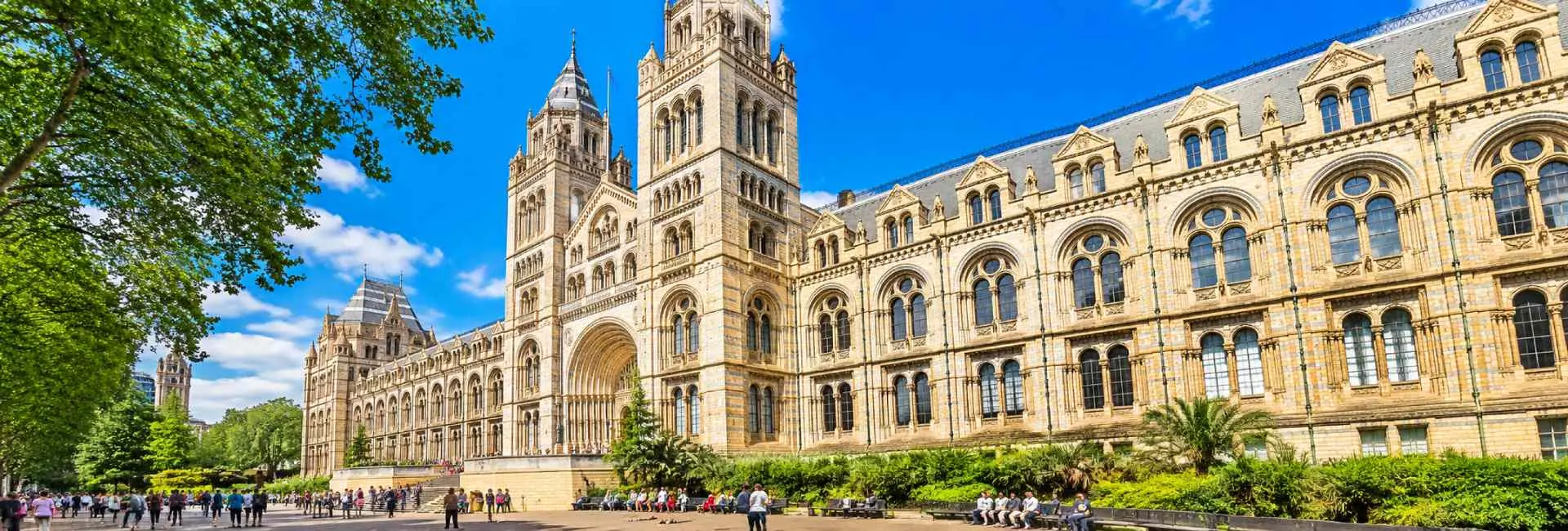
The Natural History Museum in South Kensington, London, is one of the world's great scientific institutions, holding a collection of roughly 80 million specimens spanning botany, zoology, entomology, mineralogy, and palaeontology. Housed in a soaring Victorian building often described as a "cathedral to nature," it draws millions of visitors each year and remains completely free to enter.
More than a museum of static displays, it is also a working scientific research centre, where hundreds of scientists study everything from meteorites to endangered species. Its combination of architectural grandeur, globally significant collections, and free public access has made it one of London's most visited attractions.
History
Origins
The museum's story begins with Sir Richard Owen, the anatomist who coined the term "dinosaur." Owen believed natural history deserved its own grand, freely accessible building, separate from the British Museum, where the growing natural history collections had originally been housed. He envisioned a space he called a "cathedral to nature," open to everyone regardless of wealth or class.
Design and Construction
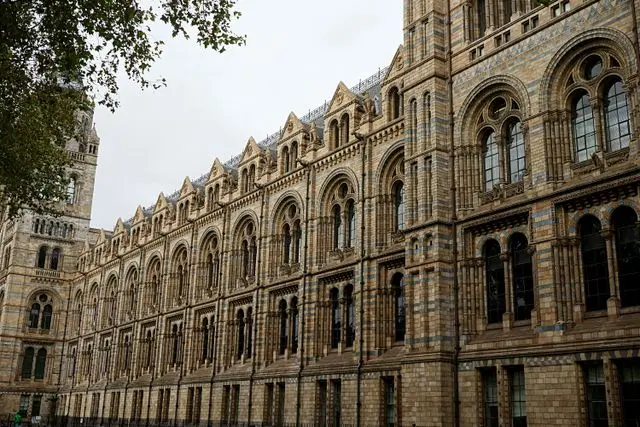
An initial design competition in 1864 was won by architect Francis Fowke, but his sudden death the following year left the project to a then relatively unknown architect, Alfred Waterhouse. Waterhouse reworked the plans into the Romanesque-inspired building seen today, choosing ornamental terracotta tiles and brick because they resisted the soot and grime of Victorian London's polluted air. Construction began in 1873 and took roughly eight years to complete.
Opening and Growth
The museum opened its doors to the public on 18 April 1881, though moving the full collection from the British Museum took several more years. Since then it has continued to expand, adding facilities such as the Darwin Centre in 2009 to house its enormous zoological and entomological collections, and undertaking ongoing renovations to its grounds and public spaces.
Architecture & Design
Waterhouse's building is widely regarded as one of Britain's finest examples of Romanesque Revival architecture, drawing on medieval European abbey design and combining it with lavish Victorian ornamentation. Nearly every surface, inside and out, is decorated with terracotta relief sculptures of plants and animals, a deliberate design choice meant to reflect the museum's contents.
- The building's façade and interior are clad in custom-made terracotta tiles chosen for their resistance to London's sooty Victorian air
- Living species are depicted on the west side of the building, while extinct species appear on the east, a symbolic layout requested by Richard Owen
- The central hall, now known as Hintze Hall, features a hand-painted ceiling of 162 botanical panels completed in 1881
- Carved details throughout the museum include dozens of sculpted animals, from monkeys climbing the columns to birds and reptiles worked into the stonework
Key Zones & Galleries
Hintze Hall
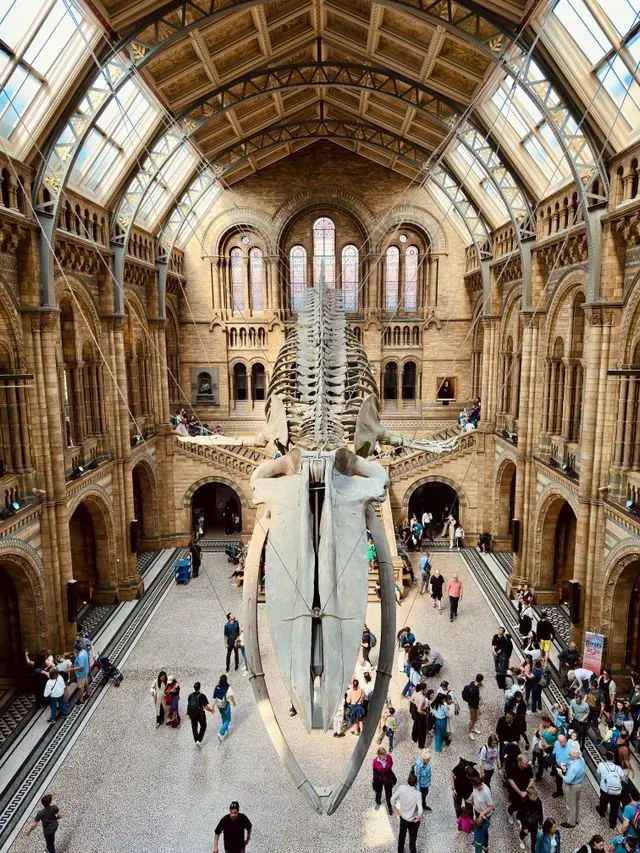
The museum's grand central hall serves as its main entrance and orientation point. Since 2017 it has been dominated by Hope, a suspended blue whale skeleton, and its upper balconies offer sweeping views of the vaulted Romanesque ceiling.
The Green Zone
Centred on Hintze Hall, the Green Zone includes galleries on birds, fossils, and the UK's natural environment, alongside creatures section featuring specimens collected on historic scientific voyages.
The Blue Zone
Home to the museum's famous Dinosaur gallery, complete with an animatronic T. rex and the fossil of Sophie the Stegosaurus, as well as galleries on mammals, human biology, and marine life.
The Red Zone
Focused on the dynamic forces that shape the planet, this zone covers volcanoes, earthquakes, and the formation of the Earth itself, and is entered through a distinctive escalator that passes through a giant rotating globe.
The Orange Zone
This zone connects visitors to living science, encompassing the Darwin Centre and the Wildlife Garden, an outdoor space recreating several British habitats just steps from the museum's entrance.
Notable Highlights
- Hope the blue whale - a 25-metre skeleton suspended in a diving pose in Hintze Hall, symbolising ocean conservation
- The Dinosaur gallery - animatronic dinosaurs and significant fossils, including Sophie the Stegosaurus, one of the most complete stegosaur skeletons ever found
- The Darwin Centre's Cocoon and Spirit Collection - a striking cocoon-shaped research building housing millions of specimens preserved in alcohol, including a giant squid
- The Vault - a gallery of rare gemstones, minerals, and meteorite fragments billions of years old
- The Wildlife Garden - a landscaped outdoor space recreating woodland, meadow, and wetland habitats found across Britain
Cultural Significance
Beyond its scientific value, the museum occupies an outsized place in Britain's cultural imagination. Its Victorian architecture has made it a filming location and a recognisable symbol of London itself, while its "cathedral to nature" concept reflects a distinctly nineteenth-century belief that scientific knowledge should be as awe-inspiring and accessible as religious spaces once were.
The shift from Dippy the Diplodocus cast to Hope the blue whale as the centrepiece of Hintze Hall in 2017 was widely read as a statement about the museum's modern priorities, moving from a symbol of prehistoric wonder toward a living emblem of conservation and humanity's impact on the natural world.
Ways to Experience It
- Self-guided exploration - wander freely between the four colour-coded zones at your own pace
- Themed trails and family activities - trails aimed at children and families run throughout the year, especially during school holidays
- Special ticketed exhibitions - temporary exhibitions on themes like wildlife photography or specific scientific topics require a separate paid ticket
- Darwin Centre tours - behind-the-scenes look at the Spirit Collection and the museum's ongoing research
- Evening and members' events - after-hours events and a dedicated members' room are available to museum members
Best Time to Visit
The museum tends to be busiest during UK school holidays and on weekends, with the heaviest crowds typically arriving between late morning and early afternoon. Galleries such as the Dinosaur gallery can involve long queues during these peak windows.
For a quieter visit, aim for a weekday morning right at opening, particularly Tuesday to Thursday, or arrive in the mid-to-late afternoon after the school-trip crowds have thinned out.
Visitor Tips
- Entry to the permanent galleries is free, though donations are welcomed and some special exhibitions charge admission
- Booking a free timed-entry ticket in advance is recommended during busy periods to manage queues
- Allow at least two to four hours to see the main highlights, or a full day if visiting every gallery and a special exhibition
- For the best photo of Hope the blue whale without crowds in the way, head to the upper balcony level of Hintze Hall
- The museum is close to South Kensington Underground station and within walking distance of the Science Museum and the Victoria and Albert Museum
Nearby Attractions
The museum sits in the heart of South Kensington's "Museum Mile," making it easy to combine with other major London institutions on the same day.
- Science Museum - a short walk away, covering technology, space exploration, and interactive science exhibits
- Victoria and Albert Museum - the world's leading museum of art and design, also within a few minutes' walk
- Hyde Park and Kensington Gardens - expansive green space a short stroll to the north, ideal for a break after museum-hopping
- Royal Albert Hall - the iconic concert venue, visible from the museum's front lawn
Common Questions about Natural History Museum
Is the Natural History Museum free to visit? +
Yes, general admission to the permanent galleries is free, though some special temporary exhibitions charge a separate ticket price and donations are welcomed.
Do I need to book tickets in advance? +
While walk-ins are usually possible, booking a free timed-entry slot online is recommended, especially during weekends and school holidays, since it helps manage queues at busy times.
How much time should I set aside for a visit? +
Most visitors spend two to four hours seeing the main highlights, but allow a full day if you want to explore every gallery in detail or visit a special exhibition as well.
What is the museum's most famous exhibit? +
Hope, the 25-metre blue whale skeleton suspended in Hintze Hall, is the museum's current centrepiece, having replaced the long-running Diplodocus cast known as Dippy in 2017.
Is the museum suitable for young children? +
Yes, it's one of London's most popular family attractions, with dinosaur galleries, animatronic exhibits, and activity trails designed to engage children, plus baby-changing facilities and pushchair access throughout.
What's the best time to visit to avoid crowds? +
Weekday mornings right at opening, particularly Tuesday through Thursday, tend to be quietest, while weekends and school holidays draw the largest crowds, especially between late morning and early afternoon.
How do I get to the museum? +
The museum is a short walk from South Kensington Underground station, served by the District, Circle, and Piccadilly lines, and is within easy walking distance of the Science Museum and the Victoria and Albert Museum.
Can I combine my visit with other nearby attractions? +
Yes, the museum sits in South Kensington's museum district alongside the Science Museum and the V&A, and Hyde Park and Kensington Gardens are also within easy walking distance for a break outdoors.