Table of Contents
Overview
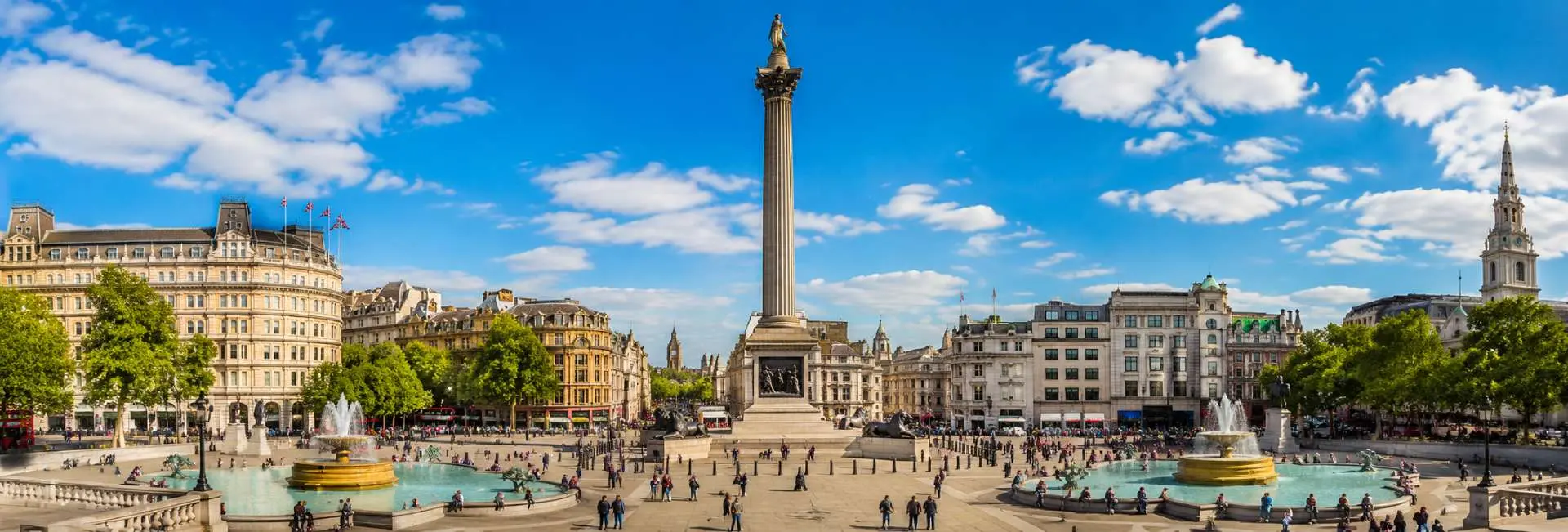
Trafalgar Square is the beating heart of central London, a grand open-air meeting point where the West End, Whitehall, and the River Thames converge. Framed by Nelson's Column, four bronze lions, twin fountains, and the columned facade of the National Gallery, it has been the city's default stage for celebration, protest, and everyday life since the 1840s.
More than just a monument, the square functions as London's unofficial town square. On any given day it hosts tourists photographing the lions, office workers eating lunch on the fountain steps, and street performers drawing a crowd, while its calendar of free festivals keeps it in near-constant motion throughout the year.
History
From King's Mews to Public Square
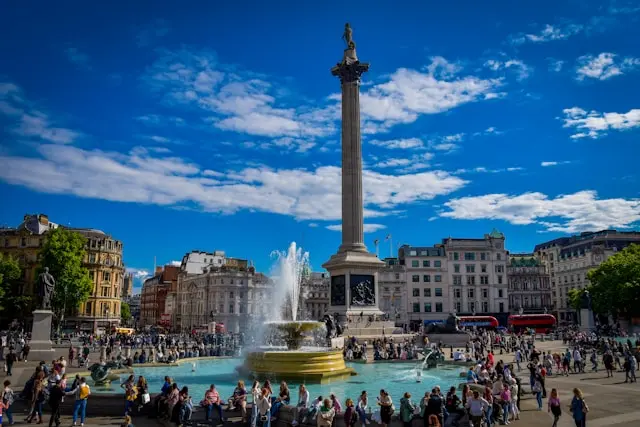
Long before it became Trafalgar Square, this patch of land was known as Charing Cross, a site of importance in London since the 1200s, and for centuries distances to the capital have been measured from this exact spot. From the 14th century onward, it housed the King's Mews, the royal stables serving the nearby palace of Whitehall.
When George IV had the mews relocated to Buckingham Palace, the site was cleared for redevelopment. Architect John Nash drew up plans for a grand new square in the 1820s, but progress stalled after his death, and the square he envisioned did not officially open to the public until 1844.
A Name Born from Battle
The square takes its name from the Battle of Trafalgar, fought on 21 October 1805 off the coast of Cape Trafalgar in southern Spain. In this decisive naval engagement, Admiral Horatio Nelson led the British fleet aboard HMS Victory to a defining victory over the combined French and Spanish navies during the Napoleonic Wars, though he was fatally wounded in the fighting. The square was officially named in his honour around 1835, cementing his legacy at the very centre of the capital.
Nelson's Column and the Bronze Lions
The Column
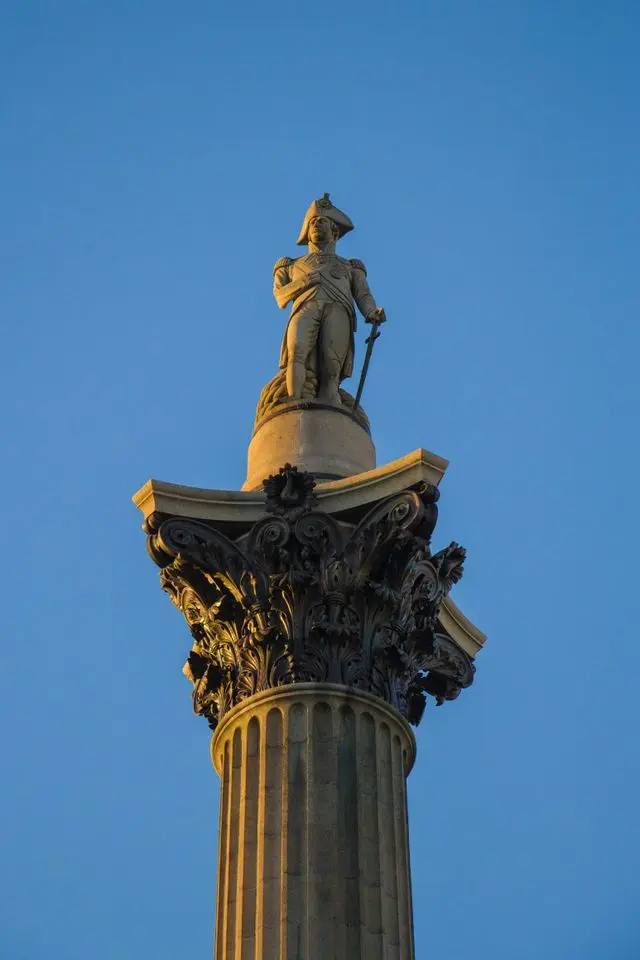
Dominating the square is Nelson's Column, a Corinthian column rising roughly 52 metres (169 feet) above the pavement. Built between 1840 and 1843 to a design by architect William Railton, it was funded through public subscription after a letter to The Times in 1837 first proposed a permanent tribute to Nelson.
At its summit stands a sandstone statue of Nelson himself, carved by sculptor Edward Hodges Baily. The pedestal below is decorated with four bronze relief panels depicting the Battle of Cape St Vincent, the Battle of the Nile, the Battle of Copenhagen, and the Battle of Trafalgar, all cast from bronze melted down from captured French and Spanish cannons.
The Four Lions
Guarding the base of the column are four monumental bronze lions, added in 1867 and designed by the celebrated painter and sculptor Sir Edwin Landseer. Popular legend holds that Landseer studied real lion carcasses to achieve their lifelike anatomy, which is said to explain their unusual, almost relaxed poses. Today they are among the most photographed sculptures in London and a favourite spot for visitors to climb and pose for pictures.
Key Landmarks and Monuments
The Fourth Plinth
In the square's north-west corner sits the Fourth Plinth, originally intended to carry an equestrian statue of William IV that was never completed due to insufficient funds. Left empty for over 150 years, it has since 1998 hosted the Fourth Plinth Commission, a rotating series of contemporary artworks that has included everything from a giant blue cockerel to a ship in a bottle.
The Fountains
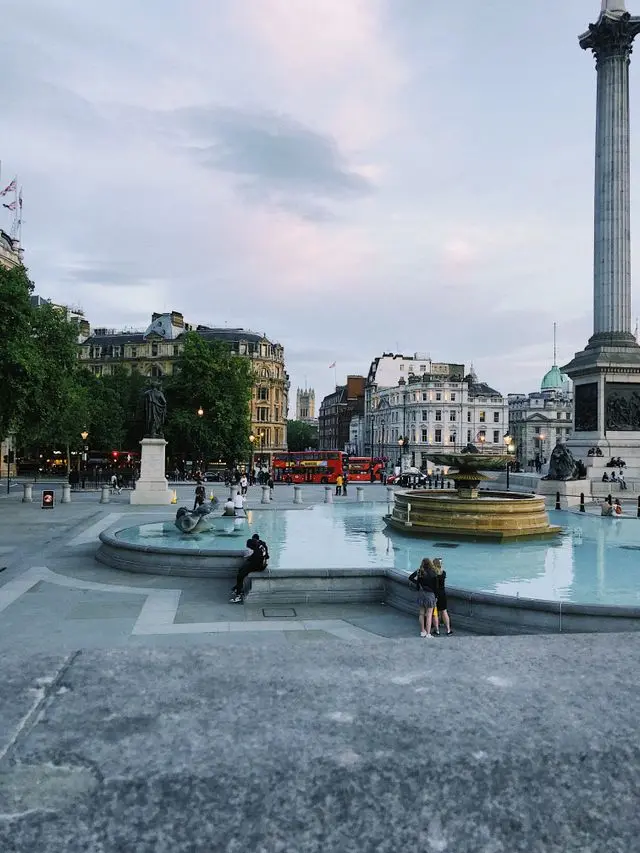
Two large fountains anchor the square, originally installed in 1845 and substantially redesigned in the 1930s by architect Sir Edwin Lutyens, who added centrepieces featuring dolphins, mermaids, and tritons. At night, the basins are lit with coloured lighting, making them a popular after-dark photo spot.
Statues and Surprises
Beyond Nelson, the square holds an unexpected mix of statuary, including an equestrian statue of George IV and figures of military commanders Sir Charles James Napier and Sir Henry Havelock. Perhaps most surprising is the statue of George Washington outside the National Gallery, a 1921 gift from the Commonwealth of Virginia. Because Washington reportedly vowed never again to set foot on British soil, the statue is said to stand on a patch of earth imported from the United States.
Cultural Significance and Events
Trafalgar Square has long served as London's default venue for collective moments, from wartime rallies and political demonstrations to royal celebrations and sporting victory parades. Its size and central location make it the natural gathering point whenever the city wants to mark something together.
- A towering Christmas tree, gifted annually by the city of Oslo since 1947 as thanks for Britain's support of Norway during the Second World War, stands in the square each December.
- Cultural festivals such as Chinese New Year, Vaisakhi, and St Patrick's Day regularly transform the square with performances, food stalls, and free concerts.
- Large crowds gather here every 31 December for London's New Year's Eve countdown.
- West End Live, a free annual showcase of London's biggest musical theatre productions, is staged in the square each summer.
Ways to Experience It
Trafalgar Square rewards both a quick photo stop and a slower visit, depending on how it fits into a wider day in London.
- Wander freely: the square is open access, with no ticket or booking required to explore it at any hour.
- Join a guided walking tour: many free and paid walking tours use the square as a starting point, weaving in its history alongside nearby Westminster or Covent Garden.
- Pair it with the National Gallery: step inside for free to see works by artists such as Turner, Monet, and Van Gogh before or after visiting the square.
- Time a visit around an event: check what's scheduled, from cultural festivals to art installations, to see the square at its liveliest.
Best Time to Visit
Because the square is open around the clock, timing shapes the experience far more than access does. Early weekday mornings are quietest, with soft light on Nelson's Column and few other visitors around, making this the window favoured by photographers.
Midday and summer weekends bring the square to full life, with street performers, tour groups, and the general buzz of central London, though this also means larger crowds around the lions and fountains. December adds a festive layer with the Christmas tree and carol singing, while a visit after dark shows off the illuminated fountains at their best.
Visitor Tips
- Entry to the square is completely free and it never closes, so there's no need to plan around opening hours.
- Budget 20 to 45 minutes to take in the column, lions, fountains, and Fourth Plinth at an easy pace; allow longer if joining a guided tour or visiting the National Gallery.
- Photography is welcome throughout the square, including of the lions and monuments.
- Visitors are asked not to feed the pigeons, as management measures have deliberately reduced their numbers in recent years.
- Charing Cross is the nearest station, served by the Underground and mainline rail, putting the square within easy walking distance of much of central London.
- Check for scheduled events before visiting, as access to parts of the square can be restricted during major festivals or gatherings.
Nearby Attractions
Trafalgar Square's central location makes it a natural launchpad for exploring several of London's best-known districts and landmarks on foot.
- The National Gallery and National Portrait Gallery sit right on the square, both offering free entry to their permanent collections.
- St Martin-in-the-Fields, just to the east, hosts free daytime concerts and a well-regarded café in its crypt.
- Whitehall leads south toward Horse Guards Parade, Downing Street, and the Houses of Parliament.
- The Mall and Admiralty Arch, to the south-west, connect the square to Buckingham Palace.
- Leicester Square, Chinatown, and Covent Garden are all within a short walk to the east, ideal for continuing on to shopping, dining, or the West End theatre district.
FAQs about Trafalgar Square
What is Trafalgar Square famous for? +
It's best known for Nelson's Column, the four bronze lions at its base, the twin fountains, and the Fourth Plinth's rotating contemporary art, all set against the backdrop of the National Gallery.
Is Trafalgar Square free to visit? +
Yes, the square is completely free to enter and open 24 hours a day, every day of the year.
How much time should I spend at Trafalgar Square? +
Most visitors spend 20 to 45 minutes taking in the monuments and fountains; allow more time if you're joining a guided tour or visiting the National Gallery next door.
What is the best time of day to visit? +
Early weekday mornings are quietest and best for photography, while midday and weekends bring the square to its liveliest with performers and crowds. After dark, the illuminated fountains offer a different atmosphere entirely.
Why is there a statue of George Washington in a London square? +
It was a 1921 gift from the Commonwealth of Virginia, placed outside the National Gallery on soil said to be imported from the United States, honouring Washington's reported vow never to set foot on British ground again.
Is Trafalgar Square suitable for children? +
Yes, its open space, climbable lions, fountains, and frequent free performances make it engaging for kids, though adults should keep an eye on younger children near the fountains and busy traffic edges.
How do I get to Trafalgar Square? +
Charing Cross is the nearest station, offering Underground and mainline rail connections, and the square is within easy walking distance of Leicester Square, Piccadilly Circus, and Westminster.
What is the Fourth Plinth and why is it empty of a permanent statue? +
It was originally meant to hold an equestrian statue of William IV, but funding ran out. Since 1998 it has instead hosted a changing series of contemporary art commissions rather than a fixed monument.
What events take place at Trafalgar Square? +
The square hosts an annual Christmas tree gifted by Oslo, cultural festivals like Chinese New Year and Vaisakhi, West End Live, St Patrick's Day celebrations, and London's New Year's Eve countdown, among other free public events.
What else is nearby worth visiting? +
The National Gallery, National Portrait Gallery, and St Martin-in-the-Fields sit directly on the square, with Covent Garden, Chinatown, Whitehall, and Buckingham Palace all within easy walking distance.