Table of Contents
Introduction
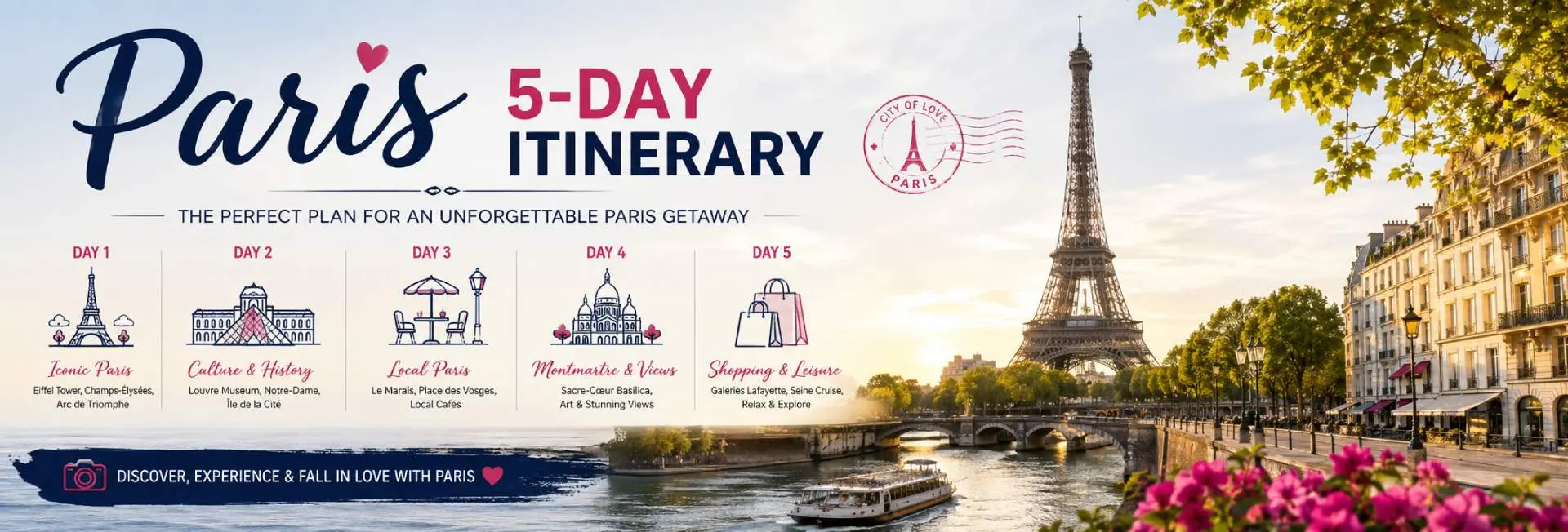
Five days is enough time to see Paris's essential landmarks without rushing between them, and to leave room for the slower pleasures - long lunches, café stops, and wandering neighborhoods that don't make it onto a checklist. This itinerary is organized by neighborhood rather than by attraction, so each day covers a walkable area instead of crisscrossing the city.
A few of the city's biggest sights have fixed closure days, so check the practical tips section before you lock in your schedule - swapping two days around a closure is far easier than discovering it at the door.
Day 1: Île de la Cité and the Latin Quarter
Start on the islands at the heart of the city, then cross into the Left Bank for the afternoon and evening.
Morning
Begin at Île de la Cité, the small island where Notre-Dame Cathedral sits. Even if you don't go inside, the exterior and surrounding square are worth the visit, and the nearby Sainte-Chapelle is known for its stained-glass windows, which are best seen on a sunny morning.
Afternoon
Cross into the Latin Quarter for lunch, then explore the neighborhood's narrow streets around the Sorbonne and the Panthéon. The area is dense with bookshops, small cinemas, and student-priced cafés, making it a good contrast to the more monumental sights of the morning.
Evening
Walk along the Seine toward Saint-Germain-des-Prés for dinner, or take an early evening river cruise, which gives a different perspective on the landmarks you've seen on foot during the day.
Day 2: The Louvre and Tuileries
This day covers one of the world's largest museums, so plan to see highlights rather than everything.
Morning
Arrive at the Louvre as close to opening as possible with a pre-booked, timed entry ticket. Focus on a manageable route rather than trying to cover the entire museum - most first-time visitors prioritize the Mona Lisa, the Winged Victory of Samothrace, and the Egyptian antiquities wing.
Afternoon
Walk through the Tuileries Garden toward Place de la Concorde. This is a good afternoon for browsing the shops around Rue de Rivoli or, if you have museum energy left, visiting the Musée de l'Orangerie for Monet's water lily murals.
Evening
Head toward the Champs-Élysées and the Arc de Triomphe for sunset, then find dinner in one of the side streets off the avenue, which tend to be less tourist-priced than the main strip itself.
- The Louvre is closed on Tuesdays - if Day 2 of your trip falls on a Tuesday, swap it with another day
- Timed reservations are required at the Louvre regardless of season, so book before you arrive
Day 3: Eiffel Tower and Trocadéro
This is the most photographed day of the trip, so timing matters more than usual.
Morning
Arrive at the Eiffel Tower by around 8:30 AM with a pre-booked, timed ticket to beat the longer queues that build up later in the day. Taking the elevator to the second level first gives panoramic views of the city's grid layout before continuing to the summit if you've booked that level of access.
Afternoon
Cross to the Trocadéro on the opposite side of the Seine for the classic wide-angle view of the tower, then walk along the river or through the nearby gardens for lunch.
Evening
Return to the Eiffel Tower area after dark to see it illuminated - it sparkles for several minutes at the top of every hour after sunset, which is worth timing your evening around.
Day 4: Montmartre and Sacré-Cœur
Montmartre offers a village-like contrast to the grand boulevards of the previous days, with steep streets and a bohemian history.
Morning
Climb (or take the funicular) up to Sacré-Cœur Basilica for views over the city, then explore the surrounding streets, including Place du Tertre, where street artists have worked for over a century.
Afternoon
Wander the quieter residential lanes of Montmartre away from the main tourist path, and consider a stop at the Musée de Montmartre, which covers the neighborhood's history as an artists' colony.
Evening
Head down toward Pigalle to see the Moulin Rouge exterior - you don't need a ticket to a show to appreciate the building and the surrounding district, which has developed a strong bar and live music scene in recent years.
Day 5: Versailles Day Trip
Reserve your last full day for a trip outside the city center to the Palace of Versailles, which requires most of a day to see properly.
Getting there
Versailles is reachable by RER train from central Paris in about 40 minutes, followed by a short walk to the palace gates. Buy your palace and gardens tickets online in advance, since lines at the entrance can be long, especially in the middle of the day.
What to see
Prioritize the Hall of Mirrors and the King's and Queen's State Apartments inside the palace, then spend at least an hour in the gardens, which are vast enough that a full exploration would take an entire additional day on their own.
Timing note
Versailles is closed on Mondays, so if Day 5 of your trip falls on a Monday, swap it with Day 4 instead.
Practical Tips for Your Trip
- Book tickets for the Eiffel Tower, Louvre, Versailles, and any other major sight online and in advance - walk-up lines can cost hours during peak season
- Consider a multi-day museum pass if you're visiting three or more paid attractions, since it can save money and lets you skip some ticket lines
- The Louvre and Orangerie are closed on Tuesdays; Versailles is closed on Mondays - plan your itinerary order around these closures
- The Paris Métro is the fastest way to move between neighborhoods, with 16 lines covering the entire city
- Daily budgets vary widely by travel style: roughly €80–120 per day for budget travel, €150–250 for mid-range, and €400 or more for a luxury pace
Conclusion
Five days gives you enough time to combine Paris's major landmarks - the Louvre, the Eiffel Tower, Montmartre, and Versailles - with the neighborhood wandering and long café stops that make the city worth returning to. The order of days can be adjusted around your arrival time or the museum closures noted above; the neighborhood-based structure makes it easy to swap a day without breaking the rest of the plan.
Opening hours, ticket prices, and closure days can change, so confirm current details for each attraction directly with the official sites before you finalize your day-by-day schedule.
FAQs about Paris 5-Day Itinerary
Is 5 days enough time to see Paris? +
Yes — five days is enough to see the major landmarks such as the Eiffel Tower, the Louvre, Montmartre, and Versailles at a comfortable pace, while still leaving room for neighborhood exploration and unhurried meals.
What day is the Louvre closed? +
The Louvre and the Musée de l'Orangerie are both closed on Tuesdays, so if a Tuesday falls during your trip, plan a different activity for that day and visit the museum on another day.
Do I need to book Eiffel Tower and Louvre tickets in advance? +
Yes — both attractions use timed-entry reservations, and booking in advance avoids the longest queues, which can stretch for hours during peak season.
Is Versailles worth a full day trip from Paris? +
Yes for most visitors — between the palace's state apartments and the extensive gardens, Versailles typically takes most of a day to see properly, and it's closed on Mondays, so plan accordingly.
What's the best way to get around Paris during a 5-day trip? +
The Paris Métro is generally the fastest option, with 16 lines covering the entire city; walking is also practical within neighborhoods, since many major sights are clustered close together.
Should I get a Paris Museum Pass? +
It's worth considering if you plan to visit three or more paid museums or monuments, since the pass can save money compared to buying individual tickets and may also reduce time spent in line.
How much should I budget per day in Paris? +
Budgets vary by travel style — roughly €80–120 per day covers hostels, street food, and free attractions, €150–250 per day covers 3-star hotels and bistro meals, and €400 or more per day reflects a boutique hotel and Michelin-dining pace.
What should I prioritize if I only have time for the highlights? +
Most first-time visitors prioritize the Eiffel Tower, the Louvre, Notre-Dame's exterior, Montmartre and Sacré-Cœur, and a half-day trip to Versailles, which together cover the city's most iconic sights.