Table of Contents
Overview
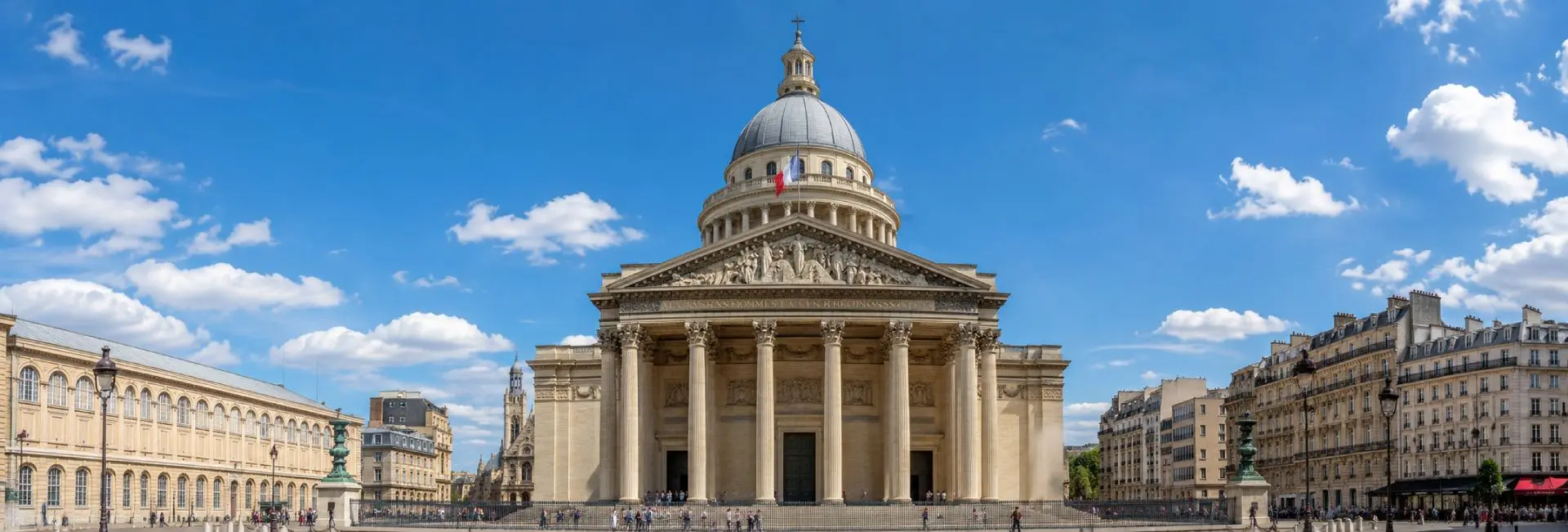
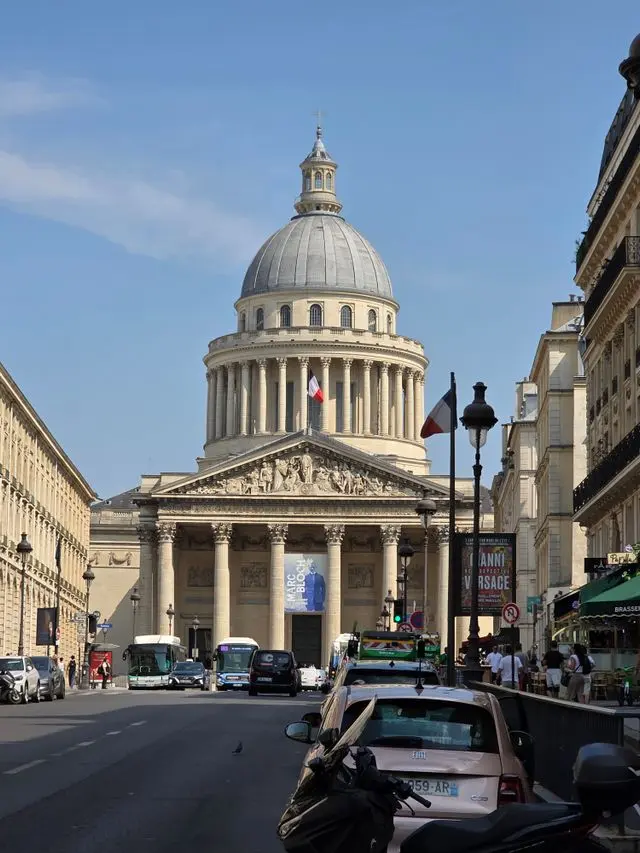
Standing atop the Sainte-Geneviève hill in the Latin Quarter, the Panthéon is one of Paris's most striking monuments - a domed, colonnaded building that began life as a church and ended up as the resting place of the nation's most celebrated figures. Inside its vast nave, visitors find the tombs of Voltaire, Rousseau, Victor Hugo, and Marie Curie, alongside a working Foucault pendulum that still demonstrates the rotation of the Earth.
Part mausoleum, part architectural showcase, the Panthéon rewards visitors on two levels: the solemn crypt below tells the story of modern France through the people buried there, while the soaring neoclassical hall above is a monument in its own right, with a dome that dominated the Paris skyline for nearly a century.
History
A Royal Vow Becomes a Church
The Panthéon's origins trace back to 1744, when King Louis XV fell gravely ill while traveling and vowed that, should he recover, he would build a magnificent church honoring Sainte Geneviève, the patron saint of Paris. He recovered, and in 1755 commissioned architect Jacques-Germain Soufflot to design a building worthy of the promise. Construction began in 1764 on the site of an older abbey church and continued long after Soufflot's death in 1780, with the building finally completed in 1790 under his successor, Jean-Baptiste Rondelet.
From Church to National Mausoleum
The timing proved dramatic: the church was finished just as the French Revolution was transforming the country. In 1791, following the death of the statesman Mirabeau, the revolutionary government repurposed the barely finished building as a secular temple to honor the nation's great citizens, renaming it the Panthéon. Voltaire and Jean-Jacques Rousseau were among the first to be interred there.
A Building With Six Identities
Over the following century, the Panthéon switched back and forth between a functioning Catholic church and a civic mausoleum no fewer than six times, reflecting the political upheavals of 19th-century France under Napoleon, the Restoration, and the various republics. The matter was finally settled in 1885, when the state funeral of Victor Hugo drew an enormous public outpouring and the National Assembly permanently fixed the building's role as a secular temple to the nation's great men and women.
Opening Up Its Honors
For most of its history, the Panthéon honored only men. That began to change in 1995, when scientist Marie Curie became the first woman interred on the strength of her own achievements. Since then the roster has continued to expand: Simone Veil joined in 2018, Josephine Baker became the first Black woman honored there in 2021, Resistance fighter Missak Manouchian - the first immigrant so honored - was inducted in 2024, and former Justice Minister Robert Badinter followed in 2025.
Architecture & Design
Neoclassical Ambition
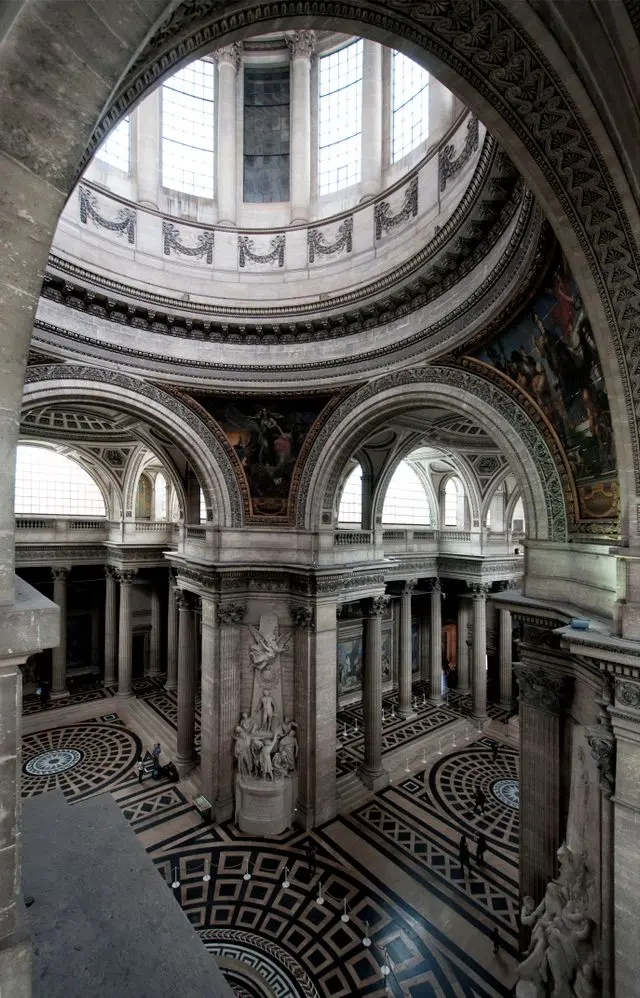
Soufflot designed the Panthéon to rival the great domed churches of Rome and London, blending the grandeur of classical Greek and Roman architecture with the structural lightness of Gothic design. The result is considered one of the earliest and finest examples of French neoclassicism, built around a Greek-cross floor plan with a monumental colonnaded portico modeled on ancient temples.
The Dome
The Panthéon's dome rises roughly 83 meters above the ground, and from its completion in 1790 until the Eiffel Tower was built in 1889, it was the tallest point in Paris. The dome is actually a triple structure, with three shells nested inside one another, an engineering solution that let Soufflot achieve height and drama without sacrificing structural stability.
Interior Details
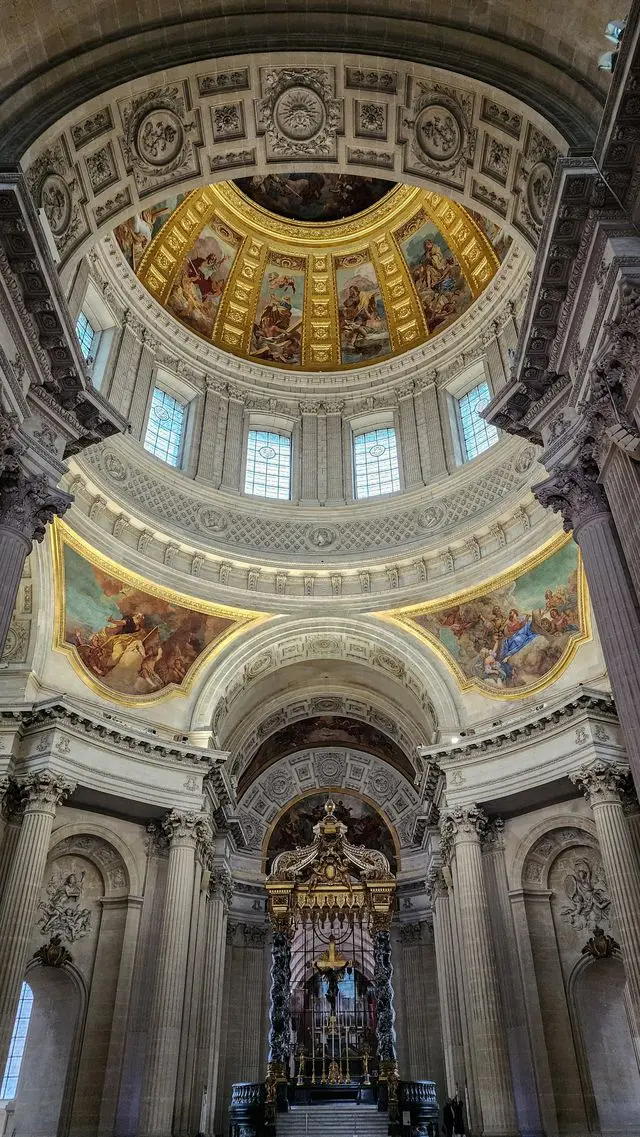
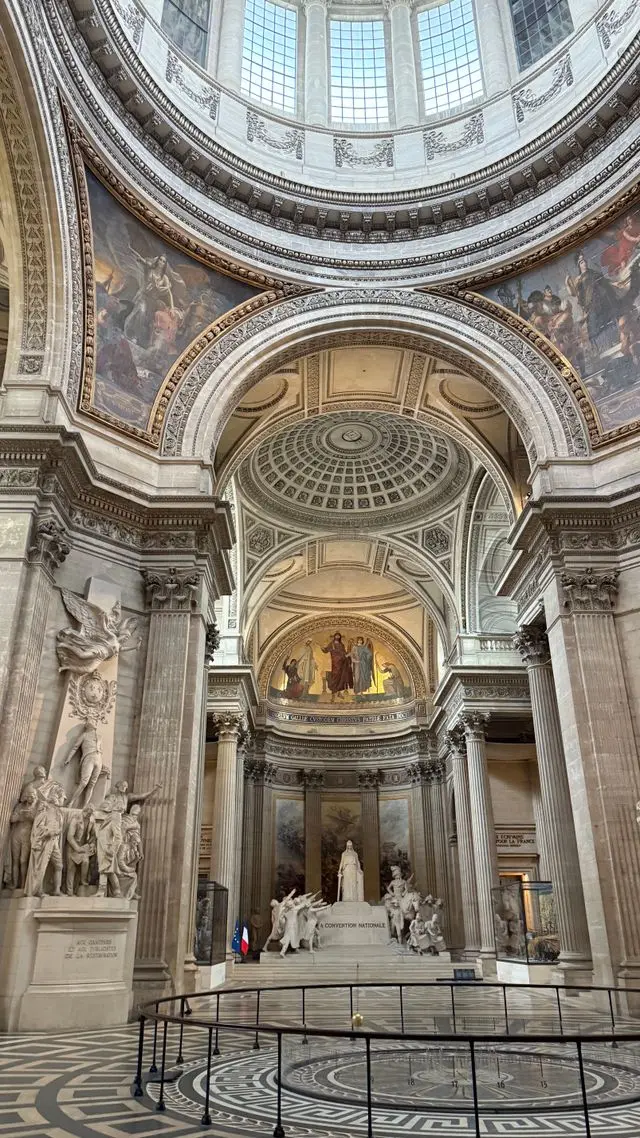
Inside, the nave is lined with paintings depicting the life of Sainte Geneviève and formative moments in French history, a reminder of the building's original religious purpose. The scale of the interior - vast, echoing, and largely unadorned by later standards - was deliberate, meant to inspire quiet awe rather than ornamental spectacle.
The Crypt: Who Is Buried Here
Beneath the main hall lies the crypt, a network of quiet corridors holding the remains of more than 80 individuals judged to have shaped the nation. Entry into the Panthéon, known in France as "panthéonisation," remains one of the country's highest posthumous honors, decided by the President.
- Voltaire and Jean-Jacques Rousseau, Enlightenment philosophers and among the first to be interred
- Victor Hugo and Émile Zola, literary giants of 19th-century France
- Marie Curie, the first woman honored on her own scientific merit, alongside her husband Pierre Curie
- Alexandre Dumas, author of The Three Musketeers
- Jean Moulin and Missak Manouchian, honored for their roles in the French Resistance
- Simone Veil and Josephine Baker, among the more recent additions recognizing figures beyond politics and science
Foucault's Pendulum
Suspended from the center of the dome, a Foucault pendulum has become one of the Panthéon's most memorable features. Physicist Léon Foucault installed the original experiment here in 1851 to give the public a direct, visible demonstration that the Earth rotates - something long known scientifically but never shown so plainly before. As the pendulum swings, its plane of motion appears to slowly rotate relative to the floor, when in fact it is the building, and the Earth beneath it, that is turning.
The pendulum on display today is a working replica: a gold-plated sphere hanging from a wire dozens of meters long, tracing its path above a marked dial on the floor of the nave. It remains a striking, almost hypnotic sight, and a rare case of a 19th-century physics experiment still running in its original setting.
The Dome & Rooftop Views
During the warmer months, visitors can climb into the upper levels of the dome and step out onto a rooftop colonnade for one of the best panoramic views in Paris, taking in the Eiffel Tower, Notre-Dame, and the rooftops of the Left Bank in a single sweep. The climb involves a long spiral staircase with no elevator, so it isn't accessible to everyone, but it rewards the effort with a vantage point far less crowded than the city's other famous viewpoints.
- Dome access is typically seasonal, running through the warmer months and closed in winter
- The climb involves several hundred steps and is not wheelchair accessible
- Rooftop access usually requires a separate ticket or supplement on top of standard admission
Best Time to Visit
The Panthéon is at its calmest right after opening, before tour groups and midday crowds arrive, and again in the later afternoon once groups have moved on. Weekday visits, especially Tuesday through Thursday, tend to be noticeably quieter than weekends.
- Arrive at opening for the emptiest galleries and best light in the nave
- Visit on a weekday if your schedule allows it
- Consider the off-season (autumn and winter) for smaller crowds, though dome access may be closed
- If you want the rooftop climb, plan your visit between spring and early autumn when it's typically open
Visitor Tips
- Budget around 1.5 to 2 hours for the nave and crypt, plus extra time if the dome is open
- The dome climb has no elevator, so wear comfortable shoes and be prepared for several hundred steps
- Free entry is generally available for visitors under 18 and for young EU residents, so bring valid photo ID
- The crypt is treated as a place of quiet reflection - keep voices low out of respect
- Combined tickets pairing the Panthéon with a Seine river cruise or other Left Bank sites are often available and can save time on a busy itinerary
- Check current hours, ticket prices, and dome availability on the official site before your visit, since these details can change seasonally
Nearby Attractions
The Panthéon sits at the heart of the Latin Quarter, within easy walking distance of several other major Paris landmarks, making it easy to combine with a broader day of sightseeing on the Left Bank.
- Luxembourg Gardens, a few minutes' walk away, perfect for a relaxed stroll afterward
- The Sorbonne, one of France's oldest and most famous universities
- Saint-Étienne-du-Mont church, known for its unusual rood screen and adjacent to the Panthéon itself
- The Musée de Cluny (Museum of the Middle Ages), a short walk toward the Seine
- Notre-Dame Cathedral and the Île de la Cité, roughly 15–20 minutes on foot
FAQs about Panthéon
What is the Panthéon and why is it famous? +
The Panthéon is a neoclassical monument in Paris that began as a church and became the national mausoleum of France, honoring figures like Voltaire, Victor Hugo, and Marie Curie, and famous for its dome and its working Foucault pendulum.
How much time should I set aside for a visit? +
Plan for about 1.5 to 2 hours to see the nave, crypt, and pendulum comfortably, and add extra time if you're also climbing to the rooftop dome.
Is the Panthéon free to visit? +
Standard admission carries a ticket price, though entry is typically free for visitors under 18 and for young EU residents with valid ID, and some monuments offer free entry on select dates - it's worth checking current conditions before you go.
Can I access the dome and rooftop year-round? +
Rooftop dome access is generally seasonal, open through the warmer months and closed in winter, and it involves a long staircase climb with no elevator, so it isn't suitable for everyone.
Is the Panthéon suitable for visitors with mobility needs? +
The main nave and crypt are generally accessible, but the dome climb is stairs-only and not wheelchair accessible, so visitors with mobility concerns should plan to skip that portion.
Who is buried in the Panthéon? +
More than 80 notable French figures are interred there, including Voltaire, Rousseau, Victor Hugo, Émile Zola, Marie and Pierre Curie, Alexandre Dumas, and more recent additions like Simone Veil, Josephine Baker, and Missak Manouchian.
What else can I combine with a Panthéon visit? +
Its Latin Quarter location makes it easy to pair with the Luxembourg Gardens, the Sorbonne, Saint-Étienne-du-Mont church, or a walk toward Notre-Dame and the Seine.
What's a common mistake visitors make? +
Many visitors underestimate the dome climb or arrive without checking seasonal hours, only to find rooftop access closed - checking ahead saves disappointment, especially if the view is a priority.