Table of Contents
Overview
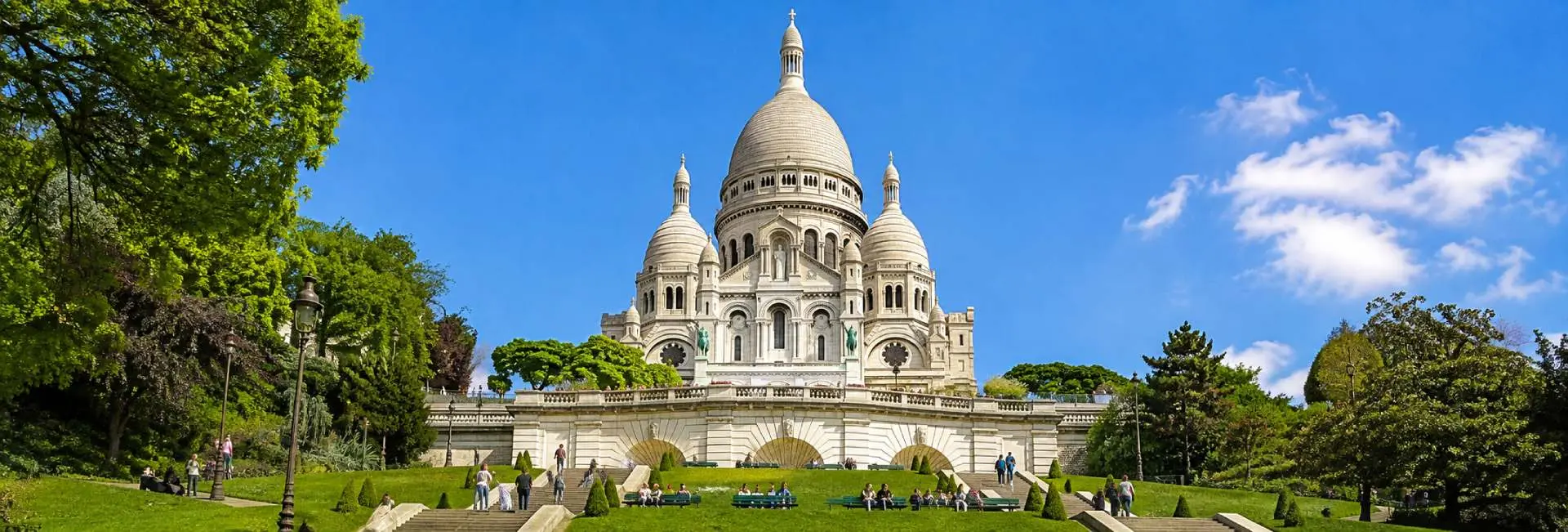
The Basilique du Sacré-Cœur crowns the summit of Montmartre, the highest natural point in Paris, its bright white domes visible across much of the city skyline. Built as a Roman Catholic church dedicated to the Sacred Heart of Jesus, it is both a working place of worship and one of the most photographed monuments in the capital.
Beyond its striking silhouette, the basilica is known for its panoramic terrace views, its Romano-Byzantine architecture unlike anything else in Paris, and its setting within Montmartre, a hillside neighborhood long associated with artists and bohemian life.
History
A Vow Born of Crisis
Sacré-Cœur's origins trace back to the aftermath of France's defeat in the 1870–71 Franco-Prussian War and the violent upheaval of the Paris Commune that followed. Catholic laymen Alexandre Legentil and Hubert Rohault de Fleury proposed building a church dedicated to the Sacred Heart as an act of national penance and moral renewal.
Choosing Montmartre
The French National Assembly declared the project a matter of public interest in 1873, and the Archbishop of Paris selected the hill of Montmartre as the site, a location already layered with religious legend tied to the martyrdom of Saint Denis.
Decades of Construction
Architect Paul Abadie won the design competition, and the cornerstone was laid in 1875. Construction stretched on for decades, funded largely by public donations, with the still-unfinished basilica inaugurated in 1891. It was formally consecrated in 1919, after the end of the First World War.
Architecture & Design
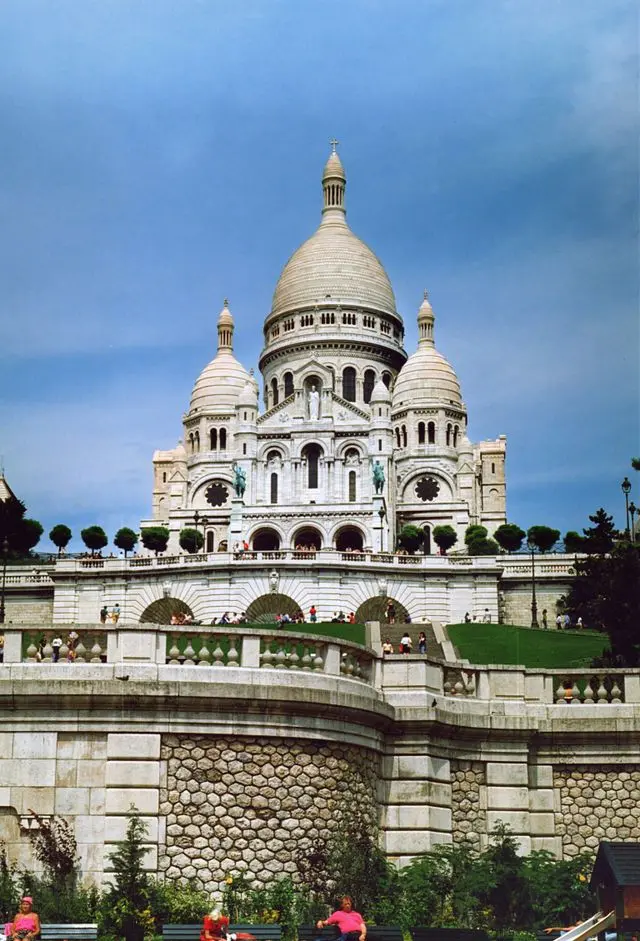
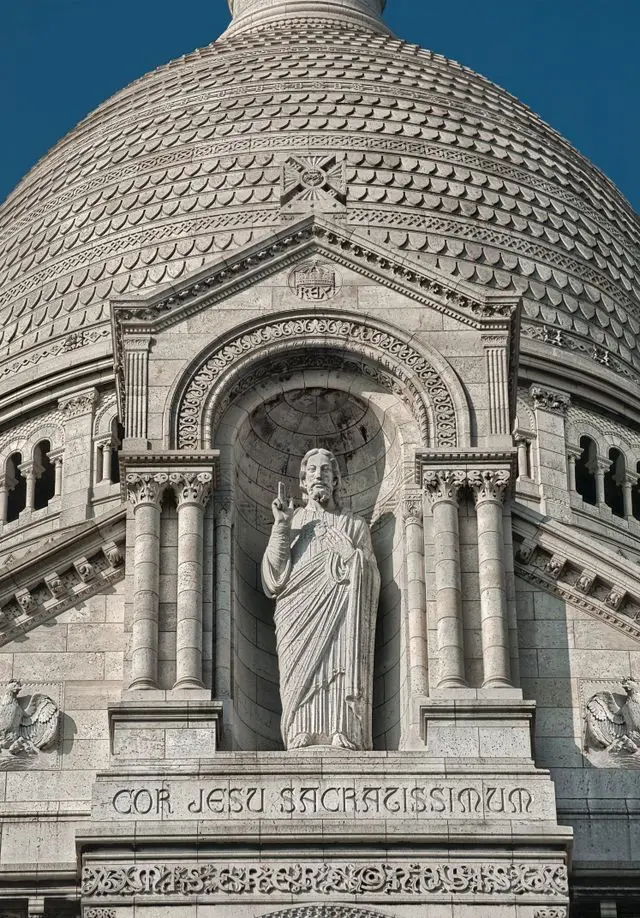
Paul Abadie designed Sacré-Cœur in a Romano-Byzantine style, a deliberate departure from the Gothic and Neoclassical traditions found elsewhere in Paris. Its rounded domes, arches, and pale silhouette set it apart from nearly every other landmark in the city.
The Travertine Stone
The basilica's facade is built from travertine stone quarried in Château-Landon, a material that whitens further over time as it reacts with rainwater, which is part of why the building appears so strikingly bright even after more than a century.
Domes and Bell Tower
The central dome rises roughly 83 meters above ground and is open to visitors willing to climb around 300 steps, rewarding them with a 360-degree view over Paris. A separate bell tower houses La Savoyarde, one of the heaviest bells in the world.
Inside the Basilica
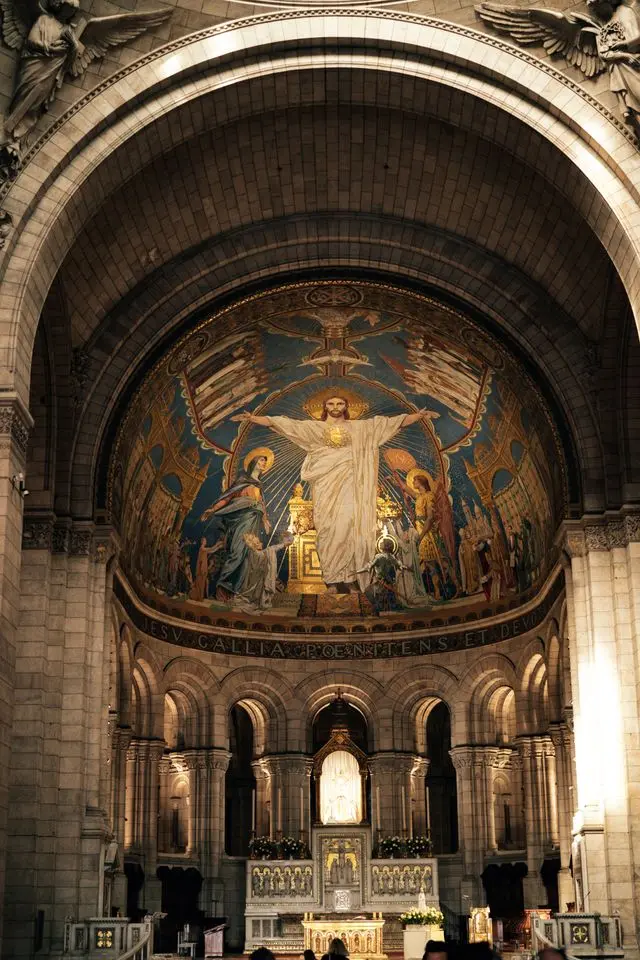
The interior is dominated by one of the largest mosaics in France, covering the apse above the choir and depicting Christ in Majesty with arms outstretched over the city. Light filtering through the domes gives the nave a distinct glow compared to the stained-glass interiors typical of Gothic churches.
- A monumental apse mosaic of Christ in Majesty, visible from much of the nave
- A historic pipe organ built by the renowned French organ maker Aristide Cavaillé-Coll
- The bell tower housing La Savoyarde, weighing around 19 tons
- A crypt beneath the main church, open to visitors
Cultural & Religious Significance
Sacré-Cœur has functioned as a site of perpetual adoration since its earliest years, meaning the Blessed Sacrament has been continuously on display and attended by worshippers day and night for over a century, a practice that continues today.
Its construction was politically charged from the start, championed by conservative Catholics as an act of national atonement and opposed by secularists who saw it as a rebuke of republican, revolutionary ideals. That tension has faded, and the basilica is now embraced as a defining symbol of the city, sitting at the heart of Montmartre, a neighborhood once home to artists such as Renoir, van Gogh, and Toulouse-Lautrec.
Ways to Experience It
- Walk up through Montmartre's winding streets and stairways to reach the basilica's forecourt
- Take the Funiculaire de Montmartre for a quick, direct ride up the hillside
- Climb the roughly 300 steps to the dome for panoramic rooftop views over Paris
- Attend a Mass or sit quietly before the Blessed Sacrament for those interested in the basilica's role as an active church
- Explore the surrounding Place du Tertre, long favored by portrait artists and street painters
Best Time to Visit
Early morning is the quietest time to visit, before tour groups arrive and while the light on the white stone facade is at its softest. Sunset is popular for the view from the forecourt, though it draws large crowds, especially in summer.
Weekdays tend to be calmer than weekends, and visiting outside peak summer months can mean shorter lines for the dome climb.
Visitor Tips
- Entry to the basilica itself is free, though there is a fee to climb the dome
- Modest dress is expected out of respect for the working church, covering shoulders and knees
- The dome climb involves nearly 300 narrow, winding steps and is not accessible for visitors with mobility issues
- Pickpocketing and street scams are common on the steps and forecourt, so keep an eye on belongings
- Photography is generally restricted inside the basilica out of respect for worshippers
Nearby Attractions
Montmartre's hilltop setting puts several other well-loved sights within a short walk of the basilica.
- Place du Tertre, the artists' square just steps from the basilica
- Montmartre Museum, tracing the neighborhood's artistic history
- Moulin Rouge and the Pigalle nightlife district, downhill from Montmartre
- Cimetière de Montmartre, the historic cemetery on the hill's northern slope
Common Questions about visiting Sacré-Cœur Basilica
Why was the Sacré-Cœur Basilica built? +
It was built as a national act of penance and moral renewal after France's defeat in the Franco-Prussian War and the upheaval of the Paris Commune in 1870–71, funded largely through public donations.
Is it free to visit Sacré-Cœur? +
Entry to the basilica is free, but there is a separate charge to climb the dome for the panoramic view over Paris.
How many steps are there to the dome? +
Visitors climb roughly 300 steps on a narrow spiral staircase to reach the top of the dome.
What architectural style is the basilica? +
It's built in a Romano-Byzantine style, marked by rounded domes and arches, which sets it apart from the Gothic and Neoclassical churches found elsewhere in Paris.
How do I get to Sacré-Cœur? +
Visitors can walk up through Montmartre's streets and staircases or take the Funiculaire de Montmartre, a short cable car that climbs the hillside to the basilica's forecourt.
Is Sacré-Cœur still an active church? +
Yes, it remains a functioning Roman Catholic church with regular Masses and a tradition of continuous prayer before the Blessed Sacrament that has continued since the basilica's early years.
What's the best time to visit for fewer crowds? +
Early morning on a weekday tends to be the quietest, while sunset draws the largest crowds, especially during summer months.
What's nearby worth combining with a visit? +
Place du Tertre, the Montmartre Museum, and the wider Montmartre neighborhood are all within walking distance, along with Pigalle and the Moulin Rouge further downhill.