Table of Contents
Overview
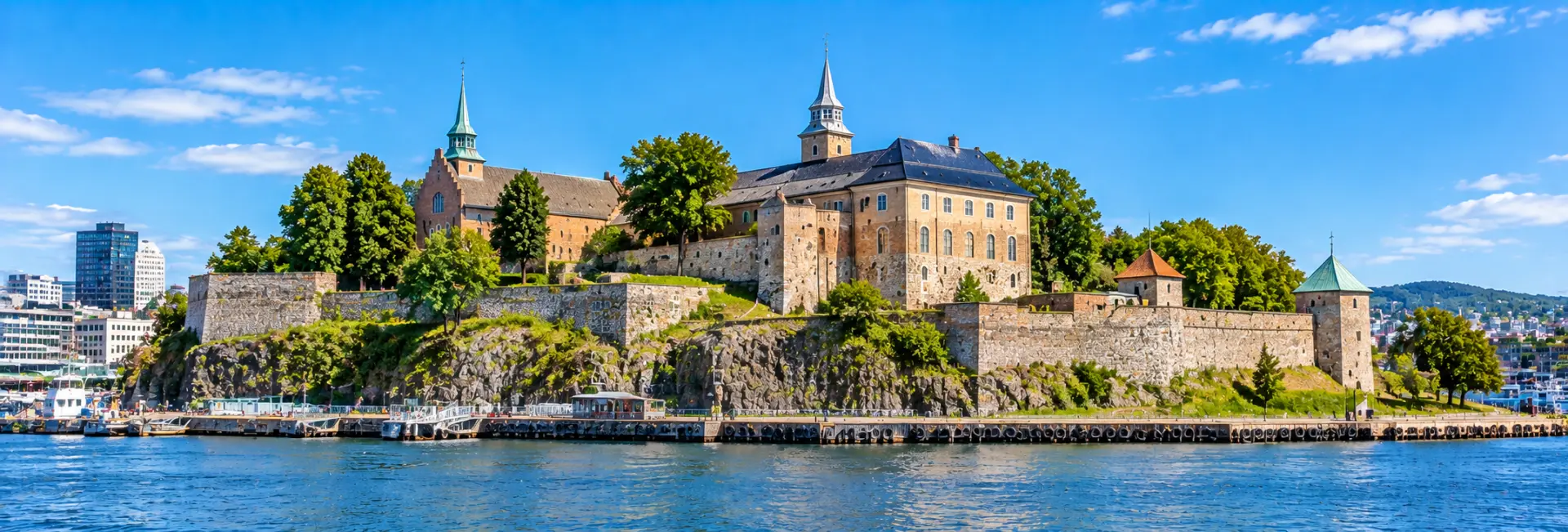
Akershus Fortress rises on a rocky headland above Oslo's harbor, its grey stone walls and green copper roofs forming one of the city's most recognizable silhouettes. Built at the end of the 13th century to defend the young capital, it has spent more than 700 years as a royal residence, a working military garrison, a prison, and a stage for some of the darkest and proudest moments in Norwegian history.
Today the fortress grounds are open to anyone who wants to wander the ramparts, admire the view across the Oslofjord, or step inside the castle and its museums to trace that history in detail. Unlike many medieval strongholds that have been reduced to ruins, Akershus is still very much in use: government ceremonies, state banquets, and military functions take place here alongside the daily flow of tourists and locals cutting through on their lunchtime walk.
History
Founding and medieval sieges
Construction on Akershus began around 1290 under King Håkon V Magnusson, who chose the site partly in response to an attack on Oslo a few years earlier by the Norwegian nobleman Alv Erlingsson. The new stone castle, finished in the early 1300s, replaced the older fortress at Tønsberg as one of the kingdom's two principal strongholds and helped cement Oslo's rise as Norway's political center.
Over the following two centuries Akershus withstood repeated sieges, including attacks during the Kalmar Union conflicts of the 15th century and a Swedish siege in 1502. It was never taken by force, a record that later became a point of national pride and helped fix the fortress in Norwegian memory as a symbol of resilience.
Renaissance transformation
In the early 17th century, King Christian IV of Denmark-Norway ordered a major rebuilding that turned the medieval fortress into a Renaissance palace, adding new wings, formal chambers, and the rounded corner towers still visible on the castle's exterior today. This is also the period when Oslo itself was rebuilt after a devastating fire and renamed Christiania in the king's honor, with the fortress standing at the heart of the redesigned city.
Decline and revival
As military technology advanced, Akershus gradually lost its strategic importance and fell into disrepair during the 18th and 19th centuries, at times serving as a prison rather than a residence. Growing interest in national heritage in the early 20th century led to a careful restoration, and the Norwegian government designated the site for national historical use, setting the stage for the mix of ceremonial, military, and public roles it still holds.
Architecture & Notable Rooms
Akershus Castle blends thick medieval stonework with the more refined Renaissance additions layered on top of it, so a walk through the interior moves between narrow, low-ceilinged passages and grander halls built for royal entertaining. The contrast is part of what makes the castle interesting to visit: few buildings this old have been continuously altered and repaired by so many different rulers.
State rooms and halls
The castle's upper floors hold the rooms added under Christian IV and later monarchs, including banquet and reception halls still used today for state occasions and official dinners hosted by the Norwegian royal family and government. Wood paneling, tapestries, and period furnishings give a sense of how the space has been used for formal ceremony across four centuries.
The Royal Mausoleum
Beneath the castle's south wing lies the Royal Mausoleum, a crypt built in the 20th century to hold the remains of Norway's modern royal family. It currently holds the remains of King Haakon VII and Queen Maud, along with King Olav V and Crown Princess Märtha, making it an active site of national commemoration rather than a purely historical curiosity.
Dungeons and older stonework
Lower levels of the castle preserve some of the oldest surviving stonework at Akershus, including dim storage vaults and former dungeon spaces that hint at the fortress's long use as a place of confinement. These sections offer the clearest physical link back to the original medieval structure, in contrast to the more polished rooms above.
Museums Within the Fortress
Beyond the castle itself, the fortress grounds host two museums that dig deeper into Norway's military and wartime history, both housed in older fortress buildings rather than purpose-built structures.
- The Norwegian Armed Forces Museum traces the country's military history from the Viking Age through modern peacekeeping operations, with displays of weapons, uniforms, and vehicles spread across several halls.
- Norway's Resistance Museum, established in 1966 and also known as the Norwegian Home Front Museum, documents the German occupation of 1940-1945 through photographs, documents, and recreated scenes of daily life under occupation.
- Both museums sit within walking distance of the castle entrance, making it possible to combine a castle visit with one or both museums in a single afternoon.
World War II & the Resistance
Akershus Fortress carries some of the heaviest history of any site in Oslo. When German forces occupied Norway in April 1940, the fortress was taken over and eventually used as a headquarters for German security forces in the city, a stark reversal for a site long associated with Norwegian sovereignty.
During the occupation, members of the Norwegian resistance movement were held, interrogated, and in a number of cases executed within the fortress grounds. A memorial near the old execution site now commemorates roughly forty Norwegian patriots who died there between 1940 and 1945. After the war, several individuals convicted of collaboration, including Vidkun Quisling, were themselves executed at Akershus, closing a grim chapter in the same location where it had unfolded.
The adjoining Resistance Museum gives this period its fullest treatment, placing the memorial and execution site in the context of the broader civilian and military resistance that operated across Norway during the war years.
Ways to Experience It
- Walk the fortress grounds independently, following the ramparts and cannon batteries for harbor views without needing a ticket for the outdoor areas.
- Join a guided tour of Akershus Castle interior, typically offered on a set schedule and covering the state rooms, dungeons, and Royal Mausoleum.
- Visit the Norwegian Armed Forces Museum and Norway's Resistance Museum separately or as part of a combined ticket sold at the fortress visitor center.
- Attend the ceremonial changing of the guard, which takes place on the fortress grounds and draws a small crowd of onlookers.
- Combine a visit with the Oslo Pass, which can include entry to several fortress attractions along with public transport across the city.
Best Time to Visit
The fortress grounds are open year-round, but the castle interior and museums generally keep shorter hours outside the summer season, so a visit between May and August offers the widest access to indoor exhibits alongside the longest daylight for exploring the ramparts. Early mornings and weekday visits tend to be quieter, before tour groups arrive from the nearby cruise terminal and Oslo City Hall area.
Because the grounds sit right on the water, late afternoon and early evening bring some of the best light for photographs, particularly looking back toward the fortress from Aker Brygge or out across the Oslofjord toward the islands. Winter visits are quieter still and can be atmospheric, though shorter opening hours for the castle and museums make it worth checking ahead.
Visitor Tips
- The fortress grounds themselves are free to enter; only the castle interior and the two museums require a ticket.
- Cobblestone paths and stone stairs throughout the site mean flat, sturdy footwear is more comfortable than sandals or heels.
- Akershus is a ten-minute walk from Oslo Central Station along the harbor promenade, making it an easy stop without needing a car or taxi.
- Because the fortress remains an active military and ceremonial site, some areas may close temporarily for state events, so it is worth checking current access before a visit.
- Confirm opening hours and ticket prices for the castle and museums directly with the fortress or museum before visiting, since these change by season and can differ from what is listed elsewhere online.
Nearby Attractions
- Oslo City Hall, a short walk away, is known for its murals and as the venue for the Nobel Peace Prize ceremony.
- Aker Brygge, a former shipyard turned waterfront district, sits just across the harbor with restaurants, shops, and views back toward the fortress.
- The Nobel Peace Center, covering the history of the Nobel Peace Prize, is a few minutes' walk along the harborfront.
- Oslo Opera House, with its sloped roof that visitors can walk up, is a short distance further along the waterfront.
FAQs about visiting Akershus Fortress
Is Akershus Fortress free to visit? +
The outdoor fortress grounds, including the ramparts and courtyards, are free to enter. A ticket is only required for the castle interior and the two museums on site.
How much time should I spend at Akershus Fortress? +
A walk around the grounds alone takes about 30 to 45 minutes, while adding the castle interior or a museum stretches a visit to roughly two to three hours.
What is inside Akershus Castle? +
The castle holds state rooms still used for official functions, the Royal Mausoleum where several modern Norwegian monarchs are buried, and older dungeon and storage areas from the medieval fortress.
Is Akershus Fortress suitable for children? +
The outdoor grounds are easy for families to explore, and the Armed Forces Museum's military vehicles and equipment tend to interest younger visitors, though some Resistance Museum content is more appropriate for older children.
How do I get to Akershus Fortress? +
The fortress sits about a ten-minute walk from Oslo Central Station along the harbor, and is also reachable on foot from Aker Brygge and the City Hall area.
Why is Akershus Fortress important to Norwegian history? +
It has served as a royal residence, a military stronghold that was never taken by force, and a site of both occupation and resistance during World War II, making it a touchstone for Norwegian national identity.
Can I see the changing of the guard at Akershus Fortress? +
Yes, a ceremonial changing of the guard takes place on the fortress grounds and is open for visitors to watch, though exact timing can vary and is worth confirming on arrival.