Table of Contents
Overview
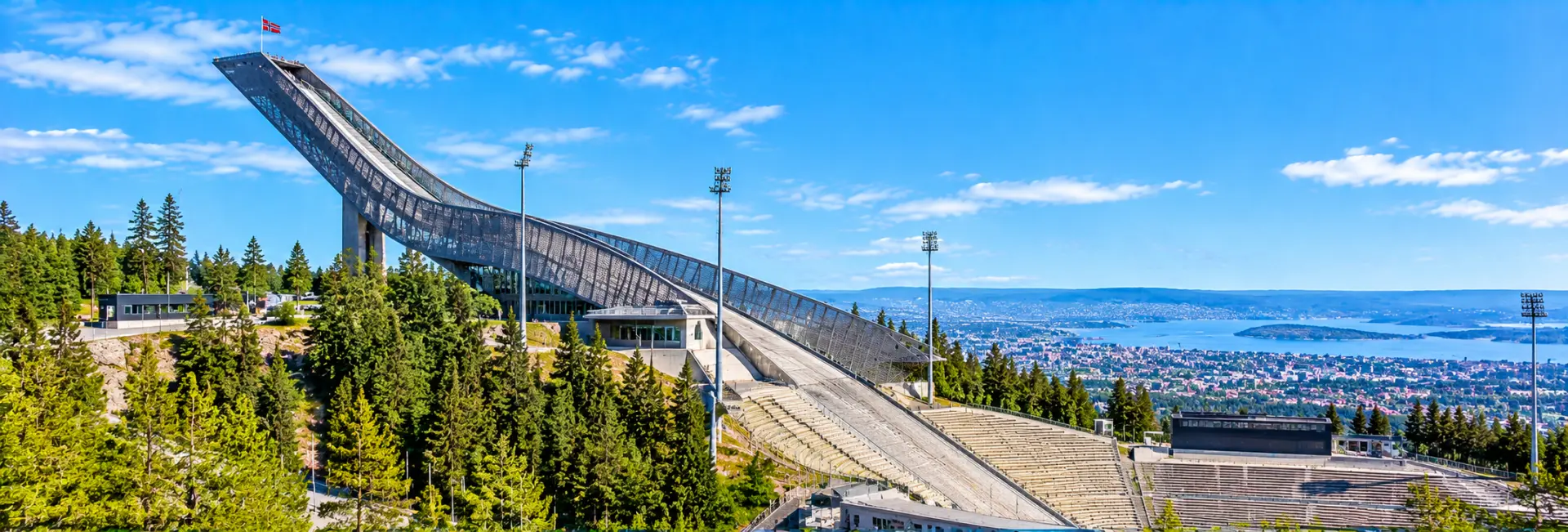
Holmenkollen Ski Jump rises above the forested hills on Oslo's northwestern edge, its sweeping steel form visible from much of the city below. It is one of the most recognizable sports facilities in the world, ranked alongside venues like Wimbledon's All England Club for its instant visual identity, and it remains an active competition hill rather than a retired landmark.
Beyond its role hosting elite ski jumping, the site draws visitors year-round for the observation platform at the top of the tower, the world's oldest ski museum built into its base, and activities like a zipline that runs down the length of the jump. A visit here combines sport, architecture, and one of the best panoramic views of Oslo and the surrounding fjord.
History
The birth of a sport
Ski jumping competitions have taken place at Holmenkollen since 1892, when the first event drew around 12,000 spectators to a natural hill fitted with a simple ramp of packed snow and branches. The scale of that early crowd signaled how quickly the sport captured public imagination in Norway, and Holmenkollen quickly became its most celebrated stage.
Growing with the sport
Over the following century the hill was rebuilt and expanded repeatedly, more than a dozen times, as jumping distances grew and safety standards changed. It hosted the ski jumping and Nordic combined events of the 1952 Winter Olympics and multiple Nordic World Ski Championships, cementing its status as a permanent fixture on the international skiing calendar.
A complete rebuild for 2011
By the mid-2000s the hill no longer met international competition standards, and in 2005 the International Ski Federation ruled it unsuitable for hosting the 2011 World Championships without major changes. Norway's heritage authorities approved demolishing the old tower, and Oslo ran an international design competition that Copenhagen-based JDS Architects won in 2008. The old structure came down and a new tower was built in its place in time for the 2011 championships, replacing more than a century of earlier structures with a single, dramatically different design.
Architecture & Design
The current tower, designed by Julien De Smedt of JDS Architects, rises about 58 metres into the air and cantilevers a further 69 metres over the start of the in-run, an engineering feat developed with the Norwegian firm Norconsult. Clad in steel mesh and glass, its curved, elongated form reads as a single continuous gesture rather than the boxier concrete towers that preceded it.
The design folds the judges' booth, spectator seating, and an inclined elevator into one unified structure, a departure from earlier versions of the hill where these elements were more visibly separate. The rebuild won multiple architecture and engineering awards after its completion, including nominations for major European design prizes, and is frequently cited as one of the more striking examples of sports architecture built in the past two decades.
The Ski Museum & Viewing Platform
At the base of the tower sits the Holmenkollen Ski Museum, founded in 1923 and recognized as the world's oldest museum dedicated to skiing. Its collection traces roughly 4,000 years of ski history, from ancient skis and polar expedition equipment to the modern competitive sport, drawing on a founding collection assembled by the architect Hjalmar Welhaven.
Climbing the tower
From the museum, visitors can ride an elevator and climb a final run of stairs to reach the observation platform near the top of the jump. The platform offers a sweeping panorama over Oslo, the Oslofjord, and the forested hills of Oslomarka, and is lit at night, giving the tower a visible glow across the city after dark.
Ways to Experience It
- Visit the Ski Museum for its collection spanning thousands of years of skiing and polar exploration history.
- Ride the elevator and climb to the viewing platform for panoramic views over Oslo and the fjord.
- Try the ski jump simulator, which recreates the sensation of an actual jump without leaving the ground.
- Take the zipline down the outside of the jump tower for a fast, high-altitude descent along the slope.
- Attend the annual Holmenkollen Ski Festival in winter, when the hill hosts World Cup ski jumping, cross-country skiing, and biathlon events.
Best Time to Visit
Winter, particularly during the Holmenkollen Ski Festival, is when the hill is at its most dramatic, with snow covering the in-run and top international athletes competing in front of large crowds. Tickets and transport are busier during festival weeks, so visitors specifically chasing a competition atmosphere should plan and book well ahead.
Outside the competition season, late spring through early autumn offers easier access, longer daylight for enjoying the viewing platform, and a quieter overall experience, though without snow the hill itself is a less dramatic sight. Some visitors note that without an interest in skiing or architecture, the site's appeal outside festival season rests mainly on the view and museum rather than the structure itself.
Visitor Tips
- The museum and tower are reached by a steep, roughly ten-minute uphill walk from Holmenkollen metro station, so comfortable shoes are worth wearing.
- The observation platform involves climbing around 250 steps after the elevator, which is worth factoring in for visitors with mobility concerns.
- The zipline experience is a separate paid activity from museum and tower admission and is not always open, so it is worth checking availability in advance.
- Free parking is available on site for visitors arriving by car, an alternative to the metro for those coming from outside central Oslo.
- During the Ski Festival, expect larger crowds and be prepared for possible changes to normal visitor access around the competition area.
Nearby Attractions
- Frognerseteren, a historic lodge and popular hiking starting point, sits at the end of the same metro line a short ride further from Holmenkollen.
- Vigeland Park, known for its sculpture collection, is a short trip back toward central Oslo.
- The Royal Palace and central Oslo attractions are reachable by the same metro line running from Holmenkollen into downtown.
- Oslomarka, the extensive forest surrounding the city, offers hiking and cross-country ski trails accessible directly from the Holmenkollen area.
FAQs about visiting Holmenkollen Ski Jump
Can you go inside Holmenkollen Ski Jump? +
Yes, visitors can enter the Ski Museum at the base of the tower and take an elevator and stairs up to an observation platform near the top for panoramic views.
How do I get to Holmenkollen Ski Jump from central Oslo? +
Take metro line 1 to Holmenkollen station, then walk about ten minutes uphill, or drive and use the free on-site parking.
Is Holmenkollen Ski Jump still used for competitions? +
Yes, it remains an active World Cup ski jumping venue and hosts the annual Holmenkollen Ski Festival along with other Nordic skiing and biathlon events.
How old is the Holmenkollen Ski Museum? +
It was founded in 1923, making it the oldest ski museum in the world, with a collection spanning roughly 4,000 years of ski history.
Is the zipline at Holmenkollen worth doing? +
The zipline offers a fast descent along the outside of the jump tower and is popular with visitors seeking an adrenaline activity, though it is a separate paid extra and its availability can vary, so it is worth checking ahead.
When is the best time to see ski jumping at Holmenkollen? +
The Holmenkollen Ski Festival, held in winter, is when the hill hosts World Cup ski jumping and other Nordic events in front of large crowds.
Is Holmenkollen Ski Jump worth visiting without snow? +
Outside the winter competition season the hill itself is less dramatic, but the museum and the view from the observation platform remain worthwhile for most visitors.