Table of Contents
Overview
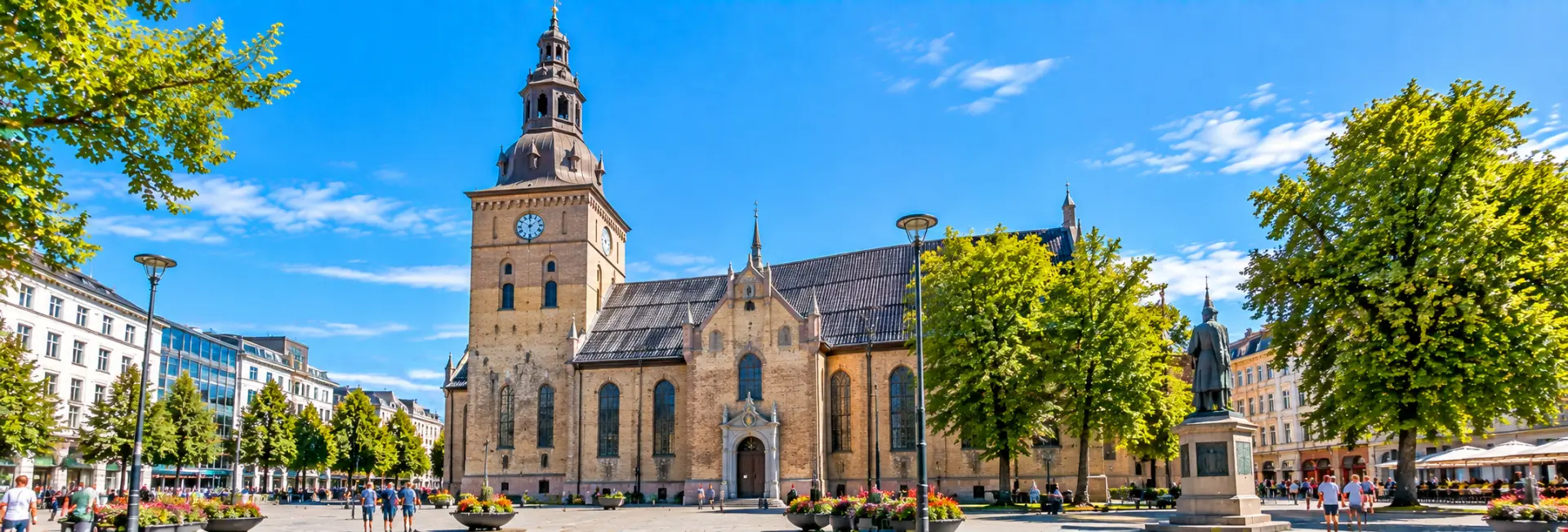
Oslo Cathedral stands on Stortorvet square in the heart of the city, its red brick tower and green copper roof visible above the surrounding rooftops of central Oslo. Consecrated in 1697 as Our Saviour's Church, it has served as the main church of the Diocese of Oslo and the city's parish church for well over three centuries, while remaining an active, everyday place of worship rather than a purely historical monument.
Beyond its religious role, the cathedral is closely tied to Norway's national and royal life, hosting state funerals, royal weddings, and the church service that opens each new session of the Norwegian parliament. Visitors are welcome to step inside free of charge to see its painted ceiling, stained glass, and Baroque woodwork, set within a building that still functions as a working church.
History
Building on Stortorvet
The present cathedral was built between 1694 and 1697, replacing an earlier medieval church that had served Oslo before fires and the city's 17th-century relocation under King Christian IV reshaped the urban center. The new church, originally named Our Saviour's Church, was positioned on Stortorvet, then a new market square at the edge of the rebuilt city.
A major 19th-century restoration
In the mid-19th century the building underwent a substantial restoration and remodeling project. Architect Alexis de Chateauneuf drew up the plans, with Heinrich Ernst Schirmer serving as construction manager; when Chateauneuf fell ill in 1850, Wilhelm von Hanno was brought in to complete the work. This project gave the cathedral much of the character it retains today, including significant changes to its interior decoration.
Twentieth-century additions and modern renovation
Major artistic additions came in the 20th century, including a painted ceiling completed over several decades by Hugo Lous Mohr and stained glass work by artist Emanuel Vigeland. The cathedral later closed for a thorough renovation beginning in August 2006 and reopened with a festive high mass on 18 April 2010, ensuring the building's structure and decoration were preserved for continued use.
Architecture & Design
Oslo Cathedral is built in a Baroque style with Scandinavian characteristics, its exterior defined by red brick walls and a distinctive tower topped with a green copper spire that remains visible from much of central Oslo. The main entrance features detailed stone carving, a legacy of the careful restoration work carried out in the 19th and 20th centuries.
At the base of the cathedral runs the Bazaar, a curved arcade of shops built in the mid-19th century and roofed in matching green copper, wrapping around the lower part of the church and linking its architecture visually to the surrounding square.
Cultural & Religious Significance
As the main church of the Church of Norway's Diocese of Oslo, the cathedral holds a central place in the country's religious life, while its downtown location has also made it the natural venue for national ceremonies. The Norwegian royal family and government regularly use the cathedral for public events, from royal weddings to state funerals and memorial services following national tragedies.
Each autumn, the cathedral hosts the church service marking the formal opening of the Norwegian parliament, a tradition that underscores its role as a shared civic and religious space rather than a purely denominational one. On an average day, between one and two thousand people pass through the cathedral, reflecting both its function as an active parish church and its popularity as a stop for visitors exploring central Oslo.
Notable Features
- The painted ceiling, completed over several decades by artist Hugo Lous Mohr, covers much of the cathedral's interior with biblical and symbolic imagery.
- Stained glass windows by Emanuel Vigeland add color and light to the interior, complementing the painted ceiling above.
- The Baroque pulpit and altar furnishings reflect the character established during the 19th-century restoration of the building.
- A historic pipe organ serves the cathedral's regular services and the concerts held there throughout the year.
Visiting Etiquette & Tips
- Entry to the cathedral is free, though donations are welcomed to support the building's upkeep.
- As an active church, the cathedral may close to visitors during services, weddings, funerals, or concerts, so checking opening hours in advance helps avoid disappointment.
- Visitors should keep voices low and avoid walking through the nave during an ongoing service or rehearsal.
- Photography is generally permitted for personal use, but visitors should avoid using flash or disrupting worshippers and other visitors.
- Modest, respectful dress is appropriate, as in most active places of worship.
Best Time to Visit
The cathedral is open to visitors most days, with hours that can vary around services, concerts, and special events, so an early check of the current schedule is worthwhile before planning a visit. Weekday mornings and early afternoons tend to offer a quieter, more contemplative visit than weekends, when concerts and services are more likely to be underway.
Because the interior is the main draw, a visit works equally well in any season, making the cathedral a practical stop on a rainy day or during Oslo's colder months when outdoor sightseeing is less appealing.
Nearby Attractions
- Stortorvet square, where the cathedral stands, is also home to a historic marketplace tradition and the statue of King Christian IV.
- Karl Johans gate, Oslo's main pedestrian street, runs a short distance from the cathedral toward the Royal Palace.
- The Norwegian Parliament building sits along the same stretch of Karl Johans gate, within easy walking distance.
- Oslo's harbor and Akershus Fortress are reachable on foot within about fifteen minutes from the cathedral.
FAQs about visiting Oslo Cathedral
Is Oslo Cathedral free to visit? +
Yes, entry is free, though donations toward the building's upkeep are welcomed.
How old is Oslo Cathedral? +
The current building was constructed between 1694 and 1697, though it has undergone significant restoration and decoration since, most notably in the 19th century and again in the 20th century.
Is Oslo Cathedral still an active church? +
Yes, it functions as the main church of the Diocese of Oslo and the parish church for downtown Oslo, holding regular services alongside its role as a visitor attraction.
What is the painted ceiling in Oslo Cathedral? +
It is a large-scale decorative ceiling completed over several decades by artist Hugo Lous Mohr, covering much of the cathedral's interior with biblical and symbolic imagery.
Does the Norwegian royal family use Oslo Cathedral? +
Yes, the cathedral regularly hosts royal weddings, state funerals, and other national ceremonies, alongside the annual service marking the opening of the Norwegian parliament.
Can I attend a concert at Oslo Cathedral? +
Yes, the cathedral regularly hosts concerts, including its historic pipe organ, and tickets or schedules are typically available through the church's own listings.
Why was Oslo Cathedral closed in 2006? +
It closed for a major renovation beginning in August 2006 to preserve the building's structure and decoration, reopening with a festive high mass on 18 April 2010.