Table of Contents
Overview
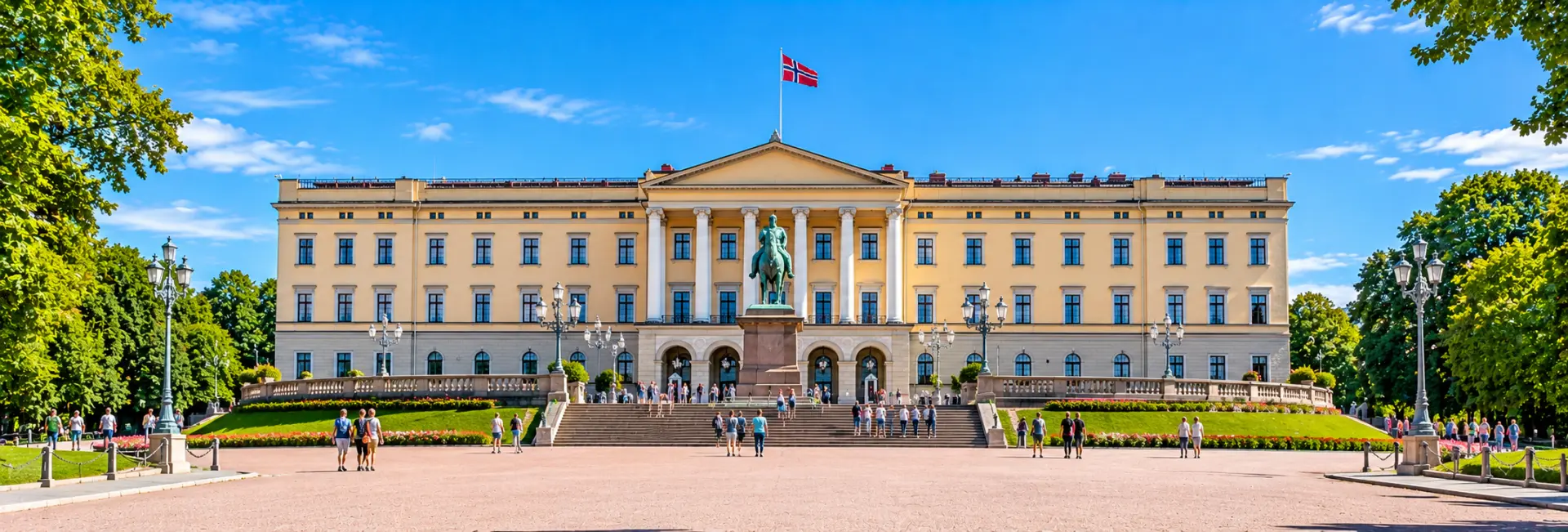
The Royal Palace sits on a low hill at the top of Karl Johans gate, Oslo's main ceremonial street, looking out over the city it was built to preside over. Pale yellow and unmistakably neoclassical, it has been the official residence of the Norwegian monarch since the country regained full independence in 1905, and it remains a working royal home and office rather than a preserved museum piece.
Visitors can approach the palace freely at any time of year, watch the daily Changing of the Guard on the square out front, and wander the surrounding public park. Getting inside the State Rooms themselves is a shorter-lived pleasure, available only during a guided-tour season each summer, which is part of what makes the interior visit feel special rather than routine.
History
Built for a union monarch
Construction began in 1825 under King Charles XIV John, the French-born marshal who became king of the united Sweden and Norway. The building was designed by the Danish-born architect Hans Linstow, and the twenty-five-year construction period meant that different wings absorbed different fashions in interior style as the decades passed.
A palace without a permanent resident
The palace was formally completed in 1849, but for most of the 19th century the Swedish-based union kings only stayed there occasionally, during visits to Christiania. Basic comforts such as reliable sanitation and electric lighting were not added until late in the century, reflecting its use as an occasional royal stopover rather than a full-time household.
Home to an independent monarchy
Everything changed after Norway dissolved its union with Sweden in 1905 and elected the Danish prince Carl as its own king, who took the name Haakon VII. He and Queen Maud became the first monarchs to live at the palace permanently, and it was refurbished over roughly two years to suit a resident royal family rather than an occasional visitor. It has remained the working residence of the Norwegian monarchy ever since, through the reigns of Haakon VII, Olav V, and the current king, Harald V.
Architecture & the State Rooms
The palace holds 173 rooms behind its plain, restrained neoclassical facade, and the interior contrast is part of the appeal: rooms decorated over a twenty-five-year build reflect a shifting mix of styles rather than one unified design scheme. Guided summer tours move through a sequence of formal spaces used for state functions and ceremonies.
The Bird Room
One of the palace's best-known interiors, the Bird Room takes its name from painted Norwegian landscapes on its walls, an idea the original architect proposed specifically to give waiting visitors something pleasant to look at. It traditionally serves as the antechamber where people wait before being received in audience by the monarch.
The Great Hall and Banquet Hall
The largest room in the palace is used for state dinners and formal receptions, seating up to around 200 guests beneath a painted ceiling and portraits of Norway's monarchs since Haakon VII. It is the room most associated with the ceremonial side of the modern monarchy, from state visits to official banquets.
The Throne Room
Decorated in white and gold, the Throne Room is used for investitures and formal receptions and centers on a throne set beneath a canopy bearing the Norwegian lion. Despite the name, visitors often note that the room feels more intimate than grand, in keeping with the generally understated tone of the Norwegian monarchy.
Palace Park
Slottsparken, the public park surrounding the palace, covers roughly 22 hectares of lawns, mature trees, and walking paths and is open to the public free of charge throughout the year. It was laid out together with the palace and the square in front of it, forming a single designed landscape rather than an afterthought.
- A pond within the park, once used to cut ice for the palace cellars, is now a quiet spot known for its water lilies in summer.
- Queen's Park, a smaller private garden within the grounds, opens to visitors for part of the year when the royal family is not in residence there.
- The Queen Sonja Art Stable, housed in the restored former royal stables behind the palace, hosts rotating exhibitions of Norwegian art, photography, and design.
- Statues throughout the park, including the equestrian statue of King Karl Johan in the square, mark different chapters of the palace's history.
Ways to Experience It
- Watch the Changing of the Guard, held daily on the palace square and performed by His Majesty The King's Guard with a fuller ceremonial display in the warmer months.
- Join a guided tour of the State Rooms during the summer tour season, when tickets are sold for a roughly hour-long walk through the Bird Room, Great Hall, and Throne Room, among other spaces.
- Walk the length of Karl Johans gate toward the palace, a route that takes in much of central Oslo's civic architecture before arriving at the square.
- Spend time in Palace Park and visit the Queen Sonja Art Stable, both accessible without a palace ticket.
Best Time to Visit
The interior tour season runs for a short window in summer, typically from late June to mid-August, and this is the only period when the State Rooms are open to the public. Tickets for this window tend to sell out, so booking ahead through the official channel is worth doing as soon as dates are announced each year.
Outside that window, the palace is still worth visiting for the exterior, the Changing of the Guard, and Palace Park, which are available year-round. Spring and autumn bring quieter crowds and pleasant conditions for walking the park, while winter gives the square and gardens a quieter, snow-covered character, with a simpler guard ceremony than the summer version.
Visitor Tips
- The palace exterior, the Changing of the Guard, and Palace Park are free; only the summer interior tour requires a ticket.
- For the Changing of the Guard, arrive at the square roughly ten to fifteen minutes before it begins, since the viewing area in front fills up quickly.
- Interior tour tickets are sold through the official booking channel for the current season and are not included in general city tourist passes, so book directly rather than assuming a discount card covers entry.
- Security screening applies for interior tours, and large bags are generally not permitted inside, so plan to travel light on tour day.
- Because it remains a working residence, parts of the grounds can close temporarily for state events, so it is worth checking current access before visiting.
Nearby Attractions
- Karl Johans gate, Oslo's main pedestrian avenue, runs directly from the palace square toward the central station, lined with shops, cafes, and civic buildings.
- The National Theatre, a short walk from the palace, is one of Norway's principal venues for Norwegian and international drama.
- Oslo City Hall and the harbor area, including Aker Brygge, are within easy walking distance downhill from the palace.
- The National Museum, Norway's largest art museum, sits a short walk south of the palace grounds.
FAQs about visiting the Royal Palace, Oslo
Can you go inside the Royal Palace in Oslo? +
Yes, but only during a guided-tour season in summer, typically late June to mid-August, when tickets are sold for tours of the State Rooms. The rest of the year, visitors can see the exterior and grounds but not the interior.
What time is the Changing of the Guard at the Royal Palace? +
The main Changing of the Guard ceremony takes place daily at 1:30 pm on the palace square and is free to watch, with a fuller display including music during the summer months.
Is the Royal Palace still used by the royal family? +
Yes. It is the official residence and workplace of King Harald V and Queen Sonja, and most of the Royal Court staff carry out their daily work there, though the Crown Prince's family lives elsewhere in the Oslo area.
How much does a Royal Palace tour cost? +
Guided interior tours are priced separately from general city passes, with adult tickets typically in the range of a modest fixed fee and discounted rates for children; current prices are set each season by the Royal House.
Is Palace Park free to visit? +
Yes, Slottsparken is a public park open year-round at no charge, separate from the ticketed summer tour of the palace interior.
How do I get to the Royal Palace in Oslo? +
The palace sits at the top of Karl Johans gate, an easy walk from Oslo Central Station, the National Theatre, and the harbor area around Aker Brygge.
What is the Bird Room in the Royal Palace? +
The Bird Room is a well-known reception room decorated with painted Norwegian landscapes, traditionally used as the waiting room for people granted an audience with the monarch.