Table of Contents
Overview
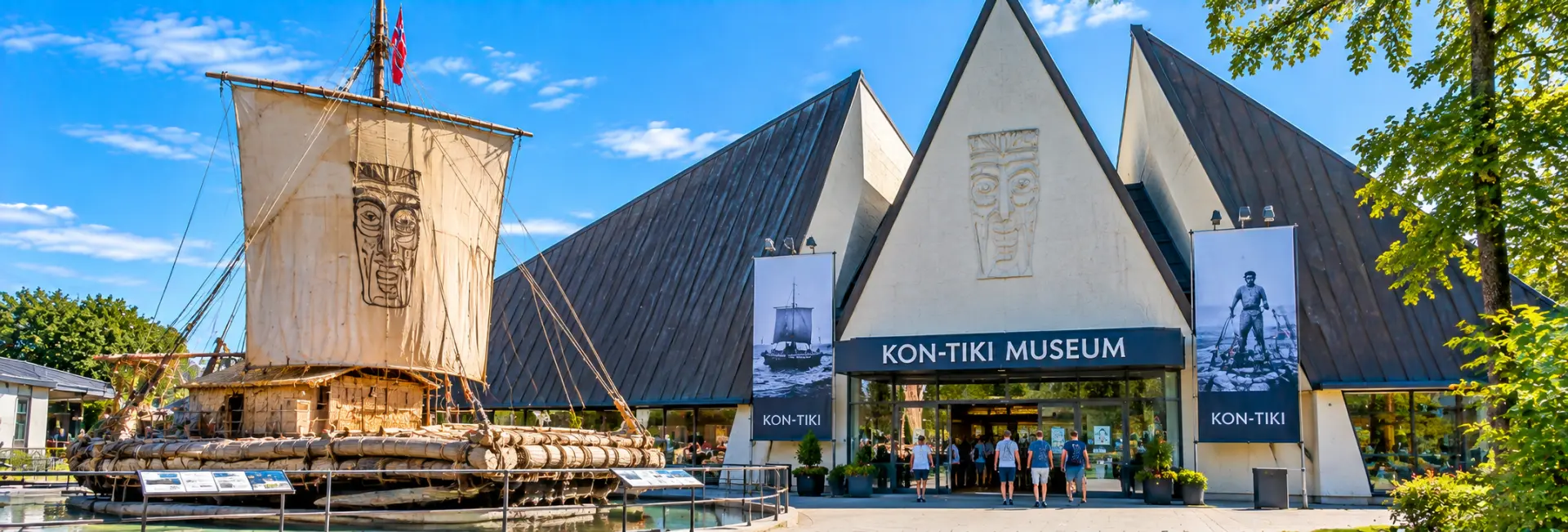
The Kon-Tiki Museum on the Bygdøy peninsula tells the story of Norwegian explorer Thor Heyerdahl through the original vessels he sailed across three oceans. Its centerpiece is the actual balsa wood raft Kon-Tiki, on which Heyerdahl and his crew crossed the Pacific in 1947, a voyage that became one of the twentieth century's best-known adventure stories and a bestselling book and film.
Beyond the raft itself, the museum covers Heyerdahl's later expeditions on reed boats built using ancient techniques, along with an exhibition on Easter Island reflecting his long-running interest in the connections between early cultures across the world's oceans. It remains one of the most visited museums on Bygdøy and a particular favorite with families and children.
History
The Kon-Tiki expedition
In 1947, Thor Heyerdahl set out to test his theory that early South American peoples could have settled Polynesia by sailing west across the Pacific on primitive rafts. He and a crew of five built the Kon-Tiki, a raft of balsa logs lashed together using only materials and techniques available to pre-Columbian sailors, and sailed roughly 8,000 kilometers from Peru to the Tuamotu Islands over 101 days at sea.
From bestseller to museum
Heyerdahl's account of the voyage became an international bestseller, and the expedition's documentary film won an Academy Award in 1951, bringing Heyerdahl worldwide fame. A museum dedicated to the raft opened in a provisional building on Bygdøy in 1949, and the purpose-built structure that still forms the core of today's museum, designed by architects F. S. Platou and Otto Torgersen, opened in 1957.
Later expeditions and a growing museum
Heyerdahl went on to build and sail reed boats modeled on ancient Egyptian and Mesopotamian designs, including Ra II across the Atlantic in 1970 and Tigris through the Persian Gulf and Red Sea in the late 1970s, expeditions intended to test whether early civilizations could have made ocean contact using similarly simple vessels. The museum was expanded in 1978 with an extension designed by Torgersen to accommodate this growing collection, and later added an exhibition on Easter Island reflecting Heyerdahl's related research there.
Architecture & Building
The museum's core building, completed in 1957, was designed specifically to display the Kon-Tiki raft at full scale indoors, its open interior built around the raft's substantial length and simple lashed-timber construction. The later 1978 extension by the same design team added further exhibition space for the reed boats and related expeditions without disrupting the original hall.
Inside, the layout moves visitors from the Kon-Tiki raft itself through displays on Heyerdahl's later voyages and finally into the Easter Island exhibition, following the rough chronological arc of his career as an explorer and experimental archaeologist.
Collections & Exhibits
The museum's collection centers on the original vessels from Heyerdahl's major expeditions, supplemented by photographs, expedition equipment, and archival material documenting how each voyage was planned and carried out.
- The original Kon-Tiki raft is displayed in the museum's main hall, largely as it appeared at the end of its 1947 Pacific crossing.
- Ra II, the reed boat Heyerdahl used to cross the Atlantic in 1970, is exhibited alongside material on the earlier Ra expedition that preceded it.
- An exhibition on the Tigris expedition covers Heyerdahl's voyage through the Persian Gulf and Red Sea region in the late 1970s.
- An Easter Island exhibition includes a ten-metre replica of one of the island's stone statues, connecting Heyerdahl's maritime expeditions to his broader research on ancient migration.
- A library holding thousands of volumes supports the museum's archival material, part of a wider Heyerdahl archive recognized by UNESCO's Memory of the World register in 2011.
Must-See Highlights
- The Kon-Tiki raft itself remains the single most significant object in the museum and the reason most visitors come.
- Ra II offers a striking contrast in construction to the Kon-Tiki, built from bundled reeds rather than balsa logs.
- The Easter Island statue replica gives a sense of scale that photographs of the actual island statues do not convey.
- Archival film footage from the original 1947 expedition adds a documentary dimension to the physical raft on display.
Ways to Experience It
- Walk through the museum's main hall to view the Kon-Tiki raft and its accompanying expedition history up close.
- Use the audio guide to add context to the exhibits on Heyerdahl's various voyages and their underlying theories.
- Watch expedition footage in the museum's film screening room for a fuller sense of conditions during the crossings.
- Combine the visit with the nearby Fram Museum and Norwegian Maritime Museum, both within walking distance on Bygdøy, for a fuller day of maritime history.
Best Time to Visit
The museum is indoors and open year-round, making it a reasonable choice regardless of weather, though Bygdøy's other outdoor and open-air attractions are best combined with a visit in the warmer months. Weekday visits and earlier in the day tend to be quieter than midday in peak summer, when Bygdøy draws large numbers of visitors from central Oslo.
Because it is a particular favorite with children and families, visiting outside school holiday periods can mean a calmer experience, especially in the main hall around the Kon-Tiki raft.
Visitor Tips
- The museum is reached by bus year-round or by a seasonal ferry to Bygdøynes in summer, both practical options given the distance from central Oslo.
- Allow roughly an hour for a focused visit, longer if watching expedition films or spending time with children at the interactive elements.
- Combination tickets covering the Kon-Tiki Museum alongside the Fram Museum and Norwegian Maritime Museum are available for visitors planning to see more than one Bygdøy museum in a day.
- Small play areas within the museum make it manageable for families visiting with younger children who may need a break from reading exhibit text.
- The museum returned a number of Easter Island artifacts to Rapa Nui in 2024, so displays related to that collection may have changed from earlier visits or older guidebooks.
Nearby Attractions
- The Fram Museum, home to the polar ship Fram and the Gjøa, sits directly next door on the same stretch of Bygdøy.
- The Norwegian Maritime Museum, covering Norway's broader seafaring history, is a short walk away.
- The Norwegian Museum of Cultural History, an open-air folk museum, lies a short distance further into the peninsula.
- Bygdøy's beaches and Oscarshall villa are also within reach for visitors extending their time on the peninsula.
FAQs about visiting the Kon-Tiki Museum
Is the original Kon-Tiki raft on display at the museum? +
Yes, the actual raft Thor Heyerdahl sailed across the Pacific in 1947 is displayed in the museum's main hall, largely as it appeared at the end of the voyage.
What was the Kon-Tiki expedition? +
It was a 1947 voyage in which Thor Heyerdahl and a crew of five sailed a balsa wood raft roughly 8,000 kilometers from Peru to the Tuamotu Islands to test a theory about early Pacific migration.
What other boats are displayed at the Kon-Tiki Museum? +
The museum also displays Ra II, the reed boat Heyerdahl used to cross the Atlantic in 1970, and has exhibits on the later Tigris expedition through the Persian Gulf and Red Sea.
How do I get to the Kon-Tiki Museum from central Oslo? +
The museum is on the Bygdøy peninsula, reachable by bus year-round or by a seasonal ferry to Bygdøynes during the summer months.
Is the Kon-Tiki Museum good for children? +
Yes, it is considered a particular favorite with children, thanks to the scale of the vessels on display and small play areas within the museum.
How long should I spend at the Kon-Tiki Museum? +
Most visitors spend around an hour, longer if watching expedition films or combining the visit with the neighboring Fram Museum.
Can I buy a combined ticket for the Kon-Tiki and Fram museums? +
Yes, combination tickets covering the Kon-Tiki Museum alongside the Fram Museum and Norwegian Maritime Museum are available for visitors seeing more than one Bygdøy museum in a day.