Table of Contents
Overview
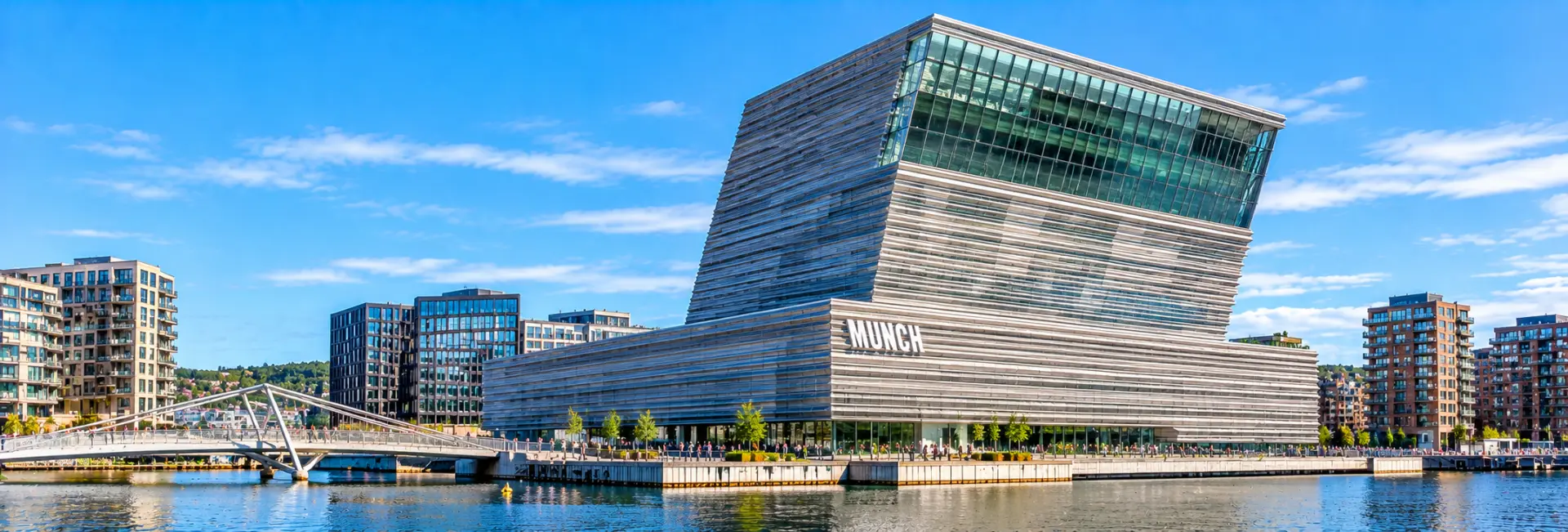
MUNCH, Oslo's dedicated museum for the painter Edvard Munch, occupies a tall, angular building on the waterfront in Bjørvika, a short walk from Oslo Central Station and directly beside the Oslo Opera House. It holds the largest single-artist collection in the world devoted to one painter, built almost entirely from the vast body of work Munch left to the city of Oslo when he died in 1944.
Rather than showing only a handful of famous canvases, the museum spreads Munch's output across multiple floors, pairing his best-known paintings with lesser-seen drawings, prints, photographs, and personal notebooks. The result is a fuller and sometimes more unsettling picture of an artist better known internationally for a single image than for the range of work he actually produced over six decades.
History
From bequest to museum
When Edvard Munch died in 1944, he left almost his entire remaining body of work, close to 28,000 pieces including paintings, prints, drawings, and photographs, to the municipality of Oslo. The scale of the gift meant the city needed to build a dedicated institution to house and study it, and further material was later added through gifts from Munch's sister Inger and through exchanges of duplicate prints.
The original museum at Tøyen
Oslo selected a site at Tøyen for the new museum in 1951, and the first Munch Museum opened there in 1963, timed to the hundredth anniversary of the artist's birth. For nearly six decades the Tøyen building served as the primary home for the collection, though its limited space and ageing facilities eventually made a larger, purpose-built museum necessary.
The move to Bjørvika
In 2008 Norway's parliament approved a new cultural quarter in the Bjørvika waterfront district, pairing a new Munch museum with the Stenersen art collection and the Oslo Public Library alongside the already-built Opera House. The new building opened to the public on 22 October 2021, rebranded simply as MUNCH, and the Tøyen site was retired as the museum's home.
Architecture & Building
The museum building was designed by the Spanish architect Juan Herreros of the firm Estudio Herreros and completed in 2020. Rising thirteen floors and around 46 metres, its slightly leaning, folded form stands in deliberate contrast to the low, sweeping roofline of the neighboring Opera House, giving Bjørvika two very different architectural landmarks side by side on the fjord.
The building's height and angular silhouette were controversial when first unveiled, drawing criticism from some residents and architecture critics over how it changed Oslo's low-rise waterfront skyline. Inside, the design prioritizes flexible, high-ceilinged gallery floors intended to accommodate everything from Munch's large-scale paintings to more intimate works on paper.
Collections & Exhibits
The museum's core holdings come directly from Munch's bequest and include roughly 1,100 paintings alongside thousands of prints, drawings, sculptures, and photographs, making it possible to rotate large portions of the collection through changing displays rather than showing a fixed, static set of works.
- Permanent and long-run displays trace Munch's career from his early Naturalist paintings through the emotionally charged Symbolist works for which he is best known.
- Print rooms show Munch's extensive work in woodcut, lithography, and etching, a side of his practice often overshadowed by his paintings.
- Temporary exhibitions bring in international contemporary artists, placing Munch's work in dialogue with later art rather than treating the collection purely as a historical archive.
- Archival material, including notebooks and photographs, gives insight into Munch's working process and the mental health struggles that shaped much of his art.
Must-See Highlights
- The Scream, Munch's most famous image, is held here in one of its several versions and remains the single work most visitors come to see.
- Madonna, a recurring subject Munch returned to across multiple paintings and prints, is represented in the collection alongside related studies.
- The Sick Child, based on the death of Munch's sister from tuberculosis, is one of several deeply personal works that recur throughout his career in different versions.
- Puberty, a starkly psychological portrait of adolescence, is among the works that show Munch's reputation for unflinching emotional subject matter beyond his single best-known image.
Ways to Experience It
- Book a timed entrance ticket in advance online, since the museum uses timed slots rather than open walk-in access.
- Use the audio guide, available in several languages including sign language, to get context on individual works as you move through the galleries.
- Visit temporary exhibitions on the upper floors, which change on a rotating basis and often complement the permanent Munch displays with contemporary work.
- Combine a visit with the Oslo Opera House next door, since both sit within a few minutes' walk of each other in Bjørvika.
Best Time to Visit
Weekday mornings shortly after opening tend to be the quietest time to visit, before tour groups and school parties arrive later in the day. Because entry is by timed ticket, crowding inside the galleries is generally more manageable than at museums with unrestricted entry, though the most popular slots around midday and on weekends still book up first.
The museum is an indoor attraction and works equally well as a plan for a rainy day or the darker winter months, when Oslo's outdoor attractions are less appealing. Its waterfront setting also makes it a pleasant stop on a longer walk through Bjørvika in summer, when the surrounding harbor promenade is at its busiest and most attractive.
Visitor Tips
- Buy timed tickets online in advance, since walk-up availability is not guaranteed, especially in peak season.
- The museum is roughly a ten-minute walk from Oslo Central Station, making it easy to reach on foot without needing local transit.
- Lockers in the lobby are sized for hand luggage only, so travelers with large bags or suitcases should plan to store them elsewhere before arriving.
- Backpacks, trolley cases, and large handbags are not permitted in the exhibition halls, along with food, drink, and umbrellas.
- The building is wheelchair accessible throughout, including its upper exhibition floors.
Nearby Attractions
- Oslo Opera House sits immediately next to the museum and is known for its sloped roof, which visitors can walk up for harbor views.
- The Oslo Public Library, part of the same Bjørvika cultural development, is a short walk away and open to the public.
- Akershus Fortress and the historic harbor promenade lie a walkable distance west along the waterfront.
- The Barcode Project, a row of modern high-rise buildings, forms the skyline immediately north of the museum.
FAQs about visiting the Munch Museum, Oslo
Is The Scream at the Munch Museum in Oslo? +
Yes, a version of The Scream is held in the museum's collection and is one of the works most visitors come specifically to see.
Do I need to book tickets in advance for MUNCH? +
Booking a timed entrance ticket online in advance is recommended, since the museum uses timed slots and walk-up entry is not guaranteed, particularly during busy periods.
How long does a visit to the Munch Museum take? +
Most visitors spend around two to three hours moving through the permanent Munch displays and any temporary exhibitions, though a quicker highlights visit is possible in about an hour.
Is the Munch Museum the same as the old museum at Tøyen? +
It holds the same core collection, but the museum moved from its original Tøyen building to a new, purpose-built location in Bjørvika in 2021, rebranded simply as MUNCH.
Is the Munch Museum suitable for children? +
The museum welcomes families, though some of Munch's subject matter deals with illness, death, and psychological distress, which may be more meaningful to older children and teenagers than to very young ones.
How do I get to the Munch Museum in Oslo? +
The museum is about a ten-minute walk from Oslo Central Station in the Bjørvika district, and is also reachable by tram or boat to the nearby Bjørvika stop.
Why is the Munch Museum building so tall? +
The building was designed by architect Juan Herreros with a leaning, thirteen-floor form intended to stand out against the low roofline of the neighboring Opera House, a choice that proved controversial when it first opened.