Table of Contents
Overview
Vigeland Sculpture Park is the artistic heart of Oslo's Frogner Park, an open-air gallery of 212 bronze, granite and wrought-iron works by one artist, Gustav Vigeland. It is widely described as the largest sculpture park in the world created by a single sculptor, and it welcomes more than a million visitors a year, which makes it one of the most visited attractions in Norway.
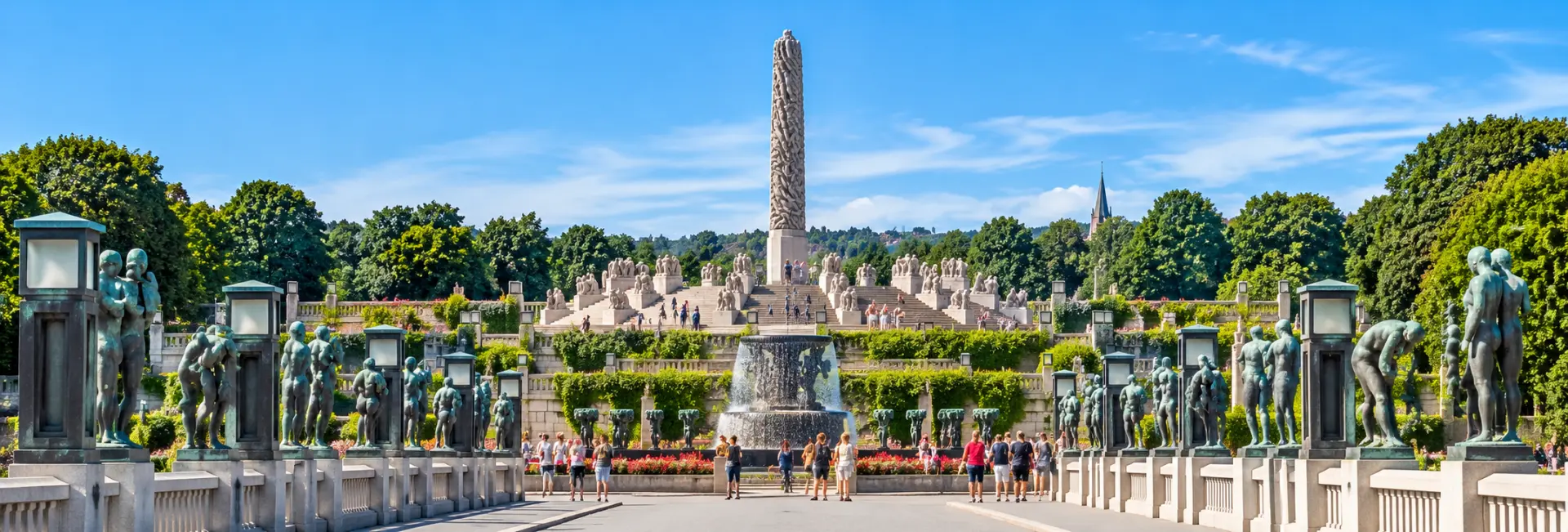
The park unfolds along an axis of roughly 850 metres. You walk from a monumental gate across a bridge lined with bronze figures, past a granite fountain, and up to the soaring Monolith and the Wheel of Life beyond it. Along the way you meet people of every age, embracing, playing, quarrelling, carrying each other and letting go, so that the whole park reads as a portrait of the human life cycle.
Entry is free and the grounds are open day and night all year. Because this is also a working city park, the sculptures share the space with joggers, dog walkers and picnickers on the lawns, and that everyday mix is a big part of the charm.
History
A studio, a city and a promise
Gustav Vigeland, born in 1869 in southern Norway, became one of the country's best-known sculptors. In the early 1920s the City of Oslo agreed to provide him with a new studio and home, and in return he promised to hand over all his later work, from sculptures to drawings and models. That deal shaped everything that followed, because it gave him the stability to think on a monumental scale.
From a fountain to a whole park
The starting point was a fountain that Vigeland had once hoped to see near the Parliament building. That plan fell through, but in 1924 the city council agreed to place the fountain in Frogner Park, and the idea soon grew to include the Monolith and the Bridge. Frogner Park itself had been a manor estate that the city bought in 1896, and its older section opened to the public in 1904.
Carved in granite
The huge granite block for the Monolith came from a quarry at the Iddefjord and was raised in the park in 1928. Carving began in 1929, with stonecutters working from Vigeland's models, and it was finished in the summer of 1942. Vigeland himself modelled the figures, while skilled craftsmen carried them out in stone and bronze.
A park finished after its creator
The first sculptures were placed along the Bridge from 1939, and the Bridge opened to the public on 7 July 1940. The Main Gate went up in 1941 and was completed in 1942. Vigeland died on 12 March 1943, but installation carried on from his plaster models, with the Fountain set in place in the mid-1940s and the last major piece, the Wheel of Life, erected in 1949.
Layout & Design
One long axis
Vigeland did not just supply the sculptures. He also shaped the overall design of the park, which is organised in five main units along a straight axis of about 850 metres: the Main Gate, the Bridge, the Fountain, the Monolith plateau and the Wheel of Life. The route rises gently, so the Monolith on its high terrace gradually becomes the focal point of the whole composition.
Gates, water and terraces
The monumental Main Gate opens onto Kirkeveien and welcomes you with wrought-iron gates and pillars designed by Vigeland. From there the path crosses the Bridge over the ponds, continues through a rose garden to the Fountain, and climbs to the Monolith plateau. Around the Monolith, granite figure groups stand on a circular flight of steps, and eight wrought-iron gates were added to the plateau in 1952.
A park within a park
The sculpture installation sits inside the much larger Frogner Park, which is the biggest public park in Oslo. Beyond the sculptures you will find ponds, wide lawns, tree-lined paths and sports facilities, so the visit can easily stretch into a longer outing.
Recognition / Status
Vigeland Sculpture Park is officially known as the Vigeland installation and forms part of Frogner Park, which is managed by the city's Agency for Urban Environment. It stands as the life's work of Vigeland and is the country's best-known outdoor art site.
The main claims to fame that set it apart include:
- The world's largest sculpture park created by a single artist
- 212 sculptures in bronze, granite and wrought iron
- More than one million visitors each year, making it one of Norway's top tourist attractions
- Free admission and access at all hours, all year round
Vigeland also designed the medal awarded with the Nobel Peace Prize, a reminder of his standing in Norwegian public life.
Key Sculptures & Highlights
The Main Gate
The tall gateway on Kirkeveien sets the tone with its wrought-iron gates, which Vigeland designed as part of the overall composition. It works as a formal threshold between the city streets and the world of the sculptures beyond.
The Bridge and The Angry Boy
The Bridge carries 58 bronze sculptures of children, women and men in many stages of life, modelled between 1925 and 1933. Its most famous resident is the small bronze boy known as Sinnataggen, or The Angry Boy, stamping his foot with clenched fists. The figures on the Bridge share themes of play, energy and vitality.
The Fountain
Set beyond a rose garden, the Fountain is the earliest sculpture unit in the park. Six giants carry a wide basin on their shoulders while a curtain of water falls around them, and twenty tree groups on the surrounding parapet trace life from childhood to old age and death. When it was completed in the 1940s the system circulated about 1,800 cubic metres of water an hour.
The Monolith
At the highest point of the park, the Monolith rises about 17 metres from a single block of granite. Its 121 human figures cling to and lift one another towards the sky, with children at the top. Around it, on a circular flight of steps, stand 36 granite groups showing different scenes of life.
The Wheel of Life
At the far end of the axis, the Wheel of Life is a bronze ring of women, men and children who hold onto one another. Modelled in 1933 and 1934 and erected in 1949, it is a symbol of eternity and sums up the theme of the whole park.
Meaning & Symbolism
Vigeland left most of his works without explanation, which leaves the meaning open. Most visitors read the park as a journey through the human life cycle, from birth and childhood through love, work, struggle and old age to death. The figures are nude, which lets them stand for people in general rather than any particular time or place.
The Monolith is often read as a vision of resurrection and a longing for something spiritual, and Vigeland is quoted as saying that the column was his religion. The Wheel of Life, by contrast, keeps the same idea grounded and human, with figures who hold on to each other for eternity.
The park has also sparked debate. Some critics have seen the monumental, idealised bodies as echoing the fascist art of the 1930s and 1940s, and have compared them with the work of German sculptor Arno Breker. Others point out that Vigeland's studio was funded by the city and that he was obliged to accept official visits, and they argue that his humane, tender treatment of the figures is a very different thing. It is a discussion worth knowing about as you stand among the granite groups.
Ways to Experience It
Walk the axis
The classic visit is a slow walk from the Main Gate to the Wheel of Life and back. Take your time on the Bridge, then pause at the Fountain before climbing the steps to the Monolith, where the composition looks completely different from each angle.
Join a guided tour
The Vigeland Museum offers guided tours in the park during the summer, and Visit Oslo can provide information on other guiding options. A guide can explain how the pieces were made and how they connect to Vigeland's ideas.
Visit the Vigeland Museum
Just south of the park, the Vigeland Museum is housed in the sculptor's former studio and home. It displays plaster models and other works, and Vigeland's ashes rest in the building's tower. The museum is ticketed separately from the park, so check the current opening days and prices before you plan a visit.
Stay for the rest of the park
Frogner Park also holds the Oslo Museum in the old Frogner Manor and a small art gallery, the Henriette Wegner Pavilion. If you need a break, there is a cafe near the Bridge, and the lawns are popular for picnics in good weather.
Best Time to Visit
Because the park never closes, you can visit whenever it suits you. Early morning is often the calmest time, with softer light and few people, which is ideal for photography. Morning fog over the ponds can give the Bridge an especially moody look.
Summer brings long days, green lawns and a lively atmosphere, and it is also when guided tours and the longer museum hours are typically available. In winter the bare trees and any snow cover give the granite and bronze a starker, quieter character, though you should dress warmly and watch for icy paths. In every season the sculptures look different depending on the light, so a second visit at another time of day can feel like a new experience.
Visitor Tips
- Cost: Entering the park is free. The Vigeland Museum charges an entrance fee, so check the museum's website for current prices and any free-entry passes.
- Opening: The park is always open. The museum keeps its own hours, is closed on Mondays and has longer summer hours, so confirm times before you go.
- Time needed: Allow about one to two hours for the sculpture axis, and more if you want to explore the wider park or the museum.
- Getting there: Take tram 12 or bus 20 to the Vigeland Park stop. For the museum, Frogner plass is the closest stop.
- Parking: Pay parking is available near Monolittveien, at Middelthunsgate by Frognerbadet and at Halvdan Svartes gate 50.
- Rules: Drones are not allowed, and permission is needed for commercial filming and events in the park.
- Accessibility: Wheelchairs cannot be rented at the park, so bring your own if you need one. The museum has a ramp and one wheelchair to borrow, but it has no lift between floors.
- Good to know: The sculptures show nude adults and children as part of their artistic message, which is worth mentioning to younger visitors in advance.
- Comfort: Wear comfortable shoes for the long paths and stairs, and bring a layer for changeable weather.
Nearby Attractions
Vigeland Museum
Immediately south of the park, the museum shows the artist's former studio and home, together with plaster models that give a behind-the-scenes look at how the outdoor works were created.
Oslo Museum at Frogner Manor
Inside Frogner Park, the manor house holds a museum of cultural history with one of the largest painting collections in Norway. It tells the story of Oslo's growth through themed exhibitions.
Central Oslo
The park lies about three kilometres from the city centre, so it is easy to combine with a day of sightseeing in the capital. Trams and buses run frequently between the centre and Frogner, and the neighbourhood itself is pleasant for a stroll through quiet residential streets.
FAQs about visiting Vigeland Sculpture Park
What is Vigeland Sculpture Park? +
It is an open-air collection of 212 bronze, granite and wrought-iron sculptures by Gustav Vigeland, set inside Oslo's Frogner Park. It is regarded as the largest sculpture park in the world made by a single artist.
Is Vigeland Park free to enter? +
Yes, the park is free to enter and it is open around the clock all year. The nearby Vigeland Museum, however, charges an entrance fee and keeps set opening hours.
How long do I need at the park? +
Most visitors spend one to two hours walking the main axis from the Main Gate to the Wheel of Life. Plan for longer if you want to add the museum, the wider Frogner Park or a picnic.
What are the most famous sculptures? +
The most popular are the Monolith with its 121 intertwined figures, The Angry Boy on the Bridge, the Fountain with its six giants and the Wheel of Life at the end of the axis.
How do I get to Vigeland Park? +
Take tram 12 or bus 20 to the Vigeland Park stop. The park is about three kilometres from the city centre, and paid parking is available in a few spots nearby.
Is the park suitable for children? +
Yes, it is a wide, open space where children can run around, and many families enjoy the Bridge and the lawns. The sculptures depict nude figures, so it is helpful to explain this to younger children before you visit.
Can I visit in winter or at night? +
The park is open around the clock throughout the year, and winter gives the sculptures a quiet, dramatic look. Dress warmly and take care on icy paths, and keep in mind that lighting and conditions vary.
Are guided tours available? +
The Vigeland Museum runs guided tours in the park during the summer, and Visit Oslo can share details about other options. Check the current schedule before you plan around a tour.