Table of Contents
Overview
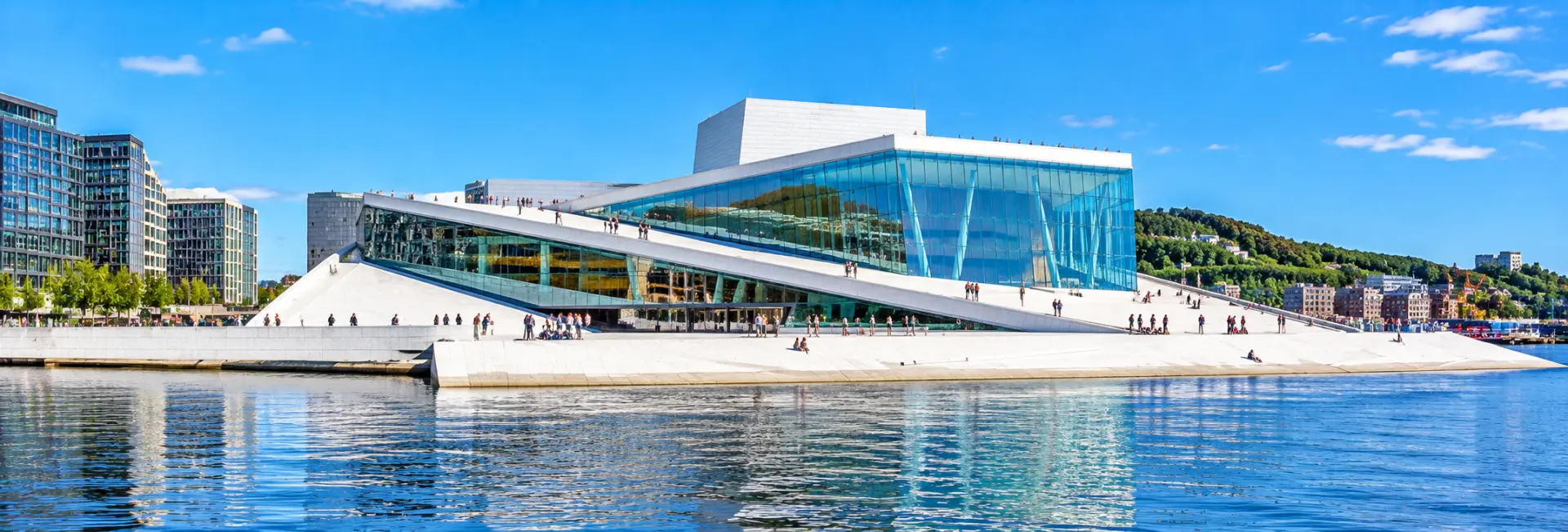
The Oslo Opera House is the home of the Norwegian National Opera and Ballet and one of the most recognisable buildings in the country. Designed by the Norwegian firm Snøhetta and opened in 2008, it sits right at the edge of the Oslofjord in the Bjørvika district, with slanted white surfaces that look as if they are rising out of the water.
What sets it apart is that you do not need a ticket to enjoy it. The sloping roof doubles as a public plaza that anyone can walk up, and from the top you can look across the fjord, the harbour and the city. Inside, a warm oak foyer opens to the water through tall glass walls, and the building's workshops are visible through large windows at street level.
Alongside its architecture, the Opera House is a working national stage that presents opera and ballet on three stages. The result is a place where a walk on the roof, a coffee in the foyer and an evening at the theatre can all belong to the same visit.
History
A long campaign for a new home
The Norwegian National Opera and Ballet was founded in 1957, and for decades its company campaigned for a proper opera house of its own. The harbour area of Bjørvika became the preferred site. In 1999, after a lengthy national debate, the Norwegian parliament decided to build one.
The competition
A design competition drew 350 entries, and the judges chose the proposal from Snøhetta. Their idea was to make the building part of the city and the fjord rather than a monument standing apart, and above all to give the public a landscape they could walk on.
Construction and opening
Construction began in 2003 on piles in the fjord and finished in 2007, ahead of schedule and about 300 million kroner under a budget of 4.4 billion kroner. The gala opening took place on 12 April 2008 and was attended by King Harald of Norway, Queen Margrethe II of Denmark and President Tarja Halonen of Finland. In its first year around 1.3 million people passed through its doors.
Starting a new waterfront
The Opera House was the first building completed in the Bjørvika redevelopment, which has since turned a former industrial harbour into one of Oslo's main cultural districts, with new museums and a library nearby.
Architecture & Design
The wave wall, the factory and the carpet
Snøhetta describes the building as a combination of three elements. The wave wall is the faceted front along the water, the factory is the tall, functional volume that holds the stage and workshops, and the carpet is the sloping stone surface that carries people from the street to the roof. Together they connect the city and the fjord.
A walkable white landscape
The roof angles down to ground level, creating a large plaza of about 20,000 square metres that is treated as public ground. It is covered in white Carrara marble and granite, and the same stone runs through the lobby so that inside and outside feel continuous. Roof events can draw crowds of many thousands, and the plaza is regularly used for concerts and live screenings of performances.
Stone, oak and glass
Three materials define the building: white stone, oak and metal. The foyer and main hall are lined in oak, whose warmth contrasts with the cool exterior. The lobby is wrapped in windows about 15 metres tall, held up by slim angled columns that keep views of the water clear. The stage tower is clad in white aluminium with a pattern that evokes old weaving.
The horseshoe hall
The main auditorium is shaped like a horseshoe, echoing classical opera houses, and it is lit by an oval chandelier made of about 5,800 handmade crystals. Seat-back screens display libretto text in Norwegian and English, and the house seats just over 1,360 people, with two smaller stages of 400 and 200 seats.
Art at the Opera House
Norwegian public buildings set aside part of their budgets for art, and the Opera House includes eight art projects by 17 artists, making it one of the largest public art commissions in the country. Most of the works are woven into the building itself.
She Lies
The best-known piece is She Lies by Italian artist Monica Bonvicini, a sculpture of stainless steel and glass panels that floats on a concrete platform in the fjord next to the building. It rises about 12 metres above the water and slowly turns with the wind and tide, so its shape and reflections keep changing. It was unveiled by Queen Sonja on 11 May 2010.
The Other Wall
In the foyer, Olafur Eliasson designed a perforated wall of hexagonal openings, lit from behind to give the illusion of melting ice. It covers the roof supports and adds a glowing, sculptural element to the lobby.
The stage curtain
The main stage curtain by American artist Pae White is woven from wool, cotton and polyester and looks like crumpled aluminium foil. She scanned a piece of real foil and translated the image into a loom pattern to create the three-dimensional effect.
Recognition / Status
The Oslo Opera House is the largest cultural building constructed in Norway since Nidaros Cathedral was completed around the year 1300, a comparison often used to show the scale of the project. It is the national opera house and the home of the country's only fully professional opera and ballet company.
The building has also won major architectural honours, including:
- The Culture Award at the World Architecture Festival in Barcelona in October 2008
- The European Union Prize for Contemporary Architecture, also known as the Mies van der Rohe Award, in 2009
Its popularity with the public is just as notable, since the roof has become a favourite gathering place for locals and visitors alike.
What to See
The roof plaza
Walk up the gentle slope of white stone to the highest point for wide views of the fjord, the islands, Akershus Fortress and the Bjørvika district. On a clear day it is one of the best free viewpoints in Oslo.
The foyer
Step inside to the undulating oak wall, the tall glass walls facing the water and Eliasson's glowing panel. It is also worth looking for the workshop windows at street level, where you can watch scenery being built.
She Lies on the water
Walk along the waterfront edge to see the floating glass and steel sculpture from different angles, because its faces shift as it turns in the fjord.
The waterfront
The area around the building has become a promenade for swimming, sunbathing and strolling in summer, with the sea and the marble creating a bright, open atmosphere.
Ways to Experience It
Explore on your own
Wandering the roof and foyer is free, and many visitors spend an hour circling the building, climbing the slopes and taking photos of the shifting angles and reflections.
Take a guided tour
Guided tours in English and Norwegian take visitors behind the scenes into spaces that are normally closed to the public, such as the stage, rehearsal areas, workshops and backstage. Tours are ticketed, so book ahead and check the schedule on the Opera's website.
See a performance
The company presents opera and ballet on its three stages, and the season typically runs from autumn to early summer. Seats at a performance are the best way to see the horseshoe hall and the crystal chandelier, and the libretto screens make opera in foreign languages easy to follow.
Roof concerts and events
The roof and foyer are also used for concerts and screenings, so check the calendar for open-air events during your visit.
Best Time to Visit
The roof is open all year, so you can visit in any season. Summer brings long light evenings, lively crowds on the waterfront and outdoor seating at the restaurants. Golden hour and sunset are especially good for photography, when the marble glows against the fjord.
For a calmer visit, choose a weekday morning, when the roof is quieter and the light is soft. Midday in peak summer can be busy, and the foyer may be restricted just before and after performances. In winter, the white stone looks stark and beautiful in low light, but you should wear shoes with good grip and take care on wet or icy surfaces.
Visitor Tips
- Cost: Walking on the roof and visiting the public foyer is free. Guided tours and performances need tickets, so check current prices on the Opera's website.
- Opening hours: The foyer keeps daytime hours that vary by day and by performance schedule, so check before you go. The roof plaza is generally accessible year-round, weather permitting.
- Getting there: The Opera House is a short walk from Oslo Central Station, and the Jernbanetorget metro and tram stop is close by. Check Ruter for buses and trams.
- What to wear: Bring layers and grippy shoes, since the marble can be slippery when wet or icy, and sunglasses on bright days.
- Food and drink: The building has restaurants and bars, with outdoor seating on the water in summer.
- Restricted areas: Areas beyond the public spaces, including the auditorium, are limited to ticket holders and tour groups.
- Tours: Guided tours are offered in English and Norwegian, and they can fill up, so book in advance if you have a specific date in mind.
- Accessibility: The public areas are designed to be open to everyone, but confirm specific facilities with the Opera before you visit.
Nearby Attractions
Munch
The Munch museum stands right beside the Opera House in Bjørvika and opened in 2021. It is a tall, modern building dedicated to the artist Edvard Munch.
Deichman Bjørvika and the Barcode district
The city's main library and the striking Barcode cluster of high-rises sit nearby, making the district a natural half-day walk for architecture fans.
Operastranda
Beside the Opera House there is a small beach area popular for swimming and relaxing in summer, with the fjord on one side and the city skyline on the other.
Akershus Fortress and Oslo Cathedral
Just under a kilometre away, Akershus Fortress and the cathedral add history to the day, and Oslo Central Station lies only a few minutes on foot.
FAQs about visiting the Oslo Opera House
Can you walk on the roof of the Oslo Opera House? +
Yes. The sloping white marble roof is designed as a public plaza, and you can climb it for free for views over the fjord and the city. It is generally open year-round, weather permitting.
Is it free to enter the Opera House? +
Walking on the roof and visiting the public foyer is free. You need tickets for performances and for guided tours.
What are the opening hours? +
The foyer keeps daytime hours that vary by day and performance schedule, and the roof plaza is generally accessible year-round. Check the Opera's website for the current times.
Who designed the Oslo Opera House? +
The Norwegian architecture firm Snøhetta designed it after winning a competition with 350 entries. It opened on 12 April 2008.
How long does a visit take? +
Allow about an hour for the roof and foyer. A guided tour or a performance will take longer, so plan accordingly.
Is a guided tour worth it? +
Tours take you behind the scenes into the stage, workshops and rehearsal spaces that are not open to the public, and they explain the architecture and the art. They are a good choice if you are curious about how an opera house works.
How do I get there? +
It is a short walk from Oslo Central Station. The Jernbanetorget metro and tram stop is also close.
Is it worth visiting if I am not into opera? +
Yes. The architecture, the roof views, the public art and the waterfront setting make it a highlight of Oslo even without seeing a show.