Table of Contents
Overview
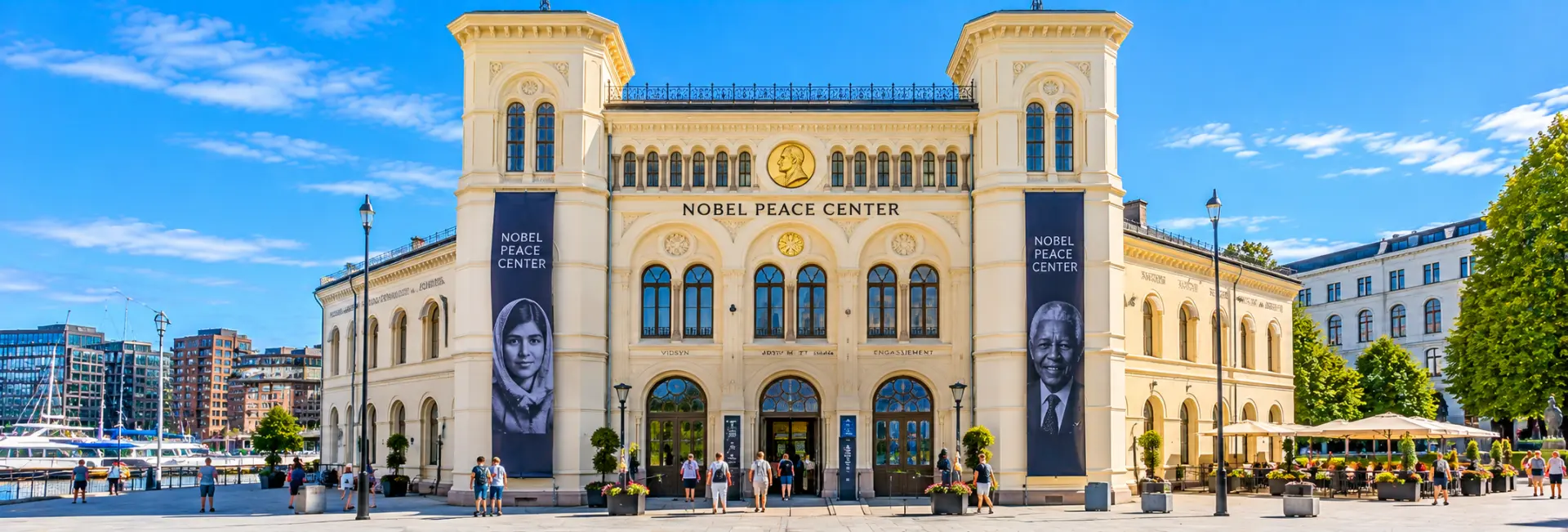
The Nobel Peace Center sits on Oslo's City Hall Square, overlooking the harbor in a building that once served as the city's main railway station. Rather than a static historical archive, it functions as a working museum and public forum, using interactive exhibits, film, and digital installations to explore the Nobel Peace Prize, its laureates, and the broader themes of war, peace, and conflict resolution.
The center draws around a quarter of a million visitors a year, making it one of Norway's most visited museums, and its central location beside Oslo City Hall places it directly on the route most visitors already take between the harbor, the fortress, and the rest of central Oslo.
History
A former railway station
The building housing the Nobel Peace Center dates to 1872, when it was designed by architect Georg Andreas Bull as Oslo's West railway station, known as Vestbanestasjonen. The station served rail traffic for over a century before closing in 1989, after which the building sat largely unused as the surrounding Vika district changed around it.
Founding the center
The Nobel Peace Center opened in 2005, inaugurated by King Harald V of Norway in a ceremony attended by the royal families of Norway and Canada, along with Nobel Peace Prize laureate Wangari Maathai. The center was created specifically to give the Peace Prize, unlike the other Nobel Prizes awarded in Sweden, a permanent public home in the city where it is decided and announced each year by the Norwegian Nobel Committee.
Architecture & Building
The center occupies the restored former station building, its pale, dignified 19th-century facade largely unchanged from its railway days, while the interior was substantially reworked to suit its new role as a museum. British architect David Adjaye led the interior design and color scheme, giving the historic shell a contemporary, gallery-like character suited to changing exhibitions.
American designer David Small developed much of the center's early digital and interactive technology, an approach that set the museum apart from more traditional history museums when it opened and has continued to shape how new exhibits are presented as the technology evolves.
Exhibits & Collections
The museum's exhibitions center on the history of Alfred Nobel, the story behind his will and the creation of the Peace Prize, and profiles of the laureates who have received it since 1901. Displays combine physical objects with digital and audiovisual elements, often allowing visitors to explore individual laureates' stories in more depth than a conventional wall panel would allow.
- A core exhibition traces the origins of the Nobel Peace Prize and Alfred Nobel's own life and motivations for establishing it.
- Rotating exhibitions, often titled around themes like paths to peace, focus on specific laureates, conflicts, or contemporary peace and human rights issues.
- Digital installations let visitors search and explore profiles of past laureates interactively rather than through static text alone.
- The center periodically updates its exhibition spaces, so specific installations can change from one visit to the next.
The Nobel Peace Prize Connection
The Nobel Peace Prize itself is decided and announced by the Norwegian Nobel Committee, working with the Norwegian Nobel Institute founded in 1904, distinguishing it from the other Nobel Prizes, which are awarded in Sweden. The Peace Center was built specifically to give this uniquely Norwegian responsibility a permanent public presence in Oslo.
The formal Nobel Peace Prize award ceremony takes place each year on 10 December, the anniversary of Alfred Nobel's death, at nearby Oslo City Hall rather than at the Peace Center itself. The center's exhibits are timed to reflect the most recent laureate shortly after each October announcement, giving visitors a close, current link to the prize's yearly cycle even though the ceremony happens elsewhere.
Ways to Experience It
- Explore the permanent exhibition on Alfred Nobel and the history of the Peace Prize at your own pace.
- Visit the current rotating exhibition, which changes periodically and often focuses on a specific laureate or global issue.
- Join a guided tour, typically offered on weekends, for a more structured introduction to the Peace Prize and its laureates.
- Use the audio guide, available in several languages, to add context to exhibits while moving through the galleries independently.
Best Time to Visit
The center is an indoor museum and works well at any time of year, making it a practical stop on a rainy day or during Oslo's colder months. Visiting shortly after the Peace Prize is announced each October can be particularly interesting, since exhibits are updated to reflect the new laureate around that time.
Weekday mornings tend to be quieter than weekends, when guided tours run and the museum sees more visitors combining a stop here with a walk around the neighboring City Hall Square and harbor promenade.
Visitor Tips
- Tickets can be bought online in advance or on arrival, and self-service lockers are available for bags and coats.
- Some exhibition spaces or floors may occasionally be closed or have limited accessibility during installation changes, so it is worth checking current conditions before visiting if accessibility is a concern.
- Eating and drinking are not permitted in the exhibition areas, so plan any snacks or meals for before or after the visit.
- Oslo Pass holders typically receive free admission, making the center an easy addition to a broader day of sightseeing on a city pass.
- The center sits directly on City Hall Square, making it an easy stop to combine with a walk along the harbor or a visit to Akershus Fortress nearby.
Nearby Attractions
- Oslo City Hall, where the Nobel Peace Prize ceremony is held each December, stands immediately next to the center on the same square.
- Akershus Fortress and its museums are a short walk east along the harbor.
- Aker Brygge, with its restaurants and waterfront shops, is a few minutes' walk from the square.
- The National Museum, Norway's largest art museum, is within easy walking distance to the south.
FAQs about visiting the Nobel Peace Center
Is the Nobel Peace Prize ceremony held at the Nobel Peace Center? +
No, the annual award ceremony takes place at nearby Oslo City Hall on 10 December each year. The Peace Center is the museum dedicated to the prize and its laureates, not the ceremony venue.
What building is the Nobel Peace Center located in? +
It occupies Oslo's former West railway station, a building dating to 1872 that served as a train station until 1989 before being converted into the museum.
How long does a visit to the Nobel Peace Center take? +
Most visitors spend around one to two hours exploring the permanent and rotating exhibitions, depending on how much time they spend on the interactive displays.
Is the Nobel Peace Center included with the Oslo Pass? +
Yes, Oslo Pass holders typically receive free admission to the center as part of the pass's included attractions.
Can I see all past Nobel Peace Prize laureates at the center? +
Yes, the museum's core exhibition and digital installations cover laureates from 1901 to the present, though the depth of coverage for any individual laureate can vary by current exhibition.
Are guided tours available at the Nobel Peace Center? +
Yes, guided tours are typically offered on weekends and give a structured overview of the Peace Prize's history and its laureates in about thirty minutes.
Is the Nobel Peace Center suitable for children? +
Yes, the interactive and digital nature of many exhibits tends to engage younger visitors, though the subject matter around conflict and human rights is often more meaningful for older children and teenagers.