
Table of Contents
Overview
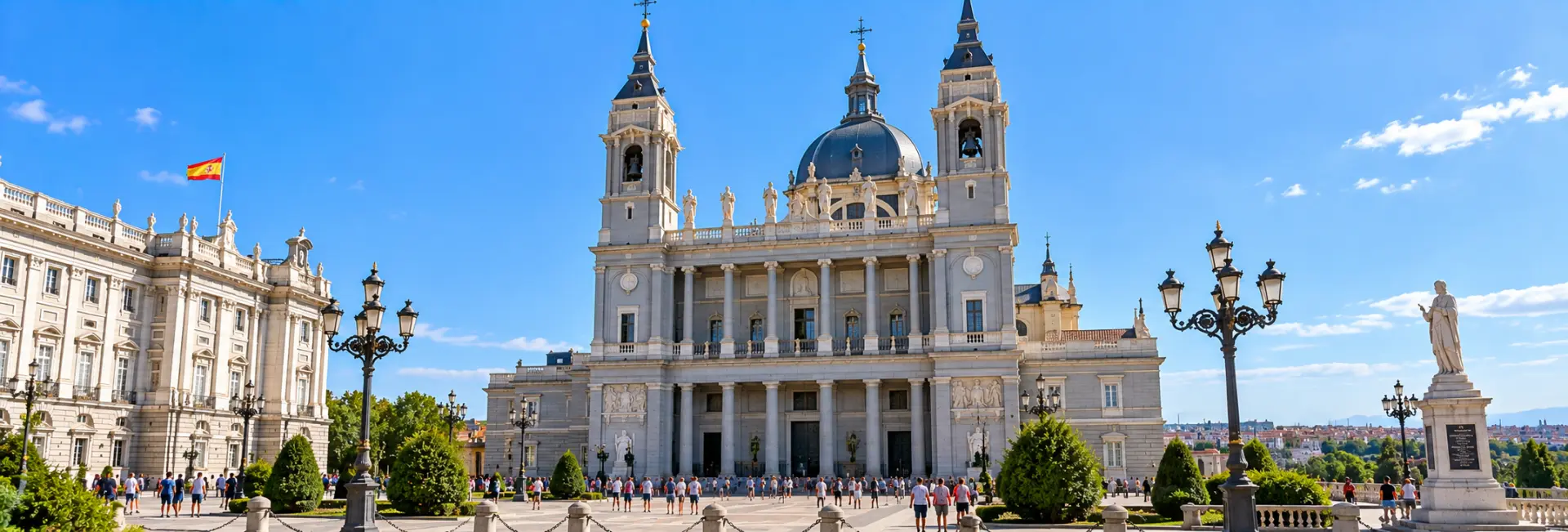
The Almudena Cathedral is Madrid's Catholic cathedral and the seat of the Archdiocese of Madrid, standing directly across from the Royal Palace on the western edge of the city's historic center. Dedicated to the Virgin of Almudena, the city's patron saint, it has an unusual distinction among Europe's major cathedrals: construction dragged on for more than a century, meaning much of what visitors see today was actually completed within living memory rather than in the medieval or Baroque periods most cathedrals date to.
That long, interrupted building history gives the cathedral a genuinely unusual character, pairing a restrained neoclassical exterior designed to match the Royal Palace with a bold, brightly colored neo-Gothic interior that surprises many first-time visitors. Free to enter and just steps from the palace, it's one of the most visited religious sites in the city.
History
A Capital Without a Cathedral
When Madrid became the capital of Spain in 1561, the seat of the Spanish church remained in Toledo, leaving the new capital without a cathedral of its own for centuries. Plans to build one gained momentum in the 19th century, and the first stone was laid on 4 April 1883 by King Alfonso XII, on a site associated with a former mosque destroyed during Madrid's reconquest in the 11th century.
The architect Francisco de Cubas designed the original project in a Gothic Revival style inspired by French cathedrals, and the building's crypt opened for worship in 1911 even as work on the main structure continued slowly above it. Construction was suspended during the Spanish Civil War in the late 1930s and resumed afterward with limited resources.
A Change in Style and a Long-Awaited Consecration
By the mid-20th century, architectural tastes had shifted, and a purely Gothic cathedral was considered a poor match for its surroundings near the Royal Palace. A national design competition held in 1944 was won by architects Fernando Chueca Goitia and Carlos Sidro, whose revised plans introduced a more neoclassical exterior intended to harmonize with the palace across the square. Work resumed in 1950, with the cloister completed in 1955 and the main façade finished by 1960.
The cathedral was finally consecrated by Pope John Paul II on 15 June 1993, more than a century after ground was first broken, during his fourth papal visit to Spain. It later gained wider international attention as the site of the 2004 wedding of the future King Felipe VI and Queen Letizia.
Architecture & Design
The Almudena Cathedral is built on a Latin cross floor plan roughly 102 metres long, with a dome rising above the crossing and a main façade designed to echo the scale and tone of the Royal Palace opposite it. Its exterior is largely neoclassical, faced in stone and granite, while the interior follows a distinctly neo-Gothic layout of tall columns and pointed arches.
The Crypt
Beneath the main cathedral lies a Neo-Romanesque crypt, the oldest completed part of the building, opened for worship in 1911 while construction continued above. Its dense forest of stout columns and round arches gives it a noticeably different atmosphere from the brighter, more open cathedral above.
The Façade
The main façade is crowned by statues of four Spanish saints connected to the city and country, carved in white stone. Its three main doors are decorated with scenes tied to the cathedral's own story, including the 1993 consecration and the annual procession of the Virgin of Almudena through Madrid's streets each November.
Notable Features
- The interior's stained-glass windows and vividly colored ceiling vaults depart sharply from the muted stonework typical of older European cathedrals, giving the nave an unusually bright, modern feel.
- Byzantine-influenced murals in the apse, painted by the contemporary artist Kiko Argüello, add a further layer of modern artistic style to the building's long and varied construction history.
- The image of the Virgin of Almudena, the medieval statue of Mary that gives the cathedral its name, sits in its own dedicated altar to the right of the main altar, reachable by stairways on either side.
- The cathedral museum houses artifacts related to the history of the Madrid diocese, along with items connected to the city's patron saints.
Cultural & Religious Significance
As the seat of the Archdiocese of Madrid, the cathedral serves as the city's principal Catholic place of worship and hosts regular services alongside its role as a tourist landmark. It carries particular civic weight each November 9th, the feast day of the Virgin of Almudena, when a procession honoring the city's patron saint passes through the streets and draws large crowds.
The cathedral's national profile was cemented by the 2004 royal wedding held within its walls, an event that placed the relatively young building at the center of a major moment in modern Spanish history and brought it wider international recognition alongside its role as a working cathedral.
Visiting Etiquette & Tips
- Entry is free, though a small donation is customarily suggested to help support the building's maintenance.
- The cathedral cannot be visited during Mass or other religious services, so it's worth checking the posted schedule before planning a visit around a specific time.
- Modest dress is appropriate, as with most active places of worship, particularly covering shoulders and knees.
- Photography is generally permitted in the main body of the cathedral, though flash photography and photography during services should be avoided out of respect for worshippers.
- The crypt has a separate access point and is included with general admission, so it's worth allowing extra time to see both levels.
Best Time to Visit
Weekday mornings tend to be the quietest time to visit, before tour groups exploring the Royal Palace across the square spill over into the cathedral later in the day. Since the cathedral is closed to visitors during services, checking the current Mass schedule ahead of time helps avoid arriving when the building isn't open for sightseeing.
Visiting around November 9th offers a different experience entirely, when the feast day of the Virgin of Almudena brings a citywide procession and a noticeably livelier atmosphere around the cathedral and the surrounding old town.
Nearby Attractions
The cathedral sits directly across from the Royal Palace, at the heart of Madrid's historic Austrias district, making it easy to pair with several other central sights.
- The Royal Palace of Madrid, just across the Plaza de la Armería, is the most obvious pairing and the cathedral's closest architectural neighbor.
- The Sabatini Gardens, on the palace's northern side, offer a quieter green space nearby for a break after visiting both buildings.
- Plaza de Oriente, framing the palace's eastern side, is lined with cafés and makes a pleasant stop between the cathedral and other sights in the area.
- Plaza Mayor and the historic Habsburg quarter are a short walk east through Madrid's old town.
FAQs about visiting the Almudena Cathedral
Is there an entrance fee for the Almudena Cathedral? +
No, entry is free, though a small donation is suggested to help support the cathedral's upkeep.
Why did the cathedral take so long to build? +
Construction began in 1883 but was repeatedly delayed by funding shortages, a change in architectural style partway through, and a suspension during the Spanish Civil War, before finally being consecrated in 1993.
Can I visit during Mass? +
No, the cathedral is closed to sightseeing visitors during Mass and other religious services, so it's worth checking the posted schedule before your visit.
What's inside the crypt? +
The crypt is a Neo-Romanesque space beneath the main cathedral, the oldest completed part of the building, with a dense arrangement of columns and round arches quite different in feel from the cathedral above.
Is the Almudena Cathedral connected to the Royal Palace? +
They stand directly across from one another on the Plaza de la Armería and are often visited together, though they are separate buildings with separate entrances.
What is the Virgin of Almudena? +
It's a medieval statue of the Virgin Mary, the patroness of Madrid, housed in its own altar inside the cathedral and honored each year with a citywide procession on November 9th.
Is photography allowed inside? +
Yes, photography is generally permitted in the main cathedral, though flash photography and photography during services are discouraged out of respect for worshippers.
What else can I see nearby? +
The Royal Palace, Sabatini Gardens, and Plaza de Oriente are all immediately adjacent, and Plaza Mayor is a short walk away through Madrid's historic old town.
