
Table of Contents
Overview
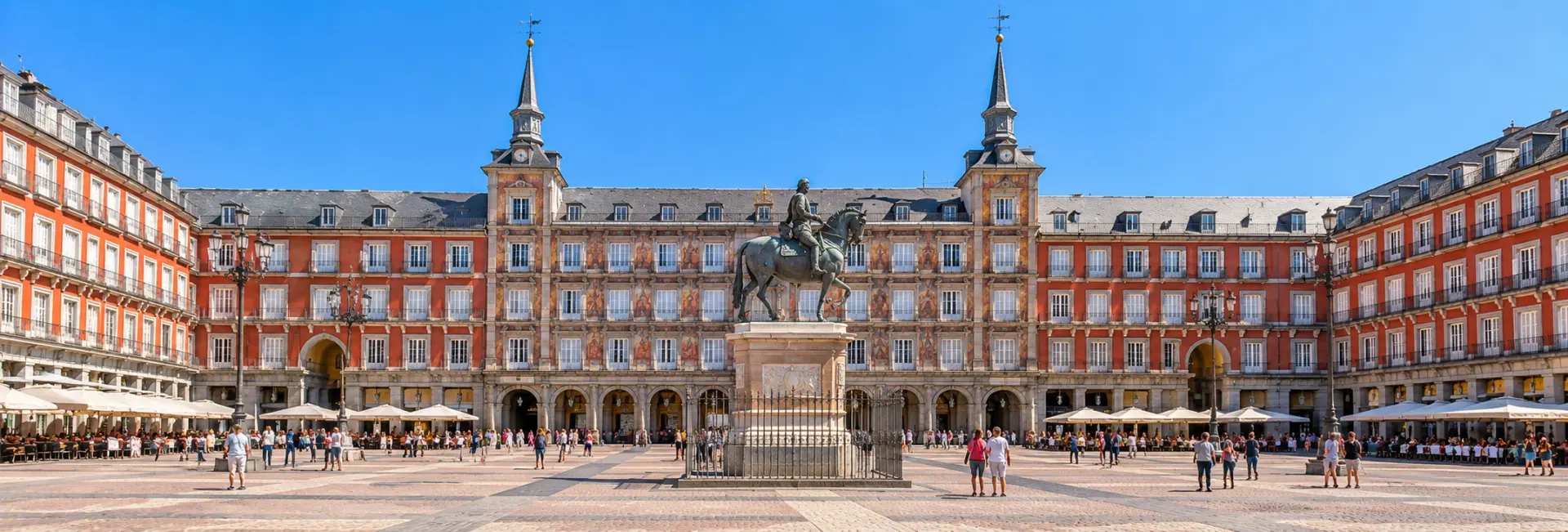
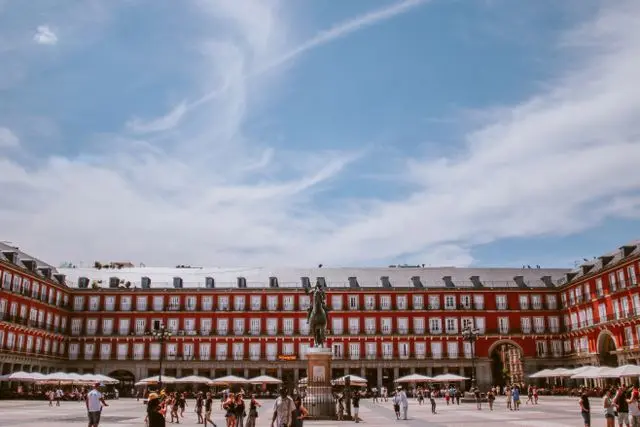
Plaza Mayor is the grand rectangular square at the historic core of Madrid, built as a stage for royal ceremony and public life under the Habsburg monarchy and still one of the busiest gathering spots in the city today. Enclosed on all sides by uniform, porticoed buildings with balconies stacked three stories high, it has a theatrical, almost enclosed quality that sets it apart from Madrid's more open modern squares.
For centuries it hosted everything from royal coronations and bullfights to markets and public trials, and while its role today is mostly social and touristic — filled with outdoor cafés, street performers, and a Christmas market each winter — its architecture and layout still reflect the ambitions of the kings who built it.

History
From Marketplace to Royal Square
The site began as the Plaza del Arrabal, an open marketplace just outside Madrid's old city walls that served as the city's main trading hub through the late 15th century. After King Philip II moved the Spanish royal court to Madrid in 1561, pressure grew to replace the irregular marketplace with a square befitting the new capital, and the architect Juan de Herrera was commissioned to draw up plans for a more formal, enclosed design.
Construction moved slowly under financial constraints, and it was Philip II's son, Philip III, who oversaw the project's completion. The architect Juan Gómez de Mora carried Herrera's ideas forward, giving the square its uniform rectangular shape and completing the surrounding porticoes by 1619, near the end of Philip III's reign.
Fires, Rebuilding, and a New Name
Over the following two centuries, the square was rebuilt multiple times after a series of major fires damaged its wooden-framed buildings. The most severe, in 1790, prompted a full reconstruction under the Enlightenment architect Juan de Villanueva, who reduced the buildings' height, closed off some of the original openings, and gave the square much of the more restrained, symmetrical look it has today.
The square's name has changed several times to reflect Spain's shifting politics, having been known at various points as the Plaza de la Constitución, the Plaza Real, and the Plaza de la República, before settling on its current name, Plaza Mayor, in the 20th century.
Architecture & Design
Plaza Mayor is rectangular, measuring roughly 129 by 94 metres, and enclosed by continuous rows of residential buildings joined by ground-floor arcades. Uniform façades, slate roofs, and repeating rows of balconies give the square a disciplined, almost theatrical symmetry that architectural historians trace back to Juan de Herrera's original, austere design principles.
Casa de la Panadería
The oldest and most distinctive building on the square is the Casa de la Panadería, originally built around 1590 as the city's main bakery, a role that also made it responsible for regulating the price of bread for ordinary Madrileños. Its twin corner towers and brightly painted façade — decorated with allegorical frescoes added in the 20th century — make it the square's visual anchor, and the building now houses Madrid's tourism information center.
Gates and Access
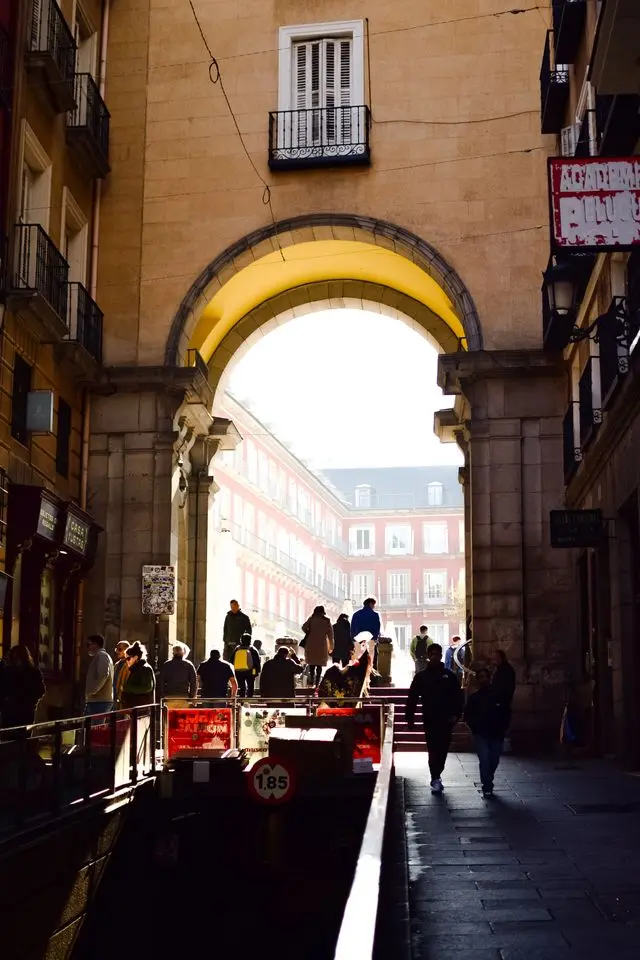
Nine named gates and a total of ten entrances lead into the square from the surrounding streets of old Madrid, each tied to a different historical or geographical reference. The Arco de Cuchilleros, on the square's southern side, is among the most photographed, opening onto a steep stairway down toward Calle Cuchilleros.

What to See There
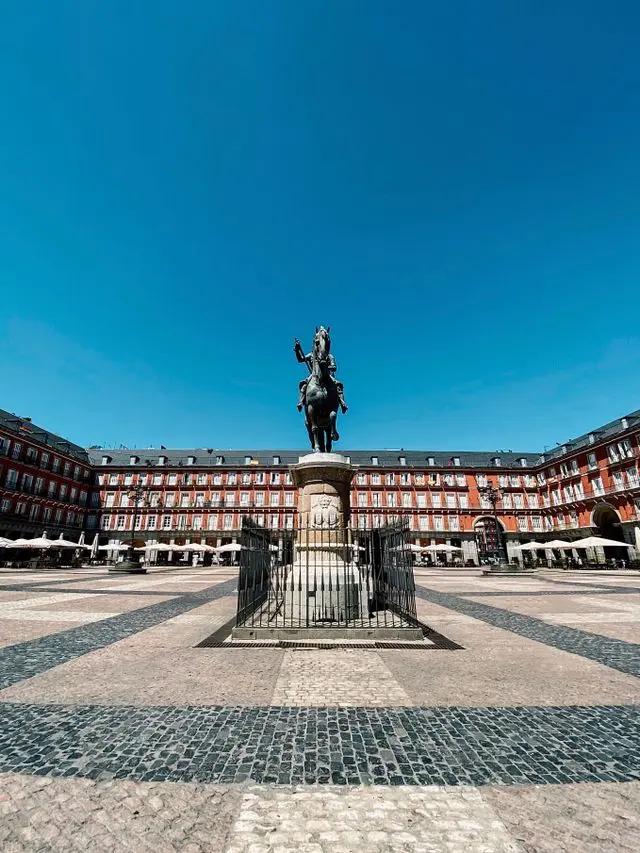
- The equestrian statue of King Philip III, cast by the Italian sculptors Giambologna and Pietro Tacca and installed at the center of the square in the mid-19th century, after decades standing elsewhere in the city.
- The Casa de la Panadería, with its painted façade and twin towers, standing opposite the square's southern entrances.
- The surrounding arcades, lined with cafés, restaurants, and shops selling everything from tourist souvenirs to traditional Spanish hats and fans.
- The balconies overlooking the square, historically rented out during major events so spectators could watch bullfights, coronations, and public ceremonies from above.
Ways to Experience It
Most visitors treat Plaza Mayor as a place to pass through and linger in rather than a single attraction with a fixed route, pairing a walk across the square with a stop at one of its arcaded cafés. The square also anchors several of Madrid's best-known walking tours through the old Habsburg quarter.
- Outdoor cafés along the arcades are a popular, if pricier, spot to sit and take in the square, especially in the evening.
- A weekly stamp and coin market draws collectors to the square on Sunday mornings.
- During the Christmas season, the square hosts one of Madrid's largest and most traditional holiday markets, filled with stalls selling decorations, costumes, and seasonal treats.
- Street performers, portrait artists, and costumed characters are a regular fixture around the square, particularly in the warmer months.

Best Time to Visit
Early morning is the quietest time to see the square before the crowds and outdoor tables fill in, making it a good window for photographing the architecture without heavy foot traffic. Evenings bring a livelier atmosphere, with the arcaded cafés filling up and the square's lighting bringing out the detail on the surrounding façades.
December brings a different kind of energy, when the square's Christmas market transforms it into one of the busiest and most festive spots in the city, though it also means much larger crowds than the rest of the year.
Visitor Tips
- Café and restaurant prices directly on the square tend to run higher than a block or two away, so it's worth wandering into the surrounding streets for a better-value meal.
- Keep an eye on belongings in busy periods, since crowded historic squares like this one can attract pickpockets.
- The square's cobblestone surface and surrounding stepped streets make flat, comfortable shoes a good idea.
- Costumed street performers and photo-op characters in the square often expect a tip if you take a photo with them.
- Visiting the Casa de la Panadería's tourism office is a convenient way to pick up maps or ask about other sights in the historic center.
Nearby Attractions
Plaza Mayor sits at the center of Madrid's oldest neighborhood, within easy walking distance of several other historic sights.
- The Puerta del Sol, Madrid's bustling central square and the symbolic kilometer zero of Spain's road network, is just a few minutes' walk away.
- The Mercado de San Miguel, a restored early 20th-century iron-and-glass market hall known for tapas stalls, sits just off the square's western edge.
- The Royal Palace and Almudena Cathedral are a short walk west through the old Habsburg quarter.
- Calle Cuchilleros and the surrounding streets are lined with traditional tapas bars and taverns, some dating back centuries.
FAQs about visiting Plaza Mayor
Is there an entrance fee for Plaza Mayor? +
No, the square is a public open space and free to enter at any time.
How long should I plan to spend there? +
Most visitors spend 20 to 40 minutes taking in the architecture and statue, though it's easy to stay longer if you sit down at one of the arcade cafés.
What is the Casa de la Panadería? +
It's the oldest building on the square, originally the city's main bakery and now home to Madrid's tourism information center, recognizable by its twin towers and painted façade.
Is Plaza Mayor a good place to eat? +
There are cafés and restaurants along the arcades, but prices tend to be higher than in the surrounding streets, so many visitors treat it as a spot for a coffee or drink rather than a full meal.
When is the best time to visit? +
Early morning offers the quietest atmosphere for photos, while evenings bring a livelier café scene. December adds a large Christmas market that transforms the square, though with much bigger crowds.
How do I get to Plaza Mayor by public transport? +
It's a short walk from Sol metro station, served by three lines, and from several other stations in Madrid's historic center.
What else can I see nearby? +
The Puerta del Sol, Mercado de San Miguel food market, and the Royal Palace are all within a short walk of the square.
Are there guided tours that include Plaza Mayor? +
Yes, the square is a common stop on walking tours of Madrid's historic Habsburg quarter, often combined with nearby sights like the Royal Palace or Mercado de San Miguel.
