
Table of Contents
Overview
Puerta del Sol is the symbolic center of Madrid and, by extension, of Spain itself — a semicircular pedestrian square where ten streets converge and where a small stone marker sets the zero point for every distance measured on the country's roads. It functions as much as a meeting point and transport hub as it does a sightseeing stop, with locals and travelers alike using its statues and clock tower as an everyday landmark.
Unlike Madrid's more formally designed squares, Sol has always been a place defined by movement and gathering rather than architectural grandeur. It has hosted political uprisings, royal announcements, and the country's biggest New Year's Eve celebration, and it remains one of the busiest and most photographed spots in the historic center.
History
A Medieval Gate
Puerta del Sol takes its name from an old gate in Madrid's medieval city walls, decorated with a sun motif and facing east toward the rising light, at a time when the square itself was little more than a widened junction just outside the city's original boundaries. Small traders and market stalls gradually filled the space as the surrounding area grew into a busy crossroads of foot traffic.
Several churches and convents, including the Buen Suceso church and the convents of San Felipe el Real and Nuestra Señora de las Victorias, once stood around the square, though none survive today. The construction of the Real Casa de Correos, a new post office building completed in 1768, gave the area its first major landmark and helped set the scale for everything built around it afterward.
The 19th-Century Transformation
Puerta del Sol took on its familiar semicircular shape between 1857 and 1862, when city planners demolished the surrounding convents, churches, and irregular older buildings to create a larger, more open plaza connected to Madrid's expanding network of avenues. The square has witnessed numerous pivotal moments in Spanish history since, including popular unrest in the 18th century, resistance against Napoleonic troops in 1808, and the proclamation of Spain's Second Republic in 1931.
More recently, the square was the epicenter of the 15-M protest movement in 2011, when large-scale demonstrations over Spain's economic crisis filled the plaza for weeks, cementing its role as a natural gathering point during moments of national significance.
Key Landmarks
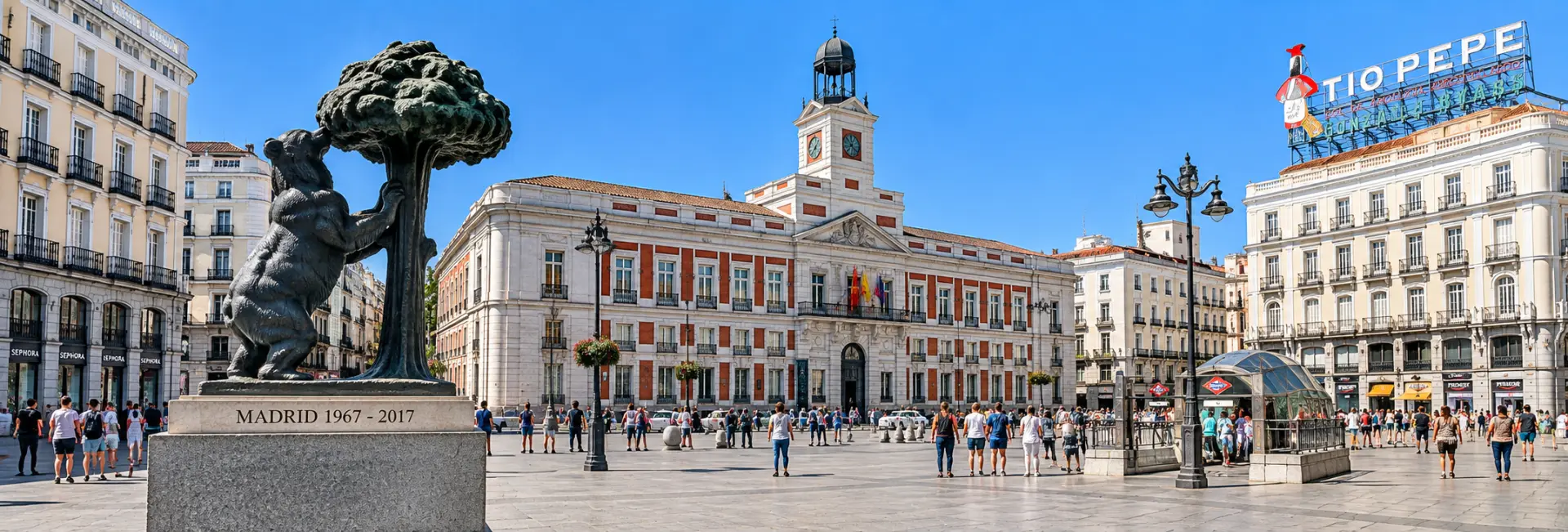
- The Real Casa de Correos, the square's oldest surviving building, was completed in 1768 as the national post office and today serves as the seat of the regional government of the Community of Madrid.
- The clock tower on the Casa de Correos, added in the 1860s, rings in the New Year for the entire country each December 31st, with its chimes broadcast nationally on Spanish television.
- Kilometre Zero, a modest stone marker set into the pavement in front of the Casa de Correos, designates the official starting point for Spain's radial network of national highways.
- The equestrian statue of King Charles III, installed at the center of the square in 1994, honors the monarch credited with modernizing 18th-century Madrid.
- El Oso y el Madroño, a sculpture of a bear reaching into a strawberry tree, reproduces the coat of arms of the city of Madrid and stands near the square's eastern entrance.
- A large illuminated sign for the sherry brand Tío Pepe, mounted above the square since the early 20th century, has become an unofficial symbol of the plaza in its own right.
Cultural Significance
Puerta del Sol's role as Kilometre Zero gives it an outsized symbolic weight for a relatively small plaza, functioning as the reference point from which every road distance in Spain is officially measured. That status, combined with the square's central location, has made it a natural stage for major political moments, from royal proclamations to mass demonstrations.
The square is most widely known outside Spain for its New Year's Eve tradition, when large crowds gather beneath the Casa de Correos clock to eat twelve grapes in time with its midnight chimes, one for each stroke of the bell, a custom believed to bring good luck for the coming year. The event is broadcast live across Spanish television, making Puerta del Sol the backdrop for one of the country's most widely shared cultural rituals.
Ways to Experience It
Most visitors treat Puerta del Sol as a starting point for exploring Madrid's historic center rather than a standalone stop, pausing to see the clock tower, Kilometre Zero, and the surrounding statues before continuing on foot toward nearby streets and squares.
- Free walking tours of Madrid's old town commonly begin or end at the square, given its central location and transport connections.
- The square sits directly above one of Madrid's busiest metro interchanges, making it a natural hub for moving on to other parts of the city.
- Shopping streets radiating out from the square, including Calle Preciados and Calle del Carmen, are popular with visitors looking to combine sightseeing with retail.
- On New Year's Eve, arriving hours in advance is standard practice for anyone hoping to join the grape-eating tradition in front of the clock.
Best Time to Visit
Puerta del Sol is busy at almost any hour, given its role as both a tourist landmark and a major transport hub, but early mornings offer the clearest views of the square's statues and façades before pedestrian traffic builds. Evenings bring a livelier atmosphere, with the surrounding shops, cafés, and street performers in full swing.
New Year's Eve is by far the most crowded time to visit, when tens of thousands gather for the midnight chimes, and December generally brings heavier foot traffic as holiday shopping picks up on the surrounding streets.
Visitor Tips
- Keep valuables secure and be mindful of pickpockets, since the square's constant crowds and transport links make it a magnet for petty theft.
- The Kilometre Zero marker is easy to miss underfoot — look for a small stone slab directly in front of the Casa de Correos entrance.
- If visiting for New Year's Eve, arrive well ahead of midnight and bring your own grapes, since the tradition calls for eating twelve of them in time with the clock's chimes.
- The square connects directly to a major metro and Cercanías interchange, making it one of the easiest points in the city to reach or depart from.
- Street vendors and photo-op characters around the square often expect a small tip if you take a photo with them.
Nearby Attractions
Puerta del Sol sits at the crossroads of several of Madrid's most walkable historic neighborhoods, making it an easy base for exploring on foot.
- Plaza Mayor, Madrid's grand 17th-century square, is just a few minutes' walk southwest through the old Habsburg quarter.
- Gran Vía, Madrid's major shopping and theater avenue, begins a short walk north of the square.
- The Royal Palace and Almudena Cathedral are within easy walking distance to the west.
- The Museo del Prado and Madrid's Golden Triangle of Art museums are a comfortable walk or short metro ride to the east.
FAQs about visiting Puerta del Sol
What is Kilometre Zero? +
It's a small stone marker set into the pavement in front of the Real Casa de Correos, marking the official starting point from which all of Spain's national road distances are measured.
Why is Puerta del Sol famous for New Year's Eve? +
The square's clock tower, on the Casa de Correos building, rings in the New Year for the entire country, and crowds gather to eat twelve grapes in time with its midnight chimes, a tradition believed to bring good luck.
Is there an entrance fee for Puerta del Sol? +
No, it's a public square that's free to visit at any time.
What are the must-see landmarks in the square? +
The Real Casa de Correos and its clock tower, the Kilometre Zero marker, the equestrian statue of Charles III, and the Bear and Strawberry Tree statue are the sights most visitors look for.
How do I get to Puerta del Sol by public transport? +
The square sits directly above Sol station, served by three metro lines as well as Cercanías regional trains, making it one of the best-connected points in the city.
Is Puerta del Sol safe to visit? +
Yes, though as with any crowded tourist hub, it's worth keeping an eye on belongings, since pickpocketing can occur in busy periods.
How much time should I plan to spend there? +
Most visitors spend 15 to 30 minutes seeing the main landmarks, though many pass through the square multiple times as a starting point for exploring the surrounding streets.
What else can I combine with a visit to the square? +
Plaza Mayor, Gran Vía, and the Royal Palace are all within easy walking distance, making Puerta del Sol a convenient base for a day exploring central Madrid.
