
Table of Contents
Overview
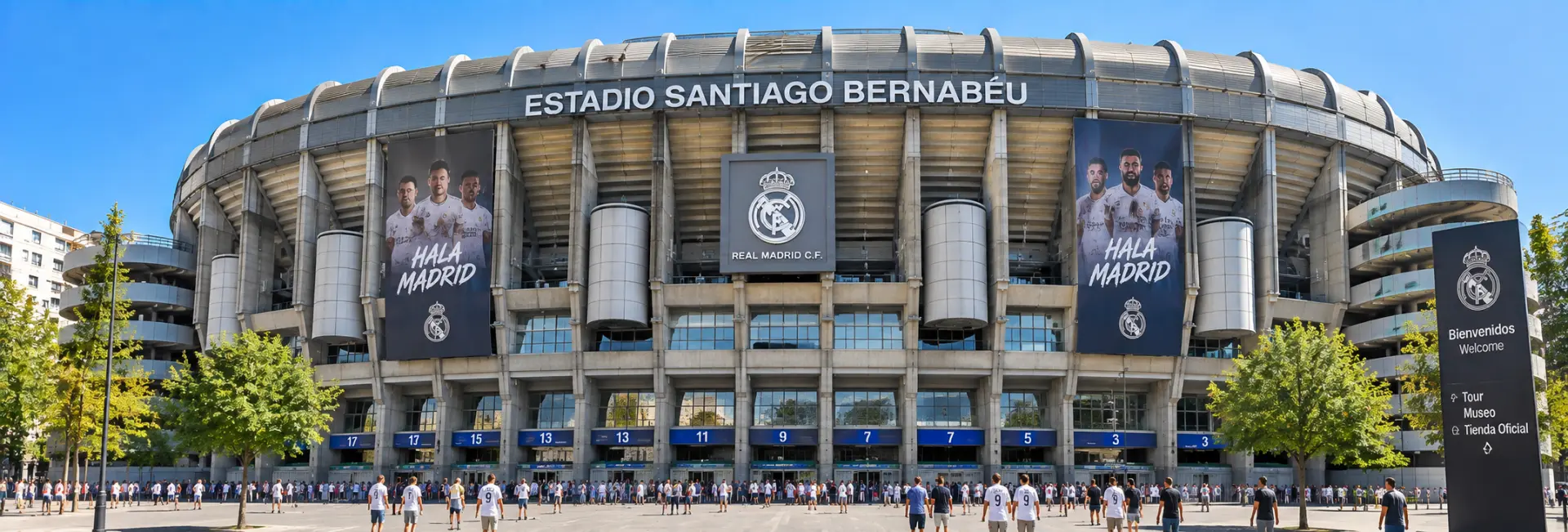
The Bernabéu, long known as the Santiago Bernabéu Stadium, is the home ground of Real Madrid and one of the most decorated venues in world football. Sitting along the Paseo de la Castellana in the Chamartín district, it has hosted the club's record run of European Cup and Champions League titles since opening in 1947, and remains one of Madrid's most visited attractions whether or not a match is on.
A recent multi-year renovation transformed the stadium's exterior and interior alike, wrapping the original concrete bowl in a curving stainless-steel façade, adding a retractable roof, and installing a pitch that can be lowered into an underground chamber to host concerts and other non-football events. In 2025, the club officially shortened the venue's name from "Estadio Santiago Bernabéu" to simply "Bernabéu," though the original name remains in everyday use among fans and visitors alike.
History
From Chamartín to a New Stadium
Real Madrid played its early matches at the modest Estadio Chamartín, a 22,500-capacity ground that served the club through the 1920s and 1930s. Club president Santiago Bernabéu Yeste, who took charge in the 1940s, concluded that a far larger venue was needed to match the club's ambitions, and construction of a new stadium began in October 1944 on a site near the old ground.
The new stadium opened in December 1947 under the name Estadio Real Madrid Club de Fútbol, with an initial capacity that would later swell to around 120,000 during the 1950s expansions. In January 1955, the stadium was renamed Estadio Santiago Bernabéu in honor of the president who had driven its construction and who continued leading the club for more than three decades.
Decades of Expansion
The stadium underwent repeated expansions and renovations over the following decades, including major work in the 1980s ahead of the 1982 FIFA World Cup and further upgrades in 2001. Its capacity fluctuated considerably across these changes, eventually settling at just over 80,000 by the early 2000s. The ground has hosted some of football's biggest occasions, including multiple European Cup and Champions League finals, and became the first stadium to host finals of both the UEFA European Championship and the FIFA World Cup.
The Renovation
Starting in 2019, the stadium underwent its most extensive transformation yet, a project that continued through 2024 at a reported cost of around 1.76 billion euros, making it one of the most expensive stadium renovations ever undertaken. Rather than demolishing the existing structure, the project rebuilt the stadium around its original bowl, replacing the old exterior facing the Castellana with a continuous, curving steel-and-glass façade on all four sides.
The renovation added a retractable roof capable of closing in around twenty minutes, along with a 360-degree interior video screen that wraps the entire seating bowl. Perhaps its most striking engineering feat is the retractable natural-grass pitch, which splits into sections that descend into a climate-controlled underground chamber, allowing the stadium to host concerts and other large events without damaging the playing surface. The work also slightly increased seating capacity to just over 83,000. In November 2025, the club made the shortened name "Bernabéu" official across its branding, a change aimed partly at making the venue easier to promote internationally.
What to See on the Tour
The self-guided Bernabéu Tour takes visitors through a route combining football history with the stadium's newly rebuilt infrastructure, typically taking around one to two hours depending on how much time is spent at each stop.
- The Trophy Room displays Real Madrid's full collection of European Cup and Champions League trophies alongside league titles, domestic cups, and personal awards won by the club's players over the decades.
- A multimedia experience zone uses interactive screens and audiovisual displays to walk visitors through the club's history and the story of the stadium's recent transformation.
- Pitch-side access lets visitors walk along the edge of the playing surface and sit in the technical area used by the team's coaching staff during matches.
- The players' tunnel and both first-team dressing rooms are included on the standard route, offering a close look at the spaces used before kickoff.
- The presidential box, reserved for executives and VIP guests on match days, is open to tour visitors the rest of the time.
Ways to Experience It
Visiting the Bernabéu generally means choosing between two distinct experiences: the self-guided stadium tour, available most days of the year, or attending an actual Real Madrid match, which fills the stadium and puts its retractable roof and video screen to full use.
- On match days and the day before a fixture, the tour route is typically cut back to the museum and panoramic viewing areas only, with the dressing rooms and pitch-side access closed.
- Match tickets for Champions League nights and marquee league fixtures sell out quickly and often carry premium pricing, so early booking is recommended for major games.
- Beyond football, the retractable pitch has allowed the stadium to host concerts and other large events, including performances during major touring artists' visits to Madrid.
- Guided tour options are available in addition to the standard self-guided route, for visitors who want more in-depth commentary along the way.
Best Time to Visit
For the tour, visiting on a non-match day gives access to the full route, including the dressing rooms and pitch-side areas that are closed in the run-up to a fixture. Weekday mornings tend to be the quietest time to take the self-guided tour before tour groups and larger crowds arrive later in the day.
For match-day visitors, the atmosphere is at its most intense during Champions League nights and high-profile league fixtures, though these dates also bring the highest ticket prices and the busiest crowds around the stadium before and after the game.
Visitor Tips
- Check whether a match is scheduled on your intended visit date, since the tour route is significantly shortened on match days and the day before.
- Booking tour or match tickets online in advance is recommended, particularly around major fixtures when demand is highest.
- The stadium entrance for tours is on Avenida de Concha Espina, distinct from the match-day entrances used around the rest of the building.
- Comfortable shoes help, since the self-guided tour covers considerable ground across multiple levels of the stadium.
- Avoid buying tickets from street sellers near the stadium on match days, and purchase only through official or verified resale channels.
Nearby Attractions
The stadium sits in Madrid's Chamartín district, along the city's central Castellana avenue, within reach of several other sights.
- The Santiago Bernabéu metro station sits directly beside the stadium, offering quick access to the rest of the city center.
- The Paseo de la Castellana, Madrid's long central boulevard, runs past the stadium and connects toward the city's modern financial district to the north and its historic core to the south.
- The Santiago Bernabéu neighborhood around the stadium is lined with sports bars and restaurants that fill up on match days.
- Retiro Park and Madrid's Golden Triangle of Art museums are a short metro ride south for visitors combining a stadium visit with sightseeing elsewhere in the city.
FAQs about visiting the Bernabéu (Santiago Bernabéu) Stadium
Is the stadium still called Santiago Bernabéu? +
The club officially shortened the name to simply "Bernabéu" in November 2025, though "Santiago Bernabéu" remains widely used by fans, media, and visitors.
What does the stadium tour include? +
The self-guided tour covers the trophy room, a multimedia history exhibit, pitch-side access, the players' tunnel, both dressing rooms, and the presidential box, typically taking one to two hours to complete.
Can I do the full tour on a match day? +
No — on match days and the day before a fixture, the route is cut back to the museum and panoramic viewing areas only, with the dressing rooms and pitch access closed.
How do I get match tickets? +
Tickets can be purchased through Real Madrid's official channels or verified resellers; Champions League and high-profile league matches sell out quickly and carry premium pricing.
What makes the recent renovation notable? +
The project added a retractable roof, a 360-degree interior video screen, a new steel-and-glass exterior façade, and a retractable natural-grass pitch that lowers into an underground chamber for non-football events, at a reported cost of around 1.76 billion euros.
Can the stadium host events besides football? +
Yes — the retractable pitch allows the venue to host concerts, American football games, and other large events without damaging the grass underneath.
How do I get to the stadium by public transport? +
The Santiago Bernabéu metro station sits directly next to the stadium, making it easy to reach from central Madrid.
How long should I plan for a tour visit? +
Most visitors spend one to two hours on the self-guided tour, though it's possible to move through the main highlights in under an hour if time is limited.
