
Table of Contents
Overview
The Reina Sofía Museum is Spain's national museum of modern and contemporary art, best known as the permanent home of Pablo Picasso's "Guernica." Housed in a converted 18th-century hospital near Atocha station, it forms the contemporary anchor of Madrid's so-called Golden Triangle of Art alongside the Prado and the Thyssen-Bornemisza museums.
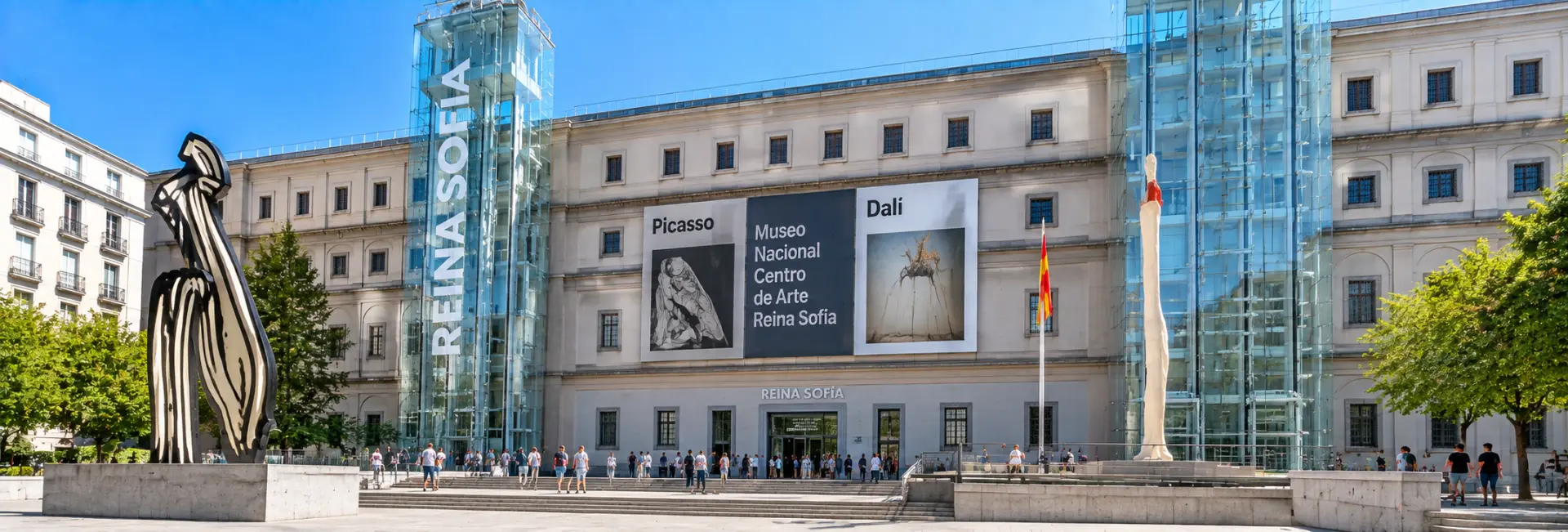
Its collection focuses on Spanish and international art from the early 20th century onward, tracing the country's turbulent modern history through the work of Picasso, Dalí, Miró, and the generations of Spanish artists who followed them. A striking contrast between the museum's historic stone hospital building and a sleek modern extension gives the Reina Sofía a distinct architectural identity within Madrid's museum district.
History
From Hospital to Cultural Institution
The building that now houses the Reina Sofía began as Madrid's General Hospital, first promoted under King Philip II in the 16th century and substantially expanded in the 18th century under Charles III. The engineer and architect José de Hermosilla drew up the original expansion plans in 1756, and the Italian architect Francesco Sabatini carried the project forward through much of the century, giving the building the large courtyarded form that survives today.
The hospital continued operating, with numerous modifications, until it finally closed in the late 1960s. The abandoned building fell into disrepair until the Spanish Ministry of Education acquired it in 1976 for conversion into a cultural center, following its declaration as a Historic-Artistic Monument the following year.
Becoming a National Museum
Restoration work began in 1980, and the building reopened as the Reina Sofía Art Centre in 1986, initially using its upper floors for temporary exhibitions. It formally became a national museum in 1990, named in honor of Queen Sofía, and was inaugurated in its current form on 10 September 1992 by King Juan Carlos I and Queen Sofía. Picasso's "Guernica" was installed shortly afterward, cementing the museum's identity around the painting's anti-war message. As the collection grew, a major extension designed by the French architect Jean Nouvel was added and completed in 2005, expanding the museum's exhibition, library, and auditorium space considerably.
Architecture & Building
The museum's original structure, now known as the Sabatini Building, retains the grand, austere stone courtyard layout of its hospital origins, softened somewhat by later renovations carried out as the building was converted for museum use. A defining addition came at the end of the 1980s, when three glass-and-steel elevator towers were installed on the building's exterior, giving visitors sweeping views over the surrounding rooftops as they move between floors.
The Nouvel Extension
Completed in 2005, the Jean Nouvel-designed extension, known as the Nouvel Building, is instantly recognizable by its bold red-tiled canopy roof and a triangular steel-and-glass atrium that connects to the older Sabatini structure. The addition considerably expanded the museum's capacity, adding new galleries for temporary exhibitions along with a library and auditorium, and created one of the more visually striking contrasts between historic and contemporary architecture found in Madrid's museum district.
Collections & Highlights
The Reina Sofía's collection concentrates on Spanish and international art from 1900 to the present, with particular strength in the movements that shaped 20th-century Spanish art around the upheavals of the Spanish Civil War and its aftermath.
- Pablo Picasso's "Guernica" (1937) is the museum's defining work, a monumental anti-war painting created in response to the bombing of the Basque town of the same name, displayed in its own dedicated gallery.
- Salvador Dalí's Surrealist paintings, including works exploring dreamlike and subconscious imagery, form a major part of the museum's early 20th-century holdings.
- Joan Miró's abstract, symbol-filled canvases represent another cornerstone of the collection's Spanish avant-garde focus.
- Works by Juan Gris and Julio González trace the development of Spanish Cubism and modern sculpture alongside the museum's better-known names.
- A smaller but notable selection of international works, including pieces connected to Man Ray, Francis Bacon, and other 20th-century figures, situates the Spanish collection within a wider global context.
Beyond its painting galleries, the museum also maintains extensive archives related to 20th-century Spanish cultural and political history, supporting an active program of research and temporary exhibitions.
Ways to Experience It
Most visitors prioritize "Guernica" and the surrounding rooms tracing the lead-up to the Spanish Civil War, since this sequence forms the emotional and historical core of the museum's permanent collection. An audio guide is available for visitors who want more context on the paintings without joining a group tour.
- Guided tours focused specifically on "Guernica" and its historical background are a popular way to go deeper into the painting's context.
- The Sabatini Building holds most of the permanent collection, while the Nouvel Building next door is generally used for temporary and rotating exhibitions.
- A combined ticket covering the Reina Sofía, the Prado, and the Thyssen-Bornemisza is available for visitors planning to see all three of Madrid's major art museums.
- Free entry is offered during set evening hours several days a week, as well as on Sunday afternoons, for visitors willing to plan around the museum's schedule.
Best Time to Visit
Weekday mornings tend to be the calmest time to see "Guernica" and the surrounding galleries without the density of crowds that builds later in the day. The museum's free entry windows are a good option for budget-conscious visitors, though they typically draw longer lines than paid admission slots.
The museum is closed on Tuesdays, so it's worth checking the current weekly schedule before planning a visit around a specific day.
Visitor Tips
- Booking tickets online in advance is recommended, particularly during free entry hours or peak tourist season, to avoid long queues at the door.
- The museum is closed on Tuesdays and on a handful of public holidays throughout the year, so it's worth confirming opening days before visiting.
- The Sabatini Building's glass elevators are worth using at least once for the view they offer over the surrounding neighborhood.
- A combined ticket with the Prado and Thyssen-Bornemisza museums is worth considering for visitors planning to see Madrid's full Golden Triangle of Art.
- Photography rules vary by gallery, so it's worth checking posted signage near "Guernica" and other sensitive works before taking pictures.
Nearby Attractions
The Reina Sofía sits at the southern end of Madrid's museum corridor, within walking distance of the city's other major art institutions.
- The Prado Museum and Thyssen-Bornemisza Museum, the other two members of the Golden Triangle of Art, are both a short walk north along the Paseo del Prado.
- Atocha train station, with its striking indoor tropical garden, sits directly across from the museum.
- Retiro Park is within easy walking distance to the northeast, offering a green space to unwind after a museum visit.
- The Lavapiés neighborhood, known for its multicultural food scene and independent art spaces, borders the museum to the south.
FAQs about visiting the Reina Sofía Museum
What is the Reina Sofía Museum best known for? +
It's best known as the permanent home of Pablo Picasso's "Guernica," a monumental anti-war painting created in response to the 1937 bombing of the Basque town of the same name.
How much time should I plan for a visit? +
Most visitors spend two to three hours seeing the permanent collection, though art lovers wanting to explore the temporary exhibitions in the Nouvel Building often plan for longer.
Is photography allowed inside the museum? +
Photography rules vary by gallery, and some highly sensitive works, including areas around "Guernica," have specific restrictions, so it's best to check posted signage in each room.
Is there free entry to the Reina Sofía? +
Yes, the museum offers free entry during set hours several evenings a week and on Sunday afternoons, though these slots tend to draw longer queues than paid admission.
What other artists are featured besides Picasso? +
The collection includes major works by Salvador Dalí, Joan Miró, Juan Gris, and Julio González, along with a smaller selection of international artists situating Spanish art in a broader context.
Which day is the museum closed? +
The Reina Sofía is closed on Tuesdays, along with a small number of public holidays throughout the year.
How do I get to the museum by public transport? +
The museum sits directly across from Atocha train and metro station, making it one of the easiest major museums in Madrid to reach by public transport.
Can I combine a Reina Sofía ticket with other Madrid museums? +
Yes, a combined pass covering the Reina Sofía, the Prado, and the Thyssen-Bornemisza is available for visitors planning to see all three of Madrid's major art museums.
What else is nearby that I can pair with a visit? +
The Prado and Thyssen-Bornemisza museums are a short walk north, and Retiro Park and the Lavapiés neighborhood are both within easy walking distance.
