
Table of Contents
Overview
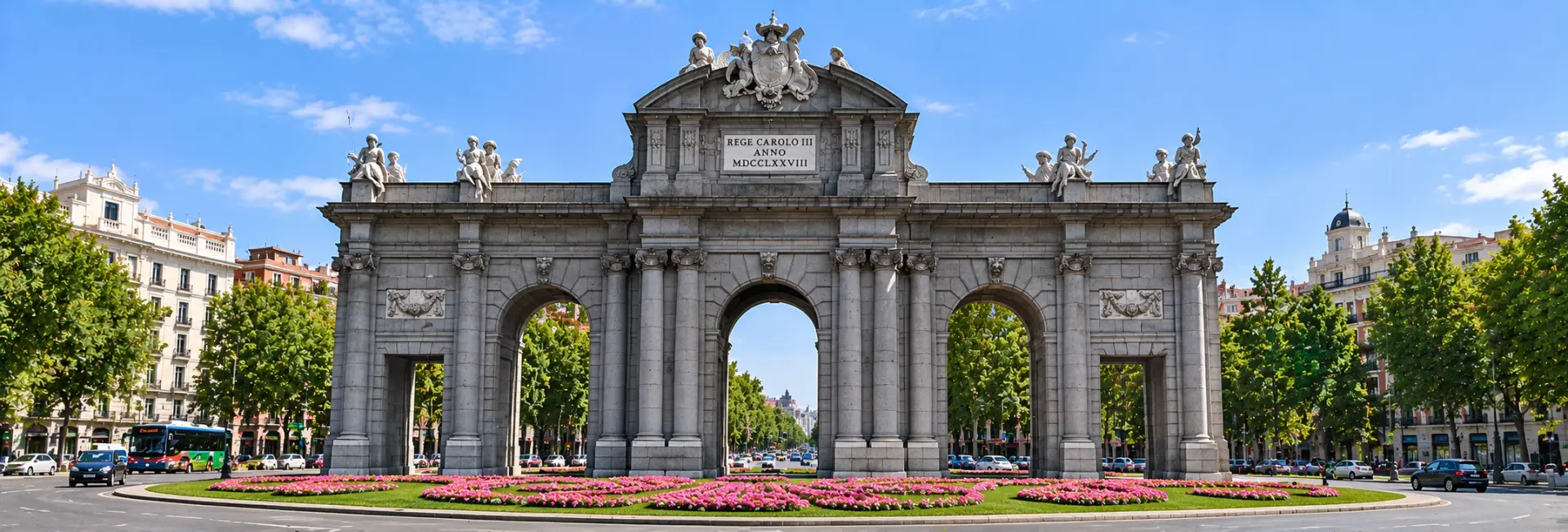
Puerta de Alcalá is an 18th-century granite gate standing in the Plaza de la Independencia, at the junction where three of Madrid's best-known streets meet just outside Retiro Park. Commissioned as a grand ceremonial entrance into the city, it has outlived its original defensive purpose by more than two centuries and now serves as one of Madrid's most recognizable free-standing monuments.
Its scale and neoclassical detailing were meant to rival the great gateways of Rome and Paris, and by most accounts it succeeded: the arch predates both the Arc de Triomphe and Berlin's Brandenburg Gate, making it one of the earliest large triumphal arches built anywhere in Europe since antiquity.
History
A King Unimpressed by His Own Capital
Puerta de Alcalá takes its name from its original role as the starting point of the road to Alcalá de Henares, a town northeast of Madrid, and stood as one of several gates set into the city's old walls. A smaller, plainer brick gate had occupied a similar site since the 16th century, but King Charles III reportedly found it an unfitting welcome when he first arrived in Madrid in 1759 to take the Spanish throne.
As part of a broader program to modernize and beautify the capital, Charles III ordered the old gate demolished and commissioned a grander replacement. After considering proposals from other prominent architects, including Ventura Rodríguez and José de Hermosilla, the king ultimately chose a design by the Italian architect Francesco Sabatini, who had also worked on the Royal Palace nearby.
Construction and Inauguration
Construction ran from 1774 to 1778, with Sabatini overseeing the project throughout. The finished gate was built substantially larger than its predecessor, with five openings instead of three, reflecting the king's wish for a more imposing monument befitting a European capital. Since its completion, the gate has undergone several restorations to preserve its stonework, while its role has shifted entirely from a functional, gated entrance to the city into a purely symbolic landmark.
Architecture & Design
Puerta de Alcalá stands 19.5 metres tall and roughly 43 metres wide, built from granite and limestone in a restrained neoclassical style influenced by Roman triumphal arches. Its five openings are arranged with three larger central arches, originally intended for carriages, flanked by two smaller rectangular openings meant for pedestrians.
Two Different Faces
A distinctive quirk of the monument is that its two façades are not identical. The side facing outward, toward those arriving in the city, differs in decoration from the inward-facing side, a deliberate design choice that rewards visitors who walk around the structure rather than viewing it from a single angle.
Sculptural Details
The gate is decorated with sculpted reliefs, capitals, and masks, along with ornamental statuary created by the sculptors Francisco Gutiérrez and Roberto Michel. These decorative elements, combined with the building's overall symmetry, reflect the Enlightenment-era architectural values that shaped much of Charles III's building program across Madrid.
Recognition & Status
Puerta de Alcalá has been designated a Bien de Interés Cultural, placing it among Spain's most protected categories of national heritage. Its historical significance rests largely on its status as the first large triumphal arch built in Europe following the fall of the Roman Empire, a distinction that places it ahead of far more famous arches built decades or centuries later elsewhere on the continent.
Beyond its architectural pedigree, the gate has become a broader symbol of Madrid itself, regularly appearing in depictions of the city and serving as a backdrop for civic celebrations held in the surrounding Plaza de la Independencia.
Ways to Experience It
Puerta de Alcalá is a freestanding monument in the middle of a busy traffic roundabout, so it's viewed and photographed from the surrounding plaza and sidewalks rather than entered or climbed. Most visitors take it in as part of a longer walk between Retiro Park and the nearby streets of the Salamanca and Retiro districts.
- Walking around the full circumference of the gate reveals the difference between its two façades, a detail easy to miss from a single viewpoint.
- The monument is illuminated at night, making it a popular photo stop for an evening walk near Retiro Park.
- Its location at Plaza de la Independencia makes it a natural stop when entering or leaving Retiro Park through the square's main gate.
Best Time to Visit
Early morning or early evening light tends to bring out the texture of the gate's granite and limestone surfaces most clearly, and traffic around the roundabout is generally lighter outside of rush hour. Evenings offer a different but equally popular view, when the monument's lighting sets it apart from the surrounding streets.
Since the gate sits in the open air with no set opening hours, it can be viewed at any time, making it an easy stop to fit around a visit to Retiro Park or the surrounding neighborhood regardless of the season.
Visitor Tips
- The gate cannot be entered or climbed, as it's preserved strictly as an exterior monument, so plan to view and photograph it from the surrounding plaza.
- Use marked crosswalks when circling the monument, since it sits within a busy traffic roundabout.
- Pairing a visit with Retiro Park's main entrance nearby makes for an efficient combined stop, since the two sit right next to each other.
- There's no admission fee or fixed visiting hours, since it's a public monument rather than an enclosed attraction.
Nearby Attractions
Puerta de Alcalá sits at a natural crossroads between several of Madrid's central neighborhoods, making it an easy stop on a longer walk.
- Retiro Park's main entrance at Plaza de la Independencia is immediately adjacent to the gate.
- The Prado Museum and the rest of Madrid's Golden Triangle of Art are a short walk south along the Paseo del Prado.
- Calle de Serrano, one of Madrid's most upscale shopping streets, extends north from the same square.
- The Salamanca district, known for its boutiques and residential architecture, borders the plaza to the north.
FAQs about visiting Puerta de Alcalá
Can I go inside or climb Puerta de Alcalá? +
No, the monument is preserved as an exterior structure only and cannot be entered or climbed by visitors.
Is there an entrance fee? +
No, it's a public monument in an open square with no admission fee or fixed opening hours.
Why is Puerta de Alcalá historically significant? +
It's considered the first large triumphal arch built in Europe since the fall of the Roman Empire, predating both the Arc de Triomphe in Paris and the Brandenburg Gate in Berlin.
Why does the gate look different from each side? +
Its two façades were deliberately designed with different decoration, one facing outward toward those entering the city and the other facing inward, a detail best appreciated by walking around the monument.
How do I get to Puerta de Alcalá by public transport? +
The Retiro metro station, on Line 2, sits right beside the gate at Plaza de la Independencia, and several bus routes also stop nearby.
What's the best time of day to see it? +
Early morning or early evening light shows off the stonework well, while evening brings a different view once the monument is illuminated.
Can I combine a visit with Retiro Park? +
Yes, the gate stands right beside the park's main entrance at Plaza de la Independencia, making the two an easy combined stop.
What else is nearby? +
The Prado Museum, Calle de Serrano's shopping district, and the Salamanca neighborhood are all within easy walking distance of the gate.
