
Table of Contents
Overview
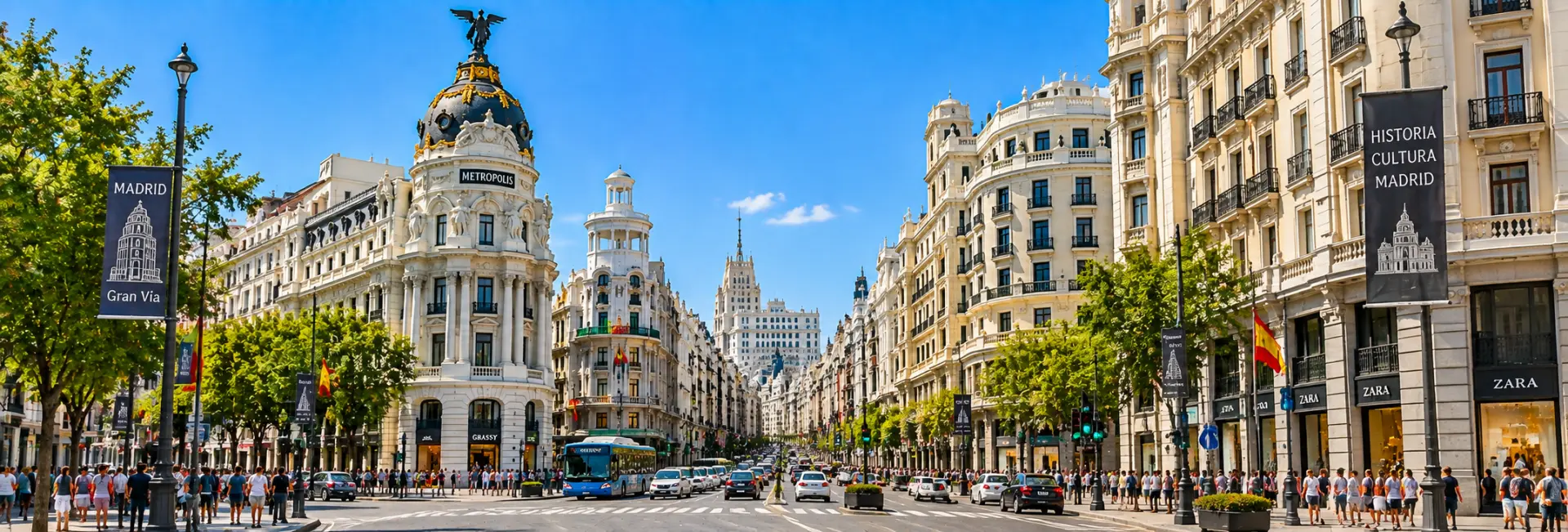
Gran Vía is Madrid's grandest avenue, a 1.3-kilometer stretch of early 20th-century towers, theaters, and shopfronts that cuts diagonally through the historic center from Calle de Alcalá to Plaza de España. Built in stages between 1910 and 1929, it introduced a scale of architecture and urban planning that Madrid had never seen before, and it remains the city's most recognizable street a century later.
Often nicknamed the "Spanish Broadway" for its concentration of theaters and cinemas, Gran Vía today functions as Madrid's busiest shopping and entertainment corridor, layered with department stores, hotels, musicals, and rooftop bars behind façades that still show off the ornate architectural styles of the era that built them.
History
An Axe Blow on the Map
Plans to cut a new avenue through Madrid's dense, irregular old quarter date back to the mid-19th century, but the legal groundwork wasn't laid until Spain's 1895 Law of Internal Reform, which allowed larger cities to redevelop their urban centers. Madrid's city council approved the specific Gran Vía project in 1901, and after further delays, construction finally began in 1910.
The project required demolishing roughly 300 existing buildings and around fifteen surrounding streets, an upheaval so severe that critics at the time dubbed it "an axe blow on the map." The avenue was built in three distinct phases, each initially treated as a separate street, and the last stretch, connecting through to Plaza de España, wasn't completed until 1929, nearly two decades after work began.
A Street of Many Names
Gran Vía has carried several official names over the past century, reflecting the political changes of each era: it was known as Avenida de la Unión Soviética during the Second Spanish Republic and later as Avenida de José Antonio under Franco's government, honoring the founder of the Falange political movement. During the Spanish Civil War, heavy shelling along the avenue earned it the grim nickname "Avenue of the Shells." The name Gran Vía was permanently restored during Spain's democratic transition in 1981 and has remained ever since.
Architecture & Notable Buildings
Gran Vía's construction gave architects of the era a rare opportunity to build large, ambitious structures in the latest international styles, resulting in a corridor that mixes Beaux-Arts, Art Nouveau, and Art Deco design within a few hundred meters of each other.
- The Edificio Metrópolis, at the avenue's eastern entrance near Calle de Alcalá, was completed in 1911 and is topped by a domed cupola and a winged statue of the goddess Victoria, making it one of the most photographed buildings in the city.
- The Edificio Grassy, built in 1917, is considered the first true building on Gran Vía itself and is recognizable by its rounded corner tower and twin open-air belvederes.
- The Telefónica Building, completed in 1929, rose 89 meters and was Europe's tallest building for over a decade; it served as a filing point for foreign war correspondents, including Ernest Hemingway, during the Spanish Civil War.
- The Edificio Carrión, better known as the Capitol Building, is a large Art Deco tower famous for the illuminated Schweppes sign mounted above its rooftop, one of the avenue's most recognizable modern landmarks.
- The Palacio de la Prensa, completed in 1929 near Callao Square, was built as the headquarters of Madrid's press association and remains one of the avenue's tallest brick-clad towers.
Key Areas Along the Avenue
Gran Vía is loosely organized around a handful of landmark squares and stretches, each with its own character.
- The eastern end, near the Edificio Metrópolis and Calle de Alcalá, marks the avenue's grandest architectural entrance and connects toward Plaza de Cibeles.
- Plaza del Callao, roughly at the midpoint, is framed by cinema marquees and department stores and functions as one of the avenue's busiest gathering points.
- The western stretch toward Plaza de España includes the mid-20th-century Edificio España, a later and more austere addition that marks a visual shift from the earlier decades of construction.
- Side streets branching off the avenue connect to the Chueca, Malasaña, and Sol neighborhoods, each offering a different pace than the avenue itself.
Ways to Experience It
Most visitors experience Gran Vía as a walk from one end to the other, taking in the architecture at street level before ducking into shops, theaters, or rooftop bars along the way. Starting at Plaza de España and walking east roughly follows the order in which the avenue's sections were originally built.
- Several buildings along the avenue, including the Círculo de Bellas Artes and the Edificio Grassy, offer rooftop terraces with panoramic views over the surrounding skyline.
- Gran Vía is home to a cluster of theaters showing long-running musicals, a big part of its reputation as Madrid's "Spanish Broadway."
- The Fundación Telefónica, inside the historic Telefónica Building, hosts free art and technology exhibitions most days of the week.
- Department stores and flagship international retailers line much of the avenue, making it one of the city's primary shopping destinations.
Best Time to Visit
Daytime hours suit shopping and architectural sightseeing, when storefronts are open and the details on the older façades are easiest to appreciate in natural light. The avenue takes on a different character after dark, when illuminated signs, theater marquees, and rooftop bars give it a livelier, more nocturnal energy.
Weekday mornings tend to be quieter for a relaxed walk, while evenings and weekends bring heavier foot traffic as theatergoers, shoppers, and nightlife crowds fill the street.
Visitor Tips
- Wear comfortable shoes — a full walk from Plaza de España to Calle de Alcalá covers roughly 1.3 kilometers, plus dips into side streets.
- Rooftop bars and viewpoints along the avenue, such as the one atop the Edificio Grassy, are among the best-value ways to see the avenue's skyline from above.
- Theater tickets for the avenue's long-running musicals sell out on popular nights, so it's worth booking ahead if a specific show is a priority.
- Traffic and pedestrian volume can be heavy at street level, so use marked crossings rather than crossing mid-block.
- The avenue is well served by multiple metro stations, making it easy to start or end a walk at whichever point suits your route.
Nearby Attractions
Gran Vía connects several of Madrid's most walkable central neighborhoods, making it a natural spine for a day of sightseeing.
- Puerta del Sol, Madrid's central square, is a short walk southeast from the avenue's midpoint.
- Plaza Mayor and the historic Habsburg quarter lie just south of Gran Vía through the surrounding streets.
- The Malasaña and Chueca neighborhoods, known for their independent shops, bars, and nightlife, branch off from the avenue's northern side.
- Plaza de España, at the avenue's western end, connects toward the Royal Palace and Templo de Debod.
FAQs about visiting Gran Vía
How long is Gran Vía and how long does it take to walk? +
The avenue runs about 1.3 kilometers between Calle de Alcalá and Plaza de España, and a relaxed walk end to end, without stops, takes roughly 20 to 30 minutes.
Why is Gran Vía called the "Spanish Broadway"? +
The nickname comes from its dense concentration of theaters and cinemas, many of which have hosted long-running musicals and film premieres for decades.
What are the must-see buildings along Gran Vía? +
The Edificio Metrópolis, the Telefónica Building, the Edificio Grassy, and the Art Deco Edificio Carrión with its Schweppes sign are the landmarks most visitors look out for.
Is Gran Vía a good place to shop? +
Yes, it's one of Madrid's busiest shopping streets, home to major department stores and international retail chains alongside older, more traditional shops.
Can I see Gran Vía from above? +
Yes — several buildings along the avenue, including the Edificio Grassy and the Círculo de Bellas Artes, offer rooftop terraces with panoramic views over the street and surrounding skyline.
What's the best time of day to visit? +
Daytime suits shopping and architectural photography, while evenings bring a livelier atmosphere with illuminated signs, theater crowds, and rooftop bars.
How do I get to Gran Vía by public transport? +
Multiple metro stations run along or near the avenue, including Gran Vía, Callao, and Santo Domingo, making it easy to join or leave the street at several points.
What else can I combine with a visit to Gran Vía? +
Puerta del Sol, Plaza Mayor, and the Malasaña and Chueca neighborhoods are all within easy walking distance of the avenue.
