
Table of Contents
Overview
Retiro Park is Madrid's grandest green space, a former royal garden that now serves as the city's most popular place to walk, row a boat, or simply sit under centuries-old trees. Spread across roughly 125 hectares just east of the city center, it blends formal 17th-century garden design with 19th-century pavilions, sculpture gardens, and open lawns that draw both locals and visitors year-round.
Once reserved for the exclusive use of the Spanish crown, the park has been open to the public since the late 19th century and today forms part of a UNESCO World Heritage Site alongside the nearby Paseo del Prado. Its mix of architecture, water features, and greenery makes it as much an open-air museum as it is a place to relax.

History
A Royal Retreat
The land that became Retiro Park was first developed as a religious retreat in the early 16th century, when a monastery moved to the site and the royal family built an adjoining retirement lodge nearby. King Philip II later enlarged the grounds after moving the Spanish court to Madrid, laying out formal tree-lined walks that formed the earliest skeleton of the park.
The gardens took on their grander form in the 1630s, when royal minister Gaspar de Guzmán, Count-Duke of Olivares, arranged for a far larger palace and garden complex to be built for King Philip IV. The layout, designed by the Italian landscaper Cosimo Lotti, was organized around a series of ponds and canals, including the great pond that still anchors the park today. For much of the 17th century, the Buen Retiro Palace and its gardens formed the social and theatrical heart of the Spanish court.
From Ruin to Public Park
Much of the original palace complex was destroyed during the Peninsular War in the early 19th century, when occupying French forces built a military citadel on the grounds. The gardens were gradually replanted and expanded under Queen Isabella II, and after her overthrow in 1868, the park passed from royal to public ownership.
The following decades reshaped the park into much of what visitors see today. International exhibitions held in the park during the 1880s left behind several of its best-known buildings, and later additions, including the rose garden created under head gardener Cecilio Rodríguez in the 1930s and 1940s, filled out the grounds further. In 2021, the park was recognized by UNESCO as part of a combined World Heritage listing covering both Retiro Park and the neighboring Paseo del Prado.

Key Areas & Landmarks
Retiro Park is dense with monuments and buildings left behind by three centuries of royal and civic history, and most visitors build their route around a handful of standout sights near the park's center.
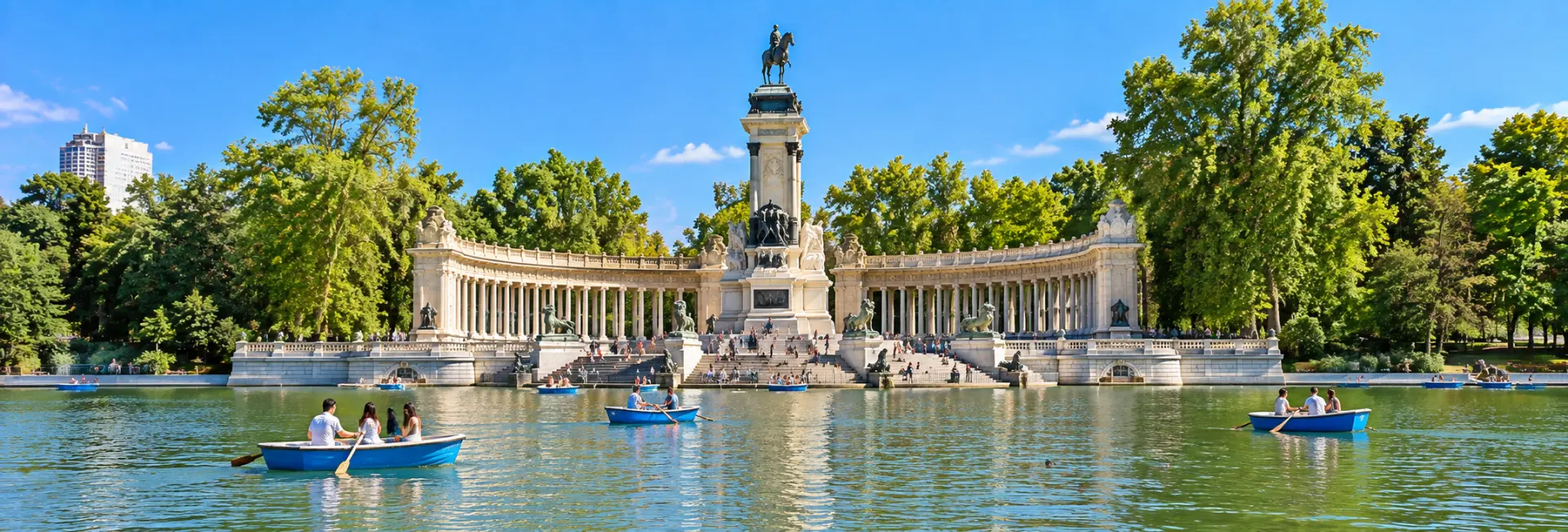
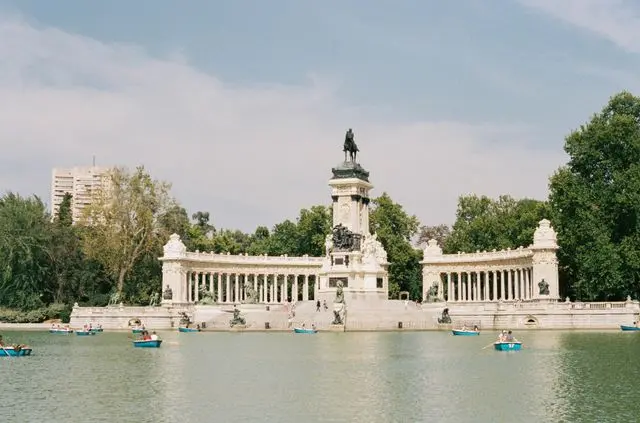
- The Retiro Pond, a large artificial lake near the park's northern entrance, is overlooked by the sweeping Monument to Alfonso XII, a semicircular colonnade topped with an equestrian statue.
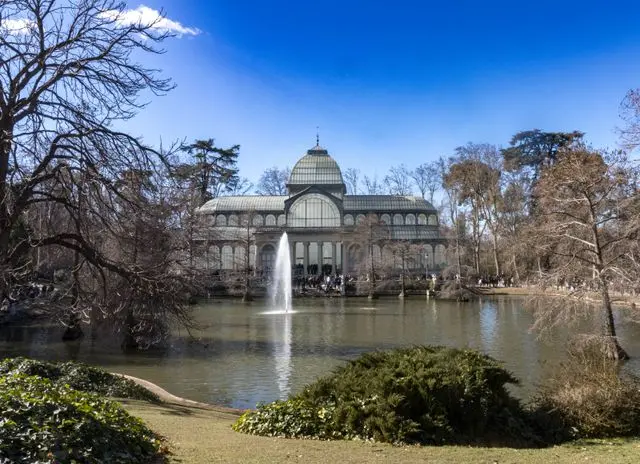
- The Crystal Palace, a glass-and-iron pavilion built in 1887 for a colonial exhibition, sits beside its own reflecting pond and now hosts contemporary art exhibitions.
- The Palacio de Velázquez, another 1880s exhibition building by the same architect, is used as an additional gallery space for temporary art shows.
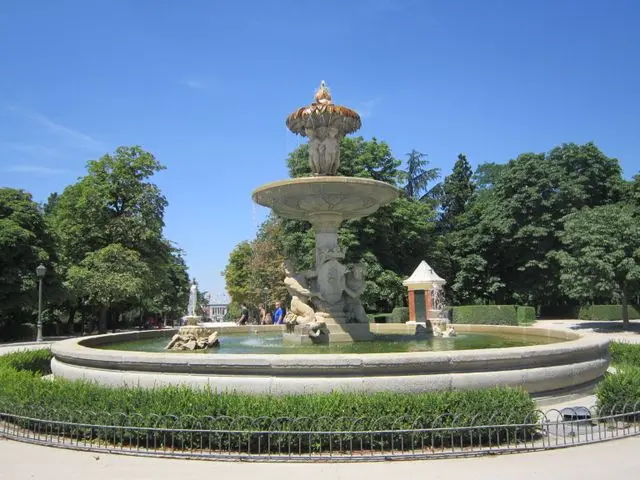
- The Fountain of the Fallen Angel, in the rose garden area, holds a striking 1922 sculpture of a falling figure inspired by Milton's "Paradise Lost" and is often described as one of the only public monuments dedicated to a devil figure anywhere in the world.
- The Paseo de la Argentina, also known as the Statue Walk, is lined with stone sculptures of Spanish monarchs originally carved for the Royal Palace.
- The Casón del Buen Retiro and the Hall of Realms are among the few surviving fragments of the original 17th-century palace complex, now used for museum purposes tied to the nearby Prado.
Gardens & Flora
Beyond its monuments, the park is known for its variety of planted gardens and its long-lived trees, with more than 15,000 trees spread across the grounds representing well over a hundred species.
Notable Gardens
The Rosaleda, or rose garden, was inspired by the Bagatelle rose garden in Paris and blooms through late spring, drawing crowds for its layered flowerbeds. Elsewhere, the Jardines de Cecilio Rodríguez brings an Andalusian-style garden of fountains, peacocks, and shaded courtyards, while the Parterre holds one of the park's oldest and most distinctive trees, a Mexican conifer planted centuries ago.
Notable Trees and Wildlife
The park's oldest known tree is an olive planted in the late 14th century, long before the gardens themselves existed in their current form. Wooded, less-manicured corners of the park are also home to a small population of red squirrels, a species that has struggled to survive in much of the rest of Europe due to competition from introduced grey squirrels.
Ways to Experience It
Most visitors treat Retiro Park as a place to wander freely rather than follow a fixed route, moving between the lake, the Crystal Palace, and the rose garden at their own pace. Renting a rowboat on the Retiro Pond is one of the park's signature activities, and the surrounding paths are popular with runners, cyclists, and rollerbladers throughout the day.
- Guided walking tours are available for visitors who want the history behind the park's monuments rather than exploring on their own.
- Puppet shows, street musicians, and fortune tellers are common around the lake, especially on weekends.
- The Crystal Palace and Palacio de Velázquez host rotating contemporary art exhibitions, usually free to enter.
- A weekly outdoor concert by the city's symphonic band runs on Sunday afternoons from late spring through early autumn.

Best Time to Visit
Spring is widely considered the park's best season, when the rose garden is in bloom and temperatures are mild enough for long walks without the summer heat. Weekday mornings offer the calmest atmosphere, before the lake area fills with visitors renting boats and locals gathering for weekend leisure.
Weekends, especially sunny Saturday and Sunday afternoons, draw the largest crowds around the pond and main paths, while the park's quieter wooded corners stay peaceful even during busy periods.
Visitor Tips
- Entry to the park itself is free, though renting a rowboat, visiting temporary exhibitions inside some pavilions, or joining a guided tour comes at an extra cost.
- The park has multiple gates around its perimeter, so it's worth picking an entrance close to whichever landmark you want to see first, such as the Puerta de la Independencia near the lake.
- Bring cash or a card for boat rentals and food stalls, since not every vendor inside the park accepts every payment method.
- The Crystal Palace can close to visitors on rainy days due to the building's construction, so it's worth checking conditions if that's a priority stop.
- Comfortable walking shoes help, since a thorough loop of the park's main sights covers a fair amount of ground on foot.
Nearby Attractions
Retiro Park sits at the edge of Madrid's museum district, making it easy to combine with several of the city's major sights in a single day.
- The Prado Museum borders the park's western edge and is within a short walk of the main lake area.
- The Puerta de Alcalá, an 18th-century neoclassical gate, stands just outside the park's northern entrance at Plaza de la Independencia.
- The Royal Botanical Garden sits between the park and the Prado, offering a quieter, more curated green space nearby.
- The Reina Sofía Museum and the Thyssen-Bornemisza Museum, both part of Madrid's Golden Triangle of Art, are within easy walking or short metro distance.
FAQs about visiting Retiro Park
Is Retiro Park free to enter? +
Yes, entry to the park is free at all times. Some activities inside it, like renting a rowboat or joining a guided tour, come with a separate cost.
How much time should I plan for a visit? +
Most visitors spend one to three hours in the park, depending on whether they're taking a quick walk or stopping at the lake, the rose garden, and the Crystal Palace along the way.
What are the must-see spots inside the park? +
The Retiro Pond and Monument to Alfonso XII, the Crystal Palace, the rose garden, and the Fountain of the Fallen Angel are the sights most visitors prioritize on a first trip.
Can I rent a boat on the lake? +
Yes, rowboats can be rented on the Retiro Pond for a paddle around the water, a popular activity for both locals and visitors.
What's the best time of year to visit? +
Spring is generally considered the best season, when the rose garden is blooming and temperatures are comfortable for extended walking, though the park is enjoyable year-round.
Is the park suitable for children? +
Yes, the park has playgrounds, open lawns, puppet shows on weekends, and boat rides on the lake, making it a popular spot for families.
How do I get to Retiro Park by public transport? +
The Retiro metro station, on Line 2, sits right by the park's northern entrance at Plaza de la Independencia, and several bus routes also stop nearby.
Why is Retiro Park a UNESCO World Heritage Site? +
It was added to the UNESCO World Heritage list in 2021 as part of a combined designation covering both Retiro Park and the neighboring Paseo del Prado boulevard, recognizing the area's history as a center of art, science, and royal life.
What else can I combine with a visit to the park? +
The Prado Museum sits right at the park's edge, and the Royal Botanical Garden, Puerta de Alcalá, and Reina Sofía and Thyssen-Bornemisza museums are all within easy reach.