
Table of Contents
Overview
Hidden beneath the busy streets of Sultanahmet lies one of Istanbul's most extraordinary and atmospheric ancient structures: the Basilica Cistern (Yerebatan Sarnıcı). Known in Turkish as the "Sunken Palace," this vast subterranean chamber was constructed in the 6th century to serve as a massive water reservoir for the Great Palace of Constantinople and the surrounding buildings.
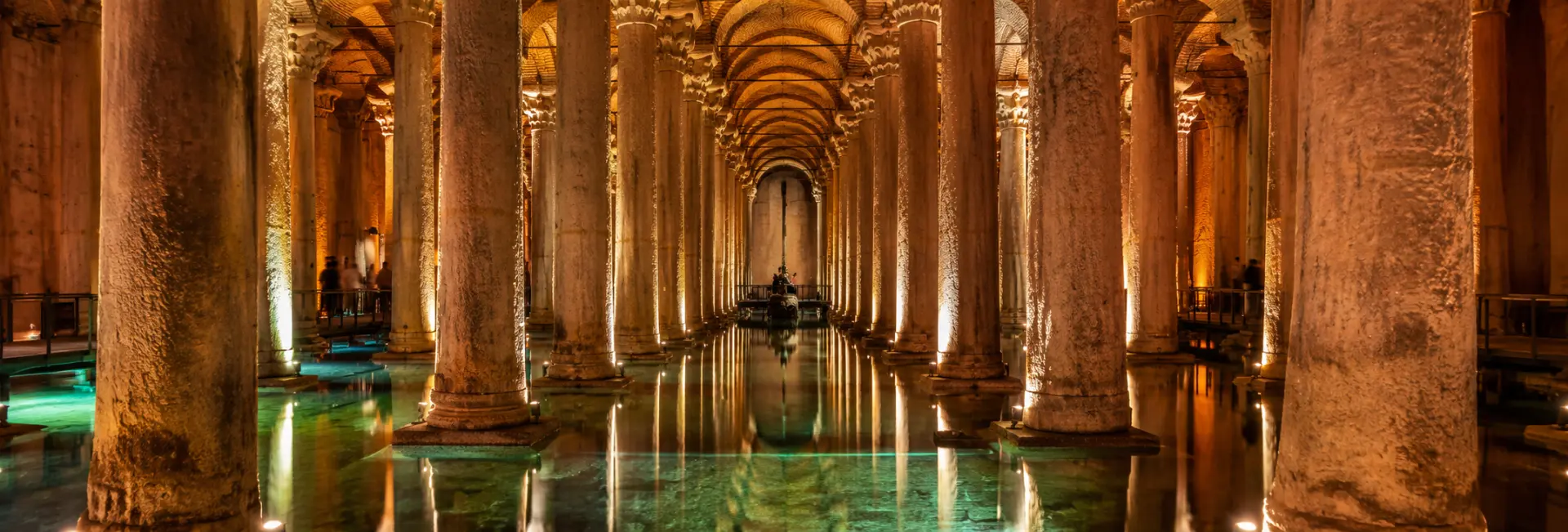
Stepping down into the cistern provides an immediate and dramatic contrast to the noisy, sunlit city above. The air is cool and damp, and the space is vast, supported by a seemingly endless forest of 336 illuminated marble columns rising out of shallow water. The subtle, theatrical lighting and the gentle sound of dripping water create a deeply mysterious and romantic atmosphere that has captivated visitors-and filmmakers-for decades.
Following a massive restoration completed in 2022, the Basilica Cistern is more breathtaking than ever. The addition of modern walkways, subtle contemporary art installations, and upgraded lighting has secured its place as a must-see marvel of Byzantine engineering and aesthetics.
History and Construction
Justinian's Water Supply
The cistern was commissioned by the Byzantine Emperor Justinian I in 532 AD. As the city of Constantinople grew, securing a reliable and secure water supply became critical, especially during times of siege. The water for the cistern was transported via a massive network of aqueducts, traveling nearly 20 kilometers from the Belgrade Forest near the Black Sea.
The name "Basilica Cistern" comes from a large public square, the Stoa Basilica, which originally sat on the land directly above the reservoir. The construction of the cistern was a monumental undertaking, reportedly requiring the labor of over 7,000 slaves to dig the massive cavern and install the brick vaulting and columns.
Rediscovery and Restoration
Following the Ottoman conquest in 1453, the Ottomans initially used the water to irrigate the gardens of Topkapi Palace. However, because Islamic tradition strongly preferred running water to stagnant water, the cistern eventually fell out of use and was largely forgotten by the city authorities. It was "rediscovered" in the mid-16th century by a French scholar, Petrus Gyllius, who was investigating rumors that locals in the area were pulling up buckets of water-and occasionally fish-through holes in their basement floors. Since then, it has undergone multiple restorations, the most recent and significant of which concluded in 2022, saving the structure from potential earthquake damage.
Architectural Features
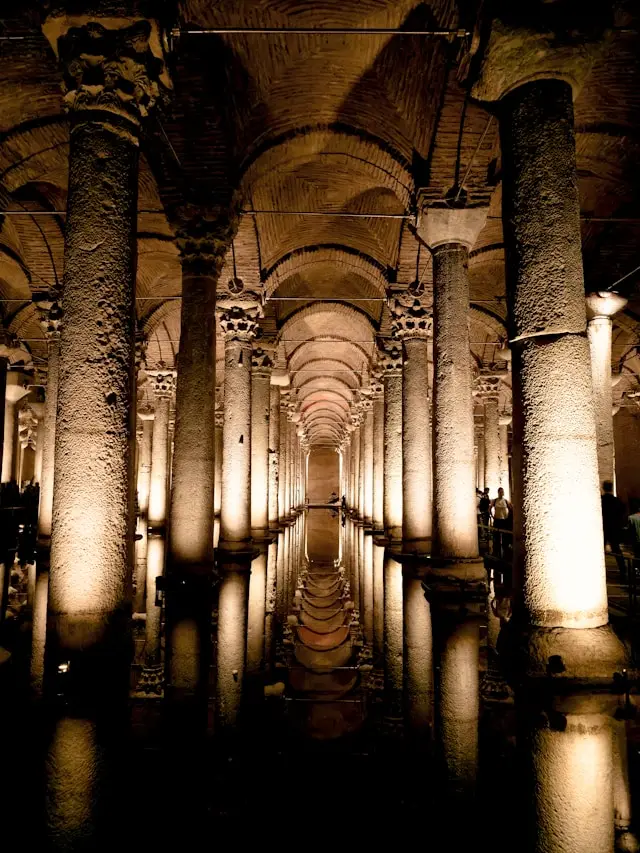
The engineering of the cistern is as impressive as its atmosphere. The rectangular chamber measures roughly 138 meters (453 feet) long and 65 meters (213 feet) wide, giving it a capacity to hold an astonishing 80,000 cubic meters of water. The ceiling is supported by a grid of 336 marble columns, arranged in 12 rows of 28 columns each.
What makes the columns particularly fascinating is that they are not uniform. Most of them were salvaged and repurposed from ruined ancient Roman temples and buildings from across the empire. As a result, you will see a mix of architectural styles, primarily Corinthian and early Byzantine, with some Ionic and Doric columns mixed in. This recycling of ancient materials (known as spolia) gives the forest of pillars a uniquely varied and textured appearance.
The Enigmatic Medusa Heads
Located in the far northwestern corner of the cistern are its most famous and mysterious features: two massive stone blocks carved with the terrifying visage of Medusa, the gorgon from Greek mythology with snakes for hair. These blocks are used as the bases for two of the columns.
What makes them intriguing is their orientation: one Medusa head is placed completely upside down, and the other is rotated on its side. Historians generally agree that they were brought from a late Roman building and placed this way simply because they were the right size and shape to serve as sturdy bases, with no regard for the pagan imagery. However, local legends persist that they were intentionally inverted to negate the deadly power of Medusa's gaze. Whatever the true reason, they remain a fascinating and eerie highlight of the visit.
The Weeping Column
Among the hundreds of smooth marble pillars, one column stands out. Known as the Weeping Column or the Hen's Eye column, it is carved with distinctive teardrop or eye-shaped motifs that run down its entire length. Due to the dampness of the cavern, the column appears to be constantly crying.
According to ancient texts, this specific column was built to honor and memorialize the thousands of slaves who died during the grueling construction of the great basilica. Just like the similar column in the Hagia Sophia, visitors often place their thumb in a small hole on the pillar, believing it brings good luck or grants a wish.
Ways to Experience It
Walking the Platforms
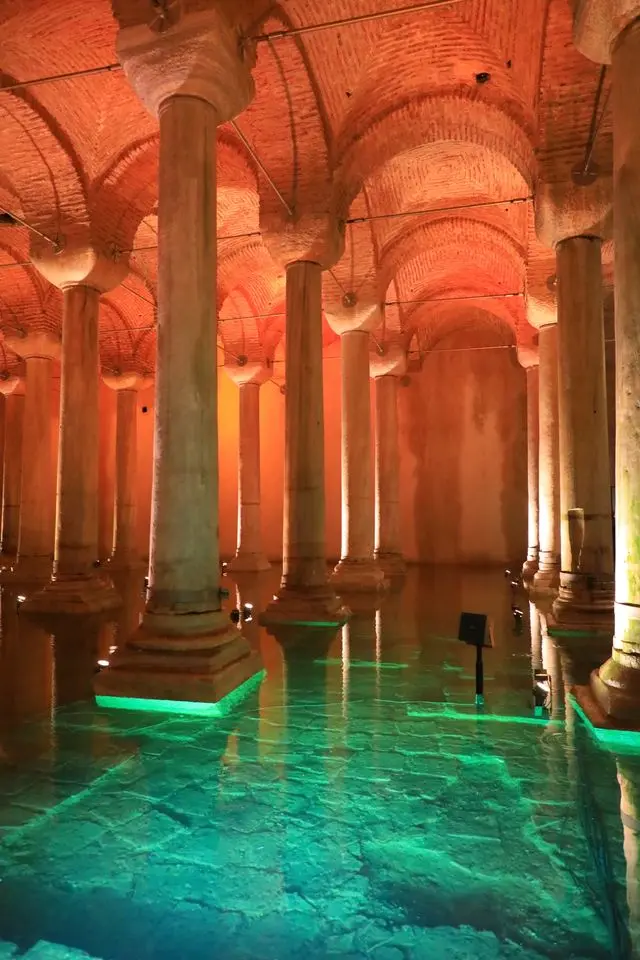
The 2022 restoration replaced the old concrete walkways with sleek, low-profile metal platforms that hover just inches above the water level. Walking these paths allows you to navigate deep into the cistern, providing stunning perspectives down the long, illuminated avenues of columns. The new lighting system changes colors subtly, enhancing the dramatic reflections on the water's surface.
Contemporary Art and Events
The cistern is no longer just a static historical site. The recent renovation incorporated modern, minimalist sculptures emerging from the water, creating a dialogue between ancient engineering and contemporary art. Because the acoustics in the cavern are exceptional, the space occasionally hosts classical music concerts and cultural performances, offering a truly unforgettable auditory experience.
Best Time to Visit
Because the cistern is completely enclosed and subterranean, it is an excellent attraction to visit during the hottest part of a summer day (as it remains incredibly cool inside) or when it is raining. To avoid the massive queues that build up outside, it is best to arrive right when it opens at 9:00 AM. Since the atmosphere inside relies on artificial lighting, visiting at night (when they often extend hours during the summer) offers the exact same visual experience as visiting during the day.
Visitor Tips and Logistics
Tickets and Entry
The Basilica Cistern is operated by the Istanbul Metropolitan Municipality, not the national Ministry of Culture. Because of this, it is **not** included in the standard Istanbul Museum Pass. You must purchase a separate ticket, either online in advance or at the kiosk near the entrance. The entrance and exit are located on different streets, so be aware of this if you are meeting someone.
Accessibility and Conditions
The environment inside is inherently dark, damp, and sometimes slippery. Walk carefully on the metal grating. Following the recent renovations, the cistern is fully accessible for wheelchair users, with an elevator installed at the entrance to bypass the stairs leading down into the cavern.
Nearby Attractions
The cistern's location at the corner of Sultanahmet Square means you are steps away from the city's other major landmarks.
- Hagia Sophia: Located directly across the street from the cistern's entrance, making it very easy to visit both on the same morning.
- Gülhane Park: A five-minute walk down the hill brings you to this massive, beautiful park, perfect for a sunny stroll after emerging from the dark underground.
- The Million Stone: Just outside the cistern entrance is a small, unremarkable-looking stone pillar. This is the Milion, the ancient zero-mile marker from which all distances in the Byzantine Empire were measured.
FAQs about visiting the Basilica Cistern
Is the Basilica Cistern included in the Istanbul Museum Pass? +
No, it is not. The cistern is run by the city municipality, not the national government, so it requires its own separate ticket. The Museum Pass will not grant you entry.
How much time do I need inside? +
A typical visit takes about 30 to 45 minutes. This is enough time to walk the full circuit of the platforms, see the Medusa heads, and take plenty of photographs.
Can I take photos inside? +
Yes, photography is allowed and encouraged. However, because the space is very dark, you will need a steady hand or a good low-light camera. Tripods are generally not permitted as they block the narrow walkways.
Is there water in the cistern? +
Yes, though not nearly as much as in ancient times. To protect the columns and allow for the modern walkways, the water level is kept very shallow, usually just a foot or two deep. You can still see large carp swimming in the water near the entrance.
Is it safe to visit if I am claustrophobic? +
While it is underground, the cavern is absolutely massive, with high ceilings (about 9 meters tall) and plenty of open space. It does not feel like a tight or enclosed cave, though the darkness might be slightly unsettling for some.
Do I need a guide for the Basilica Cistern? +
While a guide can explain the history of the Byzantine water system, the visual impact of the cistern largely speaks for itself. It is very easy to enjoy on a self-guided visit, and there are informational plaques located near key features like the Medusa heads.
