
Table of Contents
Overview
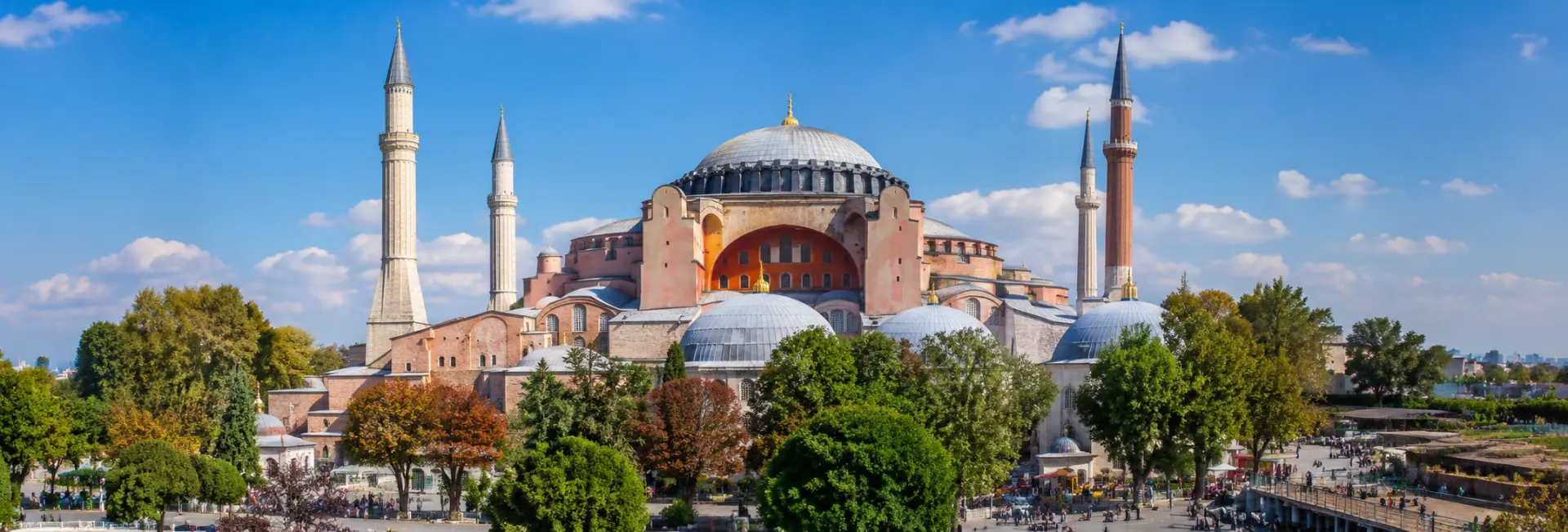
The Hagia Sophia (Ayasofya in Turkish) is arguably the most famous and historically significant structure in Istanbul. Standing proudly in the Sultanahmet district, this colossal building has survived earthquakes, conquests, and the rise and fall of great empires over its nearly 1,500-year history. Originally built as the grandest Christian cathedral in the world, it later became a central imperial mosque, then a secular museum, and recently, an active mosque once again.
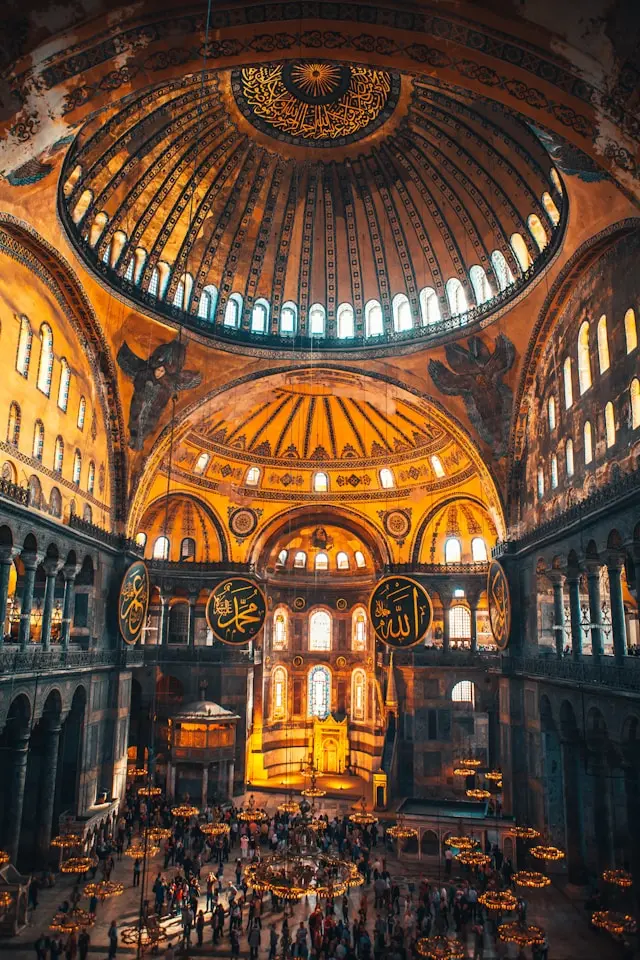
What makes the Hagia Sophia so compelling is not just its sheer size and age, but the physical layering of history visible on its walls. It is a place where two of the world's major religions physically overlap. The golden Byzantine mosaics depicting Christ and the Virgin Mary coexist with massive wooden medallions bearing Islamic calligraphy in gold leaf. This duality reflects the complex, multi-layered identity of Istanbul itself-a city perched on the edge of two continents and shaped by both the Byzantine and Ottoman empires.
Visiting the Hagia Sophia is a profound experience. The sheer scale of its interior, dominated by a massive central dome that seems to float on a ring of light, inspires awe today just as it did when it was completed in the 6th century. It remains an essential pilgrimage for anyone interested in history, architecture, or the enduring legacy of human faith and engineering.
History and Empires
The Byzantine Cathedral
The structure we see today is actually the third church built on this site. The first two were destroyed by riots and fires. In 532 AD, following the devastating Nika Riots, the Byzantine Emperor Justinian I ordered the construction of a new basilica that would be unparalleled in scale and grandeur. Designed by two Greek geometers and architects, Anthemius of Tralles and Isidore of Miletus, the new Hagia Sophia was completed in an astonishingly short period of just under six years.
For nearly a millennium, it served as the seat of the Orthodox Patriarch of Constantinople and the spiritual heart of the Byzantine Empire. It was here that Byzantine emperors were crowned, and its immense wealth and beauty were famous throughout the medieval world. It held the status of the world's largest cathedral for nearly a thousand years until the completion of Seville Cathedral in 1520.
The Ottoman Conquest and Transformation
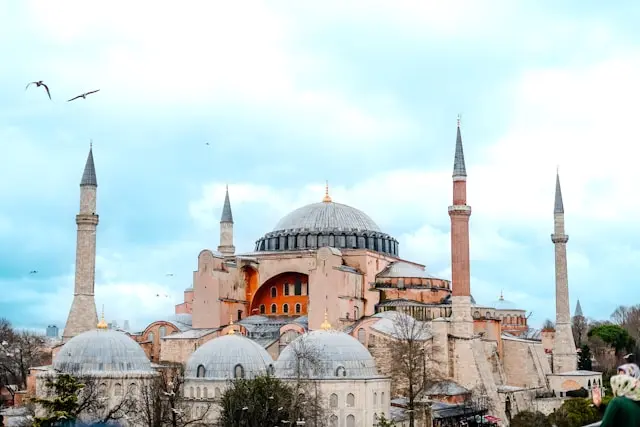
In 1453, Constantinople fell to the Ottoman Empire under Sultan Mehmed II (Mehmed the Conqueror). Recognizing the architectural brilliance of the building, Mehmed ordered its immediate conversion into a mosque rather than its destruction. Over the centuries, Ottoman sultans added Islamic features, including a minbar (pulpit), a mihrab (indicating the direction of Mecca), and four towering minarets on the exterior.
Crucially, the Ottoman rulers did not destroy the Christian mosaics; instead, they plastered over them, inadvertently preserving them for centuries. In 1935, under the direction of Mustafa Kemal Atatürk, the founder of the modern Republic of Turkey, the building was secularized and opened as a museum, leading to the uncovering and restoration of the ancient mosaics. In 2020, the Hagia Sophia's status was changed once again, and it resumed functioning as an active mosque.
Architectural Marvels
The Great Dome
The defining feature of the Hagia Sophia is its magnificent central dome. Reaching a height of 55.6 meters (182 feet) from the floor and spanning 31 meters (102 feet) across, it was a revolutionary feat of engineering. The architects utilized pendentives-curved triangular sections of masonry-to transition the weight of the massive circular dome down onto a square base. This innovation allowed for the vast, unbroken interior space below.
Around the base of the dome is a continuous ring of 40 arched windows. This brilliant design choice serves two purposes: it reduces the weight of the dome and allows sunlight to flood the interior. The light bouncing off the gold mosaics and marble walls creates an optical illusion, making the massive, heavy dome appear as though it is suspended from heaven by a golden chain.
Marble and Materials
Emperor Justinian spared no expense in sourcing materials for his great church. The interior is clad in massive slabs of multicolored marble brought from across the empire-green marble from Thessaly, black stone from the Bosphorus region, and yellow stone from Syria. Legend states that some of the massive columns were salvaged from ancient pagan temples, including the Temple of Artemis at Ephesus, bringing the architectural legacy of the ancient world into the Christian cathedral.
Christian Mosaics and Islamic Calligraphy
The interior of the Hagia Sophia is a visual dialogue between Christianity and Islam. Because it is currently an active mosque, some of the Christian iconography in the main prayer hall is covered by curtains during prayer times, but the juxtaposition of faiths remains the building's most striking feature.
High in the apse, visitors can see a stunning 9th-century mosaic of the Virgin Mary holding the infant Jesus. In the upper galleries, which require a separate ticket, some of the finest surviving Byzantine mosaics are displayed. These include the famous Deësis mosaic, depicting Christ flanked by the Virgin Mary and John the Baptist, renowned for its incredible detail and the emotional depth of the faces.
Contrasting these ancient Christian images are the massive, circular wooden medallions hung high on the walls. Added in the 19th century by the Fossati brothers (Swiss-Italian architects who restored the building) and painted by the master calligrapher Kazasker Mustafa Izzet Efendi, these medallions bear the names of Allah, the Prophet Muhammad, the first four caliphs, and the Prophet's two grandsons. They are among the largest and finest examples of Islamic calligraphy in the world.
Key Areas of the Hagia Sophia
The Imperial Gate
This massive central doorway was originally reserved exclusively for the Byzantine Emperor and his entourage. Above the door is a beautiful mosaic depicting Emperor Leo VI bowing before Christ Pantocrator. The sheer size of the wooden doors gives an immediate sense of the building's scale as you enter the main nave.
The Weeping Column
Located in the northwest aisle of the ground floor is a marble pillar with a hole covered by bronze plates. Known as the Weeping Column or Sweating Column, it is believed to stay damp year-round and possess healing properties. For centuries, visitors have placed their thumb in the hole and rotated their hand 360 degrees, making a wish in the hope that it will be granted.
The Upper Galleries
The upper galleries, originally reserved for the Empress and her court, offer the best vantage point for appreciating the vastness of the nave and the details of the dome. More importantly, they house the most spectacular and well-preserved surviving Byzantine mosaics, making a visit to the upper floor essential for history and art enthusiasts.
Ways to Experience It
Guided Tours
Because the Hagia Sophia is incredibly complex and layered with history, booking a licensed guide is highly recommended. A good guide will point out subtle architectural details you would otherwise miss, such as Viking runic graffiti carved into the marble parapets of the upper gallery, and will explain the complex political and religious history that shaped the building.
Self-Guided Visits with Audio
If you prefer to move at your own pace, downloading a high-quality audio guide app before your visit is a great alternative. It allows you to spend time absorbing the atmosphere of the main nave and closely studying the mosaics in the upper galleries without being rushed by a tour group.
Best Time to Visit
As one of the most famous monuments in the world, the Hagia Sophia is almost always busy. To avoid the worst of the crowds and the long security lines, plan to arrive right when it opens in the morning. Late afternoon, an hour or two before closing, can also be slightly less crowded. Avoid visiting on Fridays, especially around midday, as the building closes to tourists for congregational prayers and the surrounding square becomes incredibly congested.
Visitor Tips and Etiquette
Dress Code and Protocol
Since 2020, the Hagia Sophia functions as an active mosque, meaning a strict dress code is enforced. Both men and women must wear clothing that covers their shoulders and knees. Women must also cover their hair with a scarf (scarves are usually available for purchase near the entrance if you forget yours). Upon entering the carpeted prayer area on the ground floor, you must remove your shoes; there are cubbies provided to store them.
Ticketing Changes
As of early 2024, there is a new ticketing system in place for foreign visitors. Tourists are generally directed to enter through a specific side entrance to access the upper galleries (where the best mosaics are located) and are charged an entrance fee. Access to the ground floor prayer area may be restricted or managed differently depending on the time of day and ongoing prayer schedules.
Nearby Attractions
The Hagia Sophia is located at the epicenter of historic Istanbul, making it easy to visit other major sites.
- The Blue Mosque: Located directly across Sultanahmet Square, this massive 17th-century mosque provides a fascinating architectural comparison to the Hagia Sophia.
- Basilica Cistern: Just a two-minute walk away, this incredible ancient underground water reservoir offers a cool, atmospheric escape from the busy city streets above.
- Topkapi Palace: Located right behind the Hagia Sophia, this sprawling palace complex was the residence of the Ottoman Sultans for nearly 400 years and houses spectacular collections of jewels and religious relics.
FAQs about visiting the Hagia Sophia
Is there an entrance fee for the Hagia Sophia? +
Yes. While it was free for a few years after its reconversion to a mosque in 2020, as of January 2024, a significant entrance fee was reinstated for foreign tourists, which grants access specifically to the upper galleries where the mosaics are located.
Do I have to cover my head to enter? +
Yes, women are required to cover their hair with a scarf to enter the building. Both men and women must wear modest clothing covering their shoulders and knees.
Are the Christian mosaics still visible? +
Yes, the famous Christian mosaics in the upper galleries are still visible. On the ground floor prayer area, some Christian depictions (like the Virgin Mary in the apse) may be covered by curtains during Muslim prayer times.
Do I have to take my shoes off? +
Yes, you must remove your shoes before stepping onto the carpeted areas of the ground floor. You can carry them with you in a bag or leave them in the provided cubbies. If you are only visiting the stone-floored upper galleries, shoe removal may not be required.
Can I take photos inside? +
Yes, photography is allowed and highly encouraged, but you should not use a flash, particularly near the ancient mosaics. Additionally, be respectful and avoid photographing people who are actively praying on the ground floor.
Is it accessible for wheelchairs? +
The ground floor of the Hagia Sophia is accessible for wheelchairs. However, the ancient stone ramps leading to the upper galleries are steep, uneven, and can be very difficult for wheelchair users to navigate.
How much time do I need to visit? +
To properly appreciate the sheer scale of the ground floor and to carefully view the mosaics in the upper galleries, you should plan to spend at least 1.5 to 2 hours inside the building.
