
Table of Contents
Overview
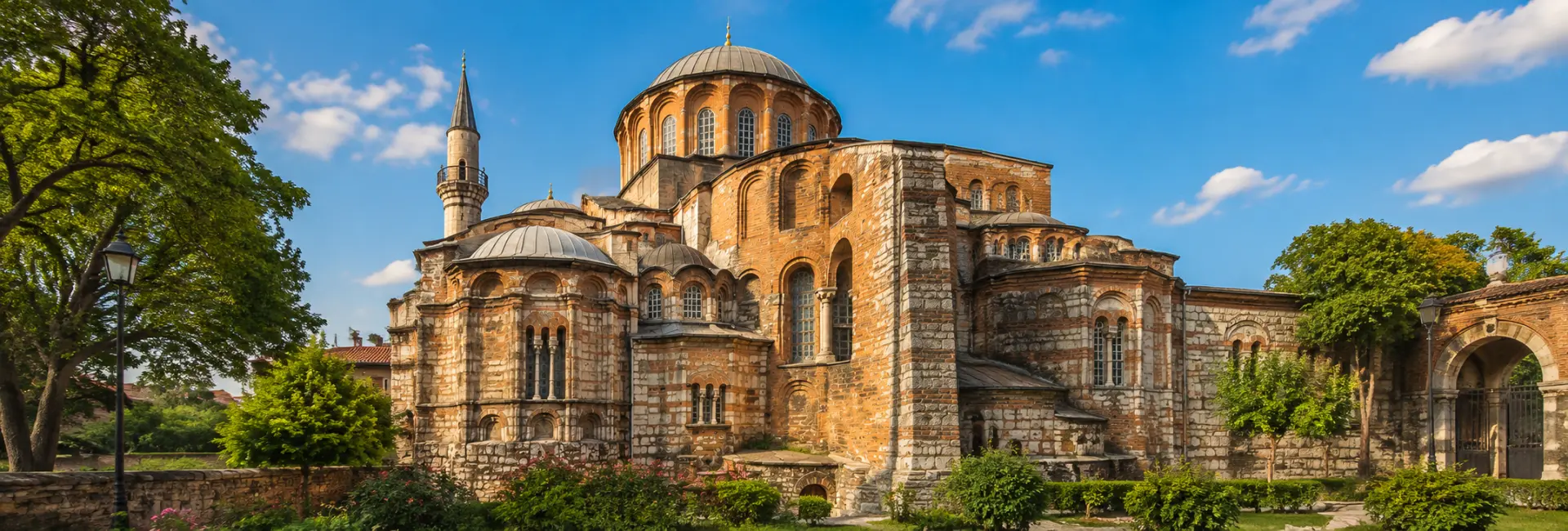
Tucked away in the Edirnekapı neighborhood, far from the primary tourist hubs of Sultanahmet, lies the Chora Church (officially known today as the Kariye Mosque). While it may lack the colossal scale and monumental architecture of the Hagia Sophia, it is arguably even more significant for art historians and lovers of Byzantine culture. The interior of this relatively small building is entirely encrusted with what are universally recognized as the finest, most vibrant, and most complete surviving examples of late Byzantine mosaics and frescoes in the world.
To step inside the Chora is to walk into a 14th-century illustrated Bible. The walls and domes tell the complete stories of the lives of the Virgin Mary and Jesus Christ with an emotional depth, striking realism, and brilliant use of color that signaled the dawn of a Renaissance in Byzantine art. For anyone with even a passing interest in art history or the medieval world, the Chora is a breathtaking, unmissable masterpiece.
History: From Countryside to City Walls
The Church "In the Fields"
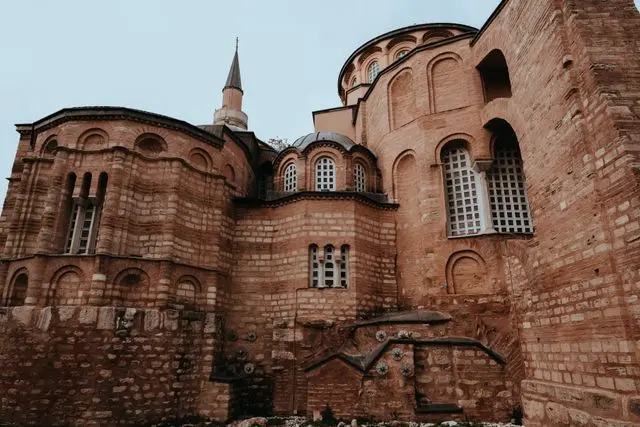
The name "Chora" translates roughly to "in the country" or "in the fields" in ancient Greek. When the first church was built on this site in the 4th century by Constantine the Great, it was located just outside the original city walls. Even when the massive Theodosian Walls were built in the 5th century, bringing the church within the city limits, it retained its traditional name.
The 14th Century Masterpiece
The building we see today, however, is not the 4th-century original. The church underwent several rebuilds due to earthquake damage. Its true golden age occurred in the early 14th century, during the twilight years of the Byzantine Empire. Between 1315 and 1321, a powerful statesman, scholar, and poet named Theodore Metochites funded a complete restoration and expansion of the church. It was Metochites who commissioned the astonishing program of mosaics and frescoes that cover the interior. He is actually depicted in a mosaic above the main door to the nave, wearing a massive, striped turban, offering a model of the church to Christ.
The Mosaics: The Life of Christ and the Virgin
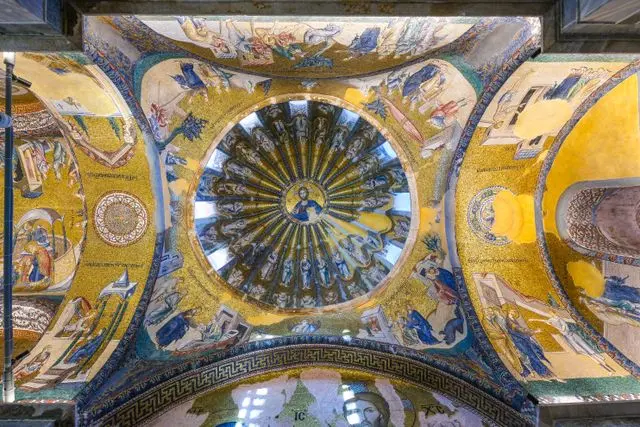
The mosaics in the inner and outer narthexes (the entrance halls) are the absolute highlight of the building. Unlike earlier, stiffer Byzantine art, the figures here display movement, emotion, and realistic volume. The artists used incredibly small, vibrantly colored glass and stone tesserae set into gold backgrounds, which catch the light and make the walls glow.
The narrative cycles are incredibly detailed. One complete cycle is dedicated to the life of the Virgin Mary, based not just on the canonical Gospels but on apocryphal texts. Visitors can follow her story from the miraculous birth to her presentation at the temple. The other major cycle details the life, miracles, and infancy of Jesus Christ, including famous scenes like the Journey to Bethlehem, the Nativity, and the Multiplication of the Loaves. The level of detail-from the expressions on the faces of peasants to the intricate folds of clothing-is astounding.
The Frescoes of the Parekklesion
Attached to the right side of the main church is the Parekklesion, a side chapel built by Theodore Metochites to serve as his own family mausoleum. Because it was a funerary chapel, the art here was painted in fresco (water-based pigments applied to wet plaster) rather than mosaic, and the themes focus heavily on death, resurrection, and the afterlife.
The masterpiece of the Parekklesion-and perhaps of all late Byzantine art-is the massive fresco in the apse depicting the Anastasis (the Harrowing of Hell). It shows a dynamic, powerful Christ dressed in glowing white robes, physically pulling Adam and Eve out of their tombs, with the shattered gates of Hell and bound Satan beneath his feet. The energy and fluidity of the painting are breathtaking, rivaling the early Renaissance works emerging in Italy at the same time.
Ottoman Conversion and Modern Restoration
Following the Ottoman conquest of Constantinople in 1453, the building continued to function as a church for roughly half a century before being converted into a mosque (Kariye Camii) in 1511. As with the Hagia Sophia, the Islamic prohibition against figurative images in places of worship meant that the mosaics and frescoes were covered up.
Fortunately, they were covered with plaster or wooden shutters rather than being destroyed. In 1948, the building was secularized and a massive, decade-long restoration project led by the Byzantine Institute of America painstakingly removed the plaster, stabilized the crumbling structure, and revealed the spectacular art beneath. After operating as a museum for over 70 years, its status was changed again in 2020, and it was reconverted into an active mosque.
Ways to Experience It
Following the Narrative
To truly appreciate the Chora, you must "read" it properly. The mosaics are laid out in a very specific, chronological narrative order. It is highly recommended to bring a detailed guidebook, download a specialized audio guide, or hire a specialized historical guide to walk you through the cycles. Understanding the stories being depicted-and identifying the obscure apocryphal references-elevates the visit from simply looking at pretty pictures to engaging with a complex theological and historical narrative.
Taking in the Details
Don't just look at the main figures; look at the backgrounds. The artists of the Chora included fascinating details of 14th-century life, architecture, and nature in the backgrounds of the religious scenes. You'll see detailed depictions of Byzantine palaces, intricate patterns on carpets, and realistic animals that give a glimpse into the medieval world.
Best Time to Visit
Because the interior of the Chora is quite small and the corridors are narrow, it can feel claustrophobic if several large tour groups arrive at once. The best time to visit is early in the morning on a weekday, right when it opens. Alternatively, late afternoon offers excellent, softer light filtering through the small windows, illuminating the gold mosaics beautifully.
Visitor Tips and Etiquette
The Reconversion and Dress Code
Following its 2020 reconversion into an active mosque, standard mosque etiquette now applies. Women must wear a headscarf, and both men and women must ensure their shoulders and knees are covered. Furthermore, because it is an active prayer space, the main nave (which contains fewer mosaics but has a beautiful marble floor) is carpeted, and shoes must be removed to enter that specific section.
Check Opening Status
Since the change in its status in 2020, the building has undergone extensive, prolonged structural restoration work. Parts of the building, or sometimes the entire structure, may be closed to the public behind scaffolding for months at a time. It is absolutely critical to check the current operational status online locally before making the long trip out to the neighborhood.
Nearby Attractions
The Chora is located near the ancient Theodosian Land Walls, an area rich in history but off the main tourist trail.
- The Theodosian Walls: Just a few minutes' walk from the church, you can see and even walk along sections of the massive, triple-layered 5th-century walls that protected the Byzantine capital for a thousand years.
- Palace of the Porphyrogenitus (Tekfur Sarayı): Located right on the city walls nearby, this is the only surviving secular Byzantine palace in Istanbul, recently restored and opened as a fascinating museum of Byzantine tiles and pottery.
- Mihrimah Sultan Mosque: Sitting prominently at the Edirnekapı gate of the city walls, this beautiful, light-filled mosque was designed by Mimar Sinan for the daughter of Suleiman the Magnificent.
FAQs about visiting the Chora Church (Kariye Mosque)
Is there an entrance fee for the Chora? +
The entrance fee situation has changed frequently since its reconversion to a mosque. As a museum, it required a ticket; as a mosque, entry to the prayer areas is generally free, but there may be specific fees implemented for tourists accessing the historical mosaic galleries. Always check current regulations before visiting.
Are the mosaics covered up now that it is a mosque? +
This is a complex issue. The massive frescoes in the Parekklesion (side chapel) and the mosaics in the entrance narthexes are generally kept visible. However, any figurative mosaics located directly within the main prayer nave (the section facing Mecca) are equipped with mechanical curtains that cover them during Muslim prayer times.
Is it easy to get to from Sultanahmet? +
It is not within walking distance of the main historic center. You will need to take public transport-usually a combination of the T1 tram and a bus or a taxi ride. A taxi from Sultanahmet or Taksim takes about 20-30 minutes, depending heavily on Istanbul traffic.
Do I need a guide? +
While you can admire the beauty on your own, a guide is highly recommended here more than almost anywhere else in Istanbul. The value of the Chora lies entirely in the complex, chronological narrative of the art, which is difficult to decipher without expert knowledge.
How much time should I spend there? +
The building is small, but the art is dense. A thorough visit to view the mosaics, study the frescoes in the Parekklesion, and explore the exterior takes about an hour to an hour and a half.
Is it wheelchair accessible? +
The exterior courtyard is accessible, and ramps have been provided for some areas, but navigating the narrow interior corridors and the thresholds between the narthexes and the side chapels can be challenging in a wheelchair.
