
Table of Contents
Overview
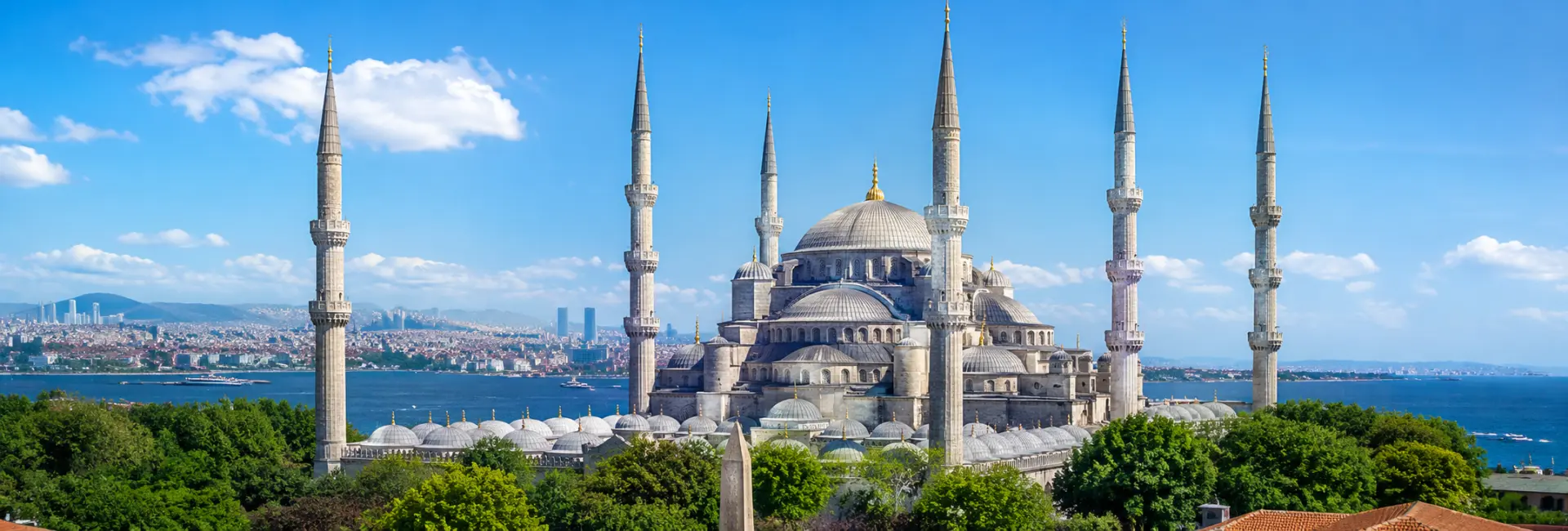
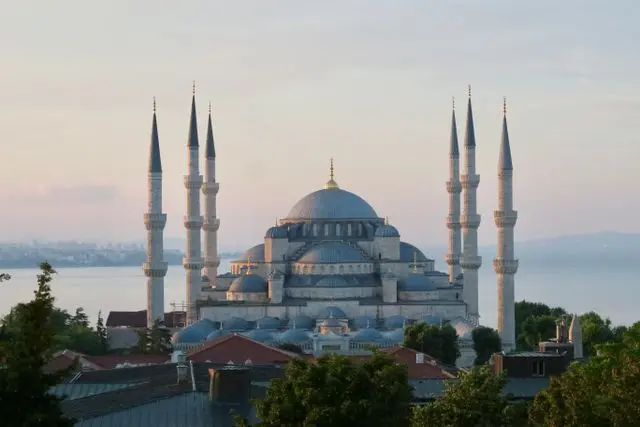
The Sultan Ahmed Mosque, known universally as the Blue Mosque, is one of the most iconic and visually arresting landmarks in Istanbul. Situated directly across the expansive Sultanahmet Square from the Hagia Sophia, it stands as the ultimate expression of classical Ottoman architecture. With its cascade of elegant grey domes and its six slender minarets piercing the skyline, the mosque defines the historic silhouette of the city.
While the exterior is monumental and awe-inspiring, the building earned its famous moniker from its interior. The massive prayer hall is adorned with tens of thousands of handmade ceramic tiles from the town of Iznik, predominantly featuring intricate floral patterns in vibrant shades of blue. The way the light filters through hundreds of stained-glass windows to illuminate these tiles creates an atmosphere of profound serenity and artistic brilliance.
Today, the Blue Mosque remains a deeply important, active place of worship for Istanbul's Muslim population, while simultaneously serving as one of Turkey's most visited tourist attractions. It perfectly encapsulates the wealth, power, and artistic heights achieved by the Ottoman Empire during the early 17th century.
History and Construction
The Vision of Sultan Ahmed I
The construction of the mosque was ordered by Sultan Ahmed I, who ascended to the throne at a young age. Following a period of military setbacks against the Habsburgs and the Safavids in the early 1600s, the Sultan decided to build a massive imperial mosque to reassert Ottoman power and secure divine favor. Unusually for imperial mosques, which were typically funded by the spoils of war, Ahmed I had to fund this project directly from the state treasury, which caused some controversy among the religious scholars of the time.
Choosing the Site
To make a bold statement, Ahmed I chose a site directly opposite the Hagia Sophia, effectively challenging the dominance of the ancient Byzantine structure with a purely Ottoman creation. To clear the space, a large portion of the ancient Byzantine Great Palace and several Ottoman palaces belonging to prominent viziers had to be purchased and demolished. Construction began in 1609 under the direction of the royal architect Sedefkâr Mehmed Ağa, a student of the legendary Ottoman architect Mimar Sinan. The mosque was completed in 1616, tragically just one year before the young Sultan Ahmed I died at the age of 27.
The Six Minarets Controversy
One of the most distinctive features of the Blue Mosque is its six minarets. At the time of its construction, the only other mosque in the world with six minarets was the Masjid al-Haram in Mecca, the holiest site in Islam. When Sultan Ahmed revealed his design, he faced intense criticism from religious leaders who viewed the six minarets as an arrogant attempt to rival Mecca.
According to legend, the six minarets were actually the result of a misunderstanding. The Sultan had supposedly requested "altın minareler" (gold minarets), but the architect misheard it as "altı minare" (six minarets). Whether true or not, the Sultan resolved the controversy not by tearing down a minaret in Istanbul, but by funding the construction of a seventh minaret at the Great Mosque in Mecca, thereby restoring its supreme status.
Architectural Design and Layout
The Exterior and Courtyard
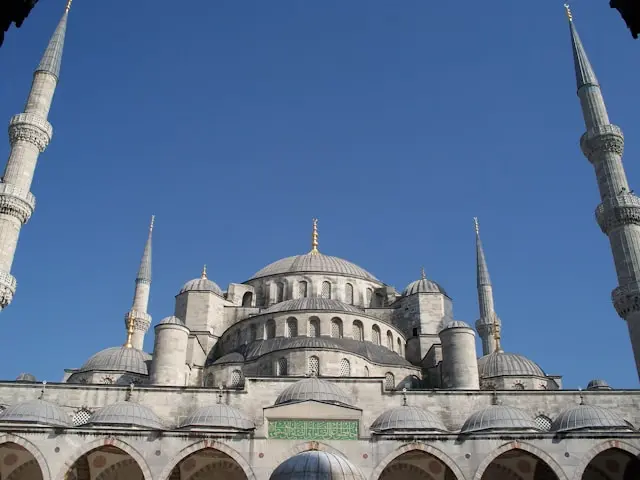
The architectural design of the Blue Mosque represents the culmination of two centuries of Ottoman mosque development. The exterior is a masterclass in harmony and proportion. The massive central dome is supported by four semi-domes, which are in turn supported by smaller domes, creating a visually pleasing cascading effect that draws the eye upward.
The mosque is preceded by a sprawling, monumental courtyard that is as large as the mosque itself. Surrounded by a continuous vaulted arcade, the courtyard features a hexagonal ablution fountain in the center. The sheer scale of the courtyard was designed to accommodate massive crowds during Friday prayers and religious festivals.
The Iron Chain
At the western entrance to the courtyard, there is a heavy iron chain hanging in the upper part of the gateway. This entrance was reserved exclusively for the Sultan, who would enter on horseback. The chain was hung low so that the Sultan had to bow his head every time he entered the courtyard, a symbolic gesture demonstrating that even the ruler of the empire must show humility before God.
The Iznik Tile Interior
While the exterior of the mosque is a study in stone and structural engineering, the interior is an explosion of color and pattern. The lower walls and pillars of the massive prayer hall are covered in over 20,000 handmade ceramic tiles produced in the city of Iznik. These tiles feature more than 50 different tulip designs, alongside cypresses, roses, and intricate geometric patterns.
The upper levels of the interior are dominated by blue paint, which, when illuminated by the natural light pouring in through more than 200 stained-glass windows, gives the entire space a distinct, glowing blue hue. The sheer volume of the interior space is staggering. The central dome rests on four massive, fluted pillars, affectionately known as the "elephant legs" due to their immense girth, measuring 5 meters in diameter.
Ways to Experience It
The Approach from the Hippodrome
To fully appreciate the architecture of the Blue Mosque, it is best to approach it not from the Hagia Sophia, but from the Hippodrome side. Walking through the monumental gates into the courtyard from this direction allows you to experience the perfect symmetry and the cascading domes exactly as the architect intended.
Sitting and Observing
Once inside, rather than rushing through, the best way to experience the mosque is to find a spot on the thick, red carpets near the edges of the tourist section. Take time to look up into the domes, observe the intricate tile work, and watch the interplay of light from the stained glass. The atmosphere, despite the crowds, remains inherently peaceful and contemplative.
Best Time to Visit
Because the Blue Mosque is an active place of worship, it closes to tourists five times a day for roughly 90 minutes during prayer times. The exact times shift slightly throughout the year based on the sun. The best time to visit is usually mid-morning (between the sunrise and midday prayers) or mid-afternoon. To avoid the massive tour groups, aim to arrive as early in the morning as visiting hours permit.
Visitor Tips and Etiquette
Dress Code
As with all active mosques, a strict dress code is enforced. Both men and women must wear clothing that covers their shoulders and knees. Women must cover their hair. If you are not dressed appropriately, the staff will provide you with robes and headscarves free of charge at the entrance.
Shoe Removal
You must remove your shoes before stepping onto the carpets of the prayer hall. The mosque provides plastic bags at the entrance for you to carry your shoes with you during your visit. The carpets inside are plush and vacuumed regularly.
Free Entry
Unlike the Hagia Sophia and Topkapi Palace, entry to the Blue Mosque is completely free for all visitors. However, donations are welcome near the exit to help maintain the historic building.
Nearby Attractions
The Blue Mosque is located directly on Sultanahmet Square, the historical heart of the city.
- The Hippodrome: Immediately adjacent to the mosque is the ancient Roman Hippodrome, featuring the Egyptian Obelisk of Theodosius and the ancient bronze Serpent Column.
- Hagia Sophia: Just a short walk across the beautiful, fountain-filled park lies the Hagia Sophia, allowing you to compare Byzantine and Ottoman architecture side-by-side.
- Museum of Turkish and Islamic Arts: Located in a historic palace right on the Hippodrome, this excellent museum houses incredible collections of antique carpets, calligraphy, and woodwork.
FAQs about visiting the Blue Mosque
Is there an entrance fee for the Blue Mosque? +
No, entry to the Blue Mosque is completely free of charge. It operates as an active place of worship, not a museum, though donations are appreciated.
When is the mosque closed to tourists? +
The mosque closes to non-worshiping visitors five times a day during the Muslim prayer times. It is closed for roughly 90 minutes each time. On Fridays, it closes for several hours around midday for the most important congregational prayer of the week.
Do I have to wear a headscarf? +
Yes, all female visitors are required to cover their hair before entering the mosque. If you do not have a scarf, one will be provided to you at the entrance.
Can I walk anywhere inside the mosque? +
No. The interior is divided into two sections. Tourists are restricted to a designated viewing area at the back and sides of the mosque, while the main central area under the dome is reserved exclusively for those who are praying.
Can I take photos inside? +
Yes, photography is allowed inside the tourist section. However, you should avoid using a flash to protect the historic tiles, and you must not take photographs of people who are actively praying.
Why is it called the Blue Mosque? +
It is known as the Blue Mosque by tourists because of the tens of thousands of blue Iznik ceramic tiles that decorate the lower interior walls, and the blue paint dominating the upper domes, which give the interior a distinctly blue atmosphere. Its official name is the Sultan Ahmed Mosque.
