
Table of Contents
Overview
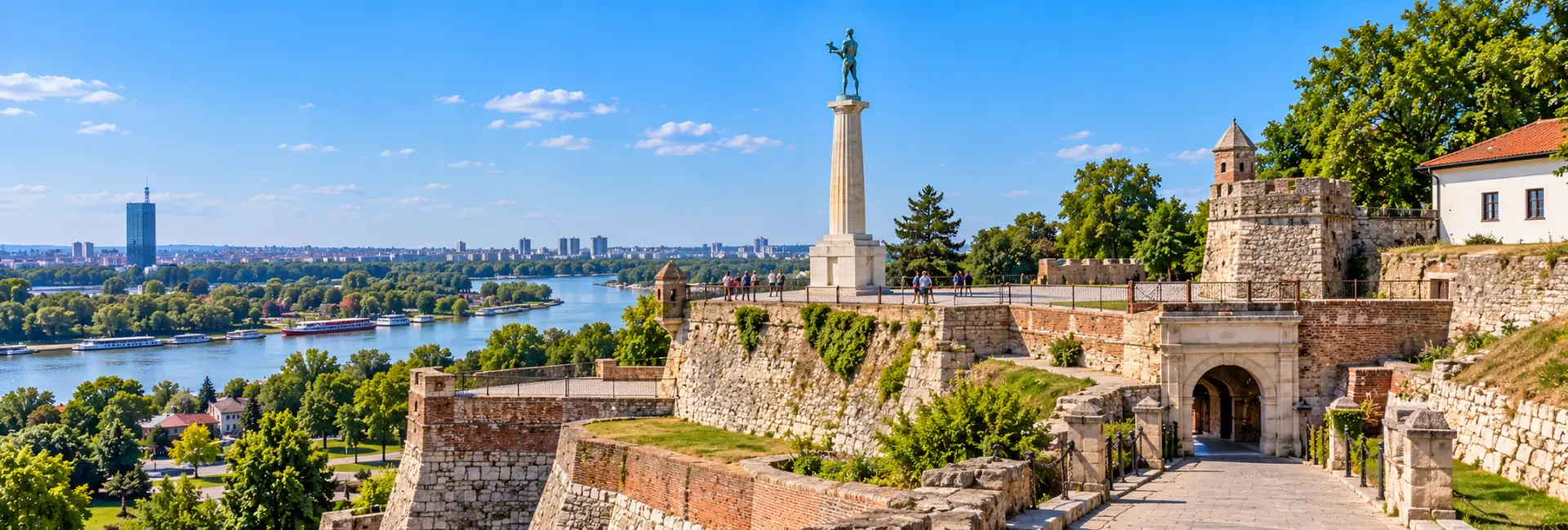
Belgrade Fortress, known to locals as Kalemegdan, stands on a rocky ridge where the Sava River flows into the Danube. It is the oldest part of the Serbian capital and the single most popular place to visit in the city, a combination of ancient ramparts, museums, quiet gardens and open views that Belgraders treat as their own backyard.
The site has two linked parts. The fortress itself is a large complex of walls, gates, towers and courtyards, and Kalemegdan Park surrounds it with tree-lined paths, statues, cafés and sports areas. The two flow into each other so smoothly that many visitors treat them as a single destination.
Part of the appeal is how free and open the place feels. You can wander the grounds without a ticket, stop at a viewpoint, step into a museum or a tower when something catches your eye, and watch the sun set over the rivers. It is both a serious historical monument and a living public space.
History
Celts and Romans
The ridge was a strategic spot long before Belgrade existed as a city. Celtic tribes fortified the hill, and around the end of the 1st century AD the Romans established a permanent legionary camp here and called the settlement Singidunum. It stood on the empire's frontier, facing the lands beyond the Danube, and the military role of the site was set from that point on.
Byzantines, Slavs and the Serbian Middle Ages
The fortress changed hands many times in the following centuries as Goths, Huns, Avars and Slavs moved through the region. It was rebuilt in Byzantine times, and in the 12th century Emperor Manuel Komnenos raised a new castle on the Roman ruins. As Slavic peoples settled the area, the town acquired the name Beograd, the White City, which became Belgrade in English. In the early 15th century, Despot Stefan Lazarević made the city the capital of the Serbian state, and a statue in the fortress honors him as a founder of medieval Belgrade.
Ottoman and Habsburg centuries
The Ottomans strengthened the fortress heavily, and the name Kalemegdan comes from the Turkish words for fortress and field, referring to the open ground near the walls. Control passed back and forth between the Ottomans and the Habsburgs. The Austrians held it from 1717 to 1739, and during that period they added modern bastions designed on contemporary European principles, turning the fortress into one of the strongest military fortifications in Europe. Much of what you see today dates from those 18th-century rebuilds.
By the end of that century the fortress had reached its final shape, though its strategic importance was already fading. In total, it is said to have seen around 115 battles and to have been destroyed dozens of times.
From garrison to public park
After the Serbian uprisings, an Ottoman garrison remained in the fortress until 1867, when the keys were handed over to Serbian authorities. The surrounding land was then turned into a public park, which has been a favorite promenade ever since. The Victor monument, added in 1928, gave the fortress a new symbol for the modern era.
Architecture & Fortifications
Belgrade Fortress is a layered structure rather than a single design. Roman, medieval, Ottoman and Austrian builders all left their marks, and the result is a patchwork of walls and gates from different centuries.
Vauban-style bastions
The most visible layer is the Austrian one. Engineers of the 18th century built the large earthen and stone bastions, long curtain walls and deep dry moats following the military design principles of the time. Some of those moats are now used as sports courts and green space, which is one of the more unusual sights in the complex.
Gates and towers
Monumental gates mark the transitions between sections of the fortress, and several towers punctuate the walls. Many are open to visitors, including the Clock Tower above the Upper Town entrance, an 18th-century structure whose clock still works, and the tower named after Nebojša near the river.
Ruins and layers
Beyond the main walls, scattered ruins and archaeological remains show older periods. Roman and medieval fragments sit alongside Ottoman structures, and signs and guides help explain what is what. Looking closely rewards visitors who like to read stone as a record of history.
Recognition / Status
Belgrade Fortress, together with Kalemegdan Park, was declared a Monument of Culture of Exceptional Importance in 1979 and is protected by the Republic of Serbia. That is the highest category of cultural heritage protection in the country.
It is also the most visited tourist attraction in Belgrade. Because entry to the grounds is free, exact numbers are hard to pin down, but estimates run to more than two million visits every year. The complex hosts concerts, festivals and cultural events, and it plays a central role in the city's public life.
Key Areas
The complex is large, roughly 66 hectares, so it helps to understand how it is divided. The grounds fall into four main parts.
- Gornji Grad (the Upper Town): the higher part of the fortress, entered through a series of gates, home to the Military Museum, the Clock Tower, the Roman Well, an Ottoman tomb and the Victor monument.
- Donji Grad (the Lower Town): the sloping area toward the river, with the large gunpowder magazine, two historic churches, an old Turkish bath and the Nebojša Tower.
- Large Kalemegdan Park: the broad green belt around the fortress, with promenades, benches, statues and the Belgrade Zoo.
- Little Kalemegdan Park: a smaller garden area near the main entrance, a gentle introduction as you arrive from the city.
Notable Landmarks
The Victor (Pobednik)
Standing on a tall column above the confluence of the rivers, this bronze figure by sculptor Ivan Meštrović is the symbol of Belgrade. It was cast in 1913 and erected in 1928, rises about 14 meters, and commemorates Serbia's victories in the Balkan Wars and the First World War. It is a classic photo spot, especially at sunset.
Clock Tower (Sahat Kula)
This 18th-century tower rises above the central gate of the Upper Town. It can be visited during its opening times, so check the current schedule.
Roman Well
Despite its name, the Roman Well is best treated as a deep, atmospheric well shaft and one of the more mysterious places in the complex. Access has its own opening hours and ticket, and booking ahead can be needed.
Military Museum
The Military Museum occupies a prominent building within the fortress walls and traces the military history of the region from prehistory to modern times. Outside, an open-air display of tanks, cannons and other equipment is easy to enjoy even without going indoors.
Nebojša Tower
This tower near the river guarded the old harbor entrance and is one of the landmarks of the Lower Town. It can be visited during its opening times.
Churches and the gunpowder magazine
The Lower Town holds two historic churches, the Church of Ružica and the Church of Saint Petka, as well as the large gunpowder magazine. Together they show the religious and military sides of the fortress.
Ways to Experience It
Walk the walls and park
The simplest way to experience the fortress is to walk it. Enter from the end of Knez Mihailova, drift through the park, pass through the gates into the Upper Town and follow the ramparts toward the river. The grounds are open around the clock and free to enter.
Visit the museums and towers
Inside, several sites charge their own admission and keep their own hours. The Military Museum, the Clock Tower, the Roman Well and the Nebojša Tower are among the main ones. Audio guides are available at the souvenir shop by the Inner Stambol Gate, where some tickets are also sold.
Guided tours
Walking tours cover the fortress, and many combine it with the old town streets nearby. A guide can help you make sense of the overlapping layers of history, especially in the Upper Town.
Sunset at the confluence
The ridge looks over the meeting of the Sava and the Danube, and the viewpoints near the Victor are a favorite place to watch the sun go down. Bring a camera and a jacket for the evening breeze.
Parks, sports and events
Kalemegdan is also a place for everyday leisure. People jog, cycle, play sports in the old moats, picnic on the grass and visit the zoo. Concerts and festivals take place here at times throughout the year.
Best Time to Visit
Spring and early autumn are the most comfortable seasons, with mild weather, green parkland and good light for photography. Summer evenings are lively, with crowds gathering to enjoy the views and the cooler air, while winter brings a quieter, more atmospheric mood, although some areas can be cold and windy.
For fewer people, try weekday mornings. Weekends and sunny evenings are the busiest, especially around the Victor and the main viewpoints.
If you plan to visit the museums and towers, aim for the daytime hours, because the enclosed sites have set opening times, and some close on certain days of the week or on holidays. The grounds themselves stay open day and night, so you can combine a daytime museum visit with an evening walk.
Visitor Tips
- Entry to the grounds is free: you pay only for specific attractions such as the Clock Tower, Roman Well, Nebojša Tower and the Military Museum. Check current prices and opening hours on the official fortress website before you go.
- Book ahead where needed: some sites, including the Roman Well, require advance booking, so look into this early if they are on your list.
- Allow enough time: two to four hours is a good estimate for a general visit, and the Military Museum alone can take up to two hours.
- Getting there: the main entrance is at the end of the pedestrian street Knez Mihailova, and trams 2 and 11 stop at Kalemegdanski Park, with trolleybuses reaching Students' Square nearby. Many visitors simply walk in from the city center.
- Wear comfortable shoes: the site is large, with cobbles, slopes and uneven ground.
- Bring water and layers: the ridge can be windy, and shade is limited in some parts of the fortress.
- Accessibility: historic surfaces, steps and slopes can be difficult for wheelchair users and strollers, so plan routes carefully and check access at individual sites.
Nearby Attractions
Belgrade Fortress sits at the edge of the old center, so many other sights are within walking distance.
- Knez Mihailova Street: the pedestrian main street leading to the fortress, lined with 19th and early 20th-century buildings, shops and cafés.
- Students' Square and the old center: a short walk from the fortress, with museums, cafés and historic buildings.
- Skadarlija: the old bohemian quarter, the second most visited attraction in Belgrade, known for its cobbled street and traditional restaurants.
- Belgrade Zoo: located inside the park, an easy add-on for visitors with children.
- The river promenades: paths along the Sava and Danube below the fortress give another view of the rivers and the city.
FAQs about visiting Belgrade Fortress (Kalemegdan)
What is Belgrade Fortress? +
It is the historic citadel of Belgrade, built on a ridge above the meeting of the Sava and Danube rivers. Together with the surrounding Kalemegdan Park, it is the most popular attraction in the city.
Is it free to visit? +
Yes, entry to the grounds and park is free and open around the clock. Separate tickets apply for some attractions, such as the Clock Tower, Roman Well, Nebojša Tower and the Military Museum.
How long should I spend there? +
Plan on two to four hours for a general visit. Add more time if you want to see the Military Museum or several of the towers.
Why is it called Kalemegdan? +
The name comes from Turkish words meaning fortress and field, referring to the open ground beside the walls that the Ottomans used as a battlefield and parade area.
What is the Victor monument? +
It is a bronze statue by Ivan Meštrović, erected in 1928, that commemorates Serbia's victories in the Balkan Wars and the First World War. It has become the symbol of Belgrade.
How do I get there? +
Most visitors walk from the city center along Knez Mihailova Street to the park entrance. Trams 2 and 11 stop at Kalemegdanski Park, and several trolleybuses reach Students' Square nearby.
What is the best time to go? +
Spring and early autumn have the nicest weather, and sunset is a popular time for the views over the rivers. Weekday mornings are the quietest.
Is it suitable for kids? +
Yes. Children enjoy the open spaces, the outdoor military exhibits, the park and the zoo. Be mindful of steep drops and uneven ground on the ramparts.
