
Table of Contents
Overview
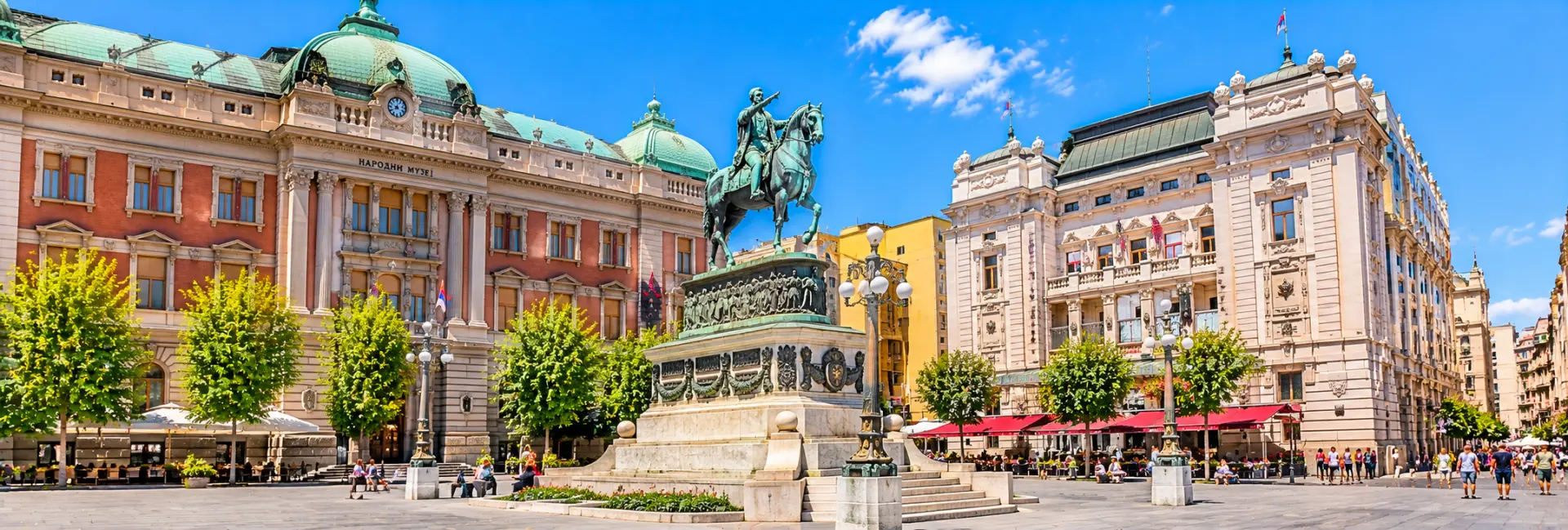
Republic Square, or Trg Republike, is the spot where Belgrade meets itself. Locals arrange to see each other here, trams and buses pass through it, and the pedestrian promenade of Knez Mihailova Street begins on its edge. Its most recognizable features are the bronze statue of Prince Mihailo on horseback, the National Theatre and the columned façade of the National Museum.
The square is not a calm Italian-style piazza. It is a broad, slightly sloping open space, crossed by traffic and framed by buildings of very different ages, which gives it a lively, mixed character. Many first-time visitors assume it is the exact center of the city, though the official center, Terazije, lies just a short walk away.
What makes the square worth a stop is how much history is packed into it. A Roman burial ground, two generations of fortress gates, a nineteenth-century theatre, wartime damage and a controversial recent renovation all left traces here, and a visit works well as a short introduction to the story of Belgrade.
History
Roman Graves and Fortress Gates
Long before it was a square, this area lay outside the Roman fort of Singidunum and was used as a burial ground. When workers dug the foundations for the monument in 1882, they found deep, well-shaped tombs dating from around the year 100, along with pottery, lamps and small objects. The whole square belongs to a protected archaeological zone, declared in 1964.
Later, the spot sat at the entrance to the fortified city. During the Austrian occupation in the early eighteenth century, an impressive gate stood here, and after the Ottomans returned, a new city gate known as the Stambol Gate took its place. It marked the start of the road to Constantinople, and it was a feared and hated place during Ottoman rule.
The Gate Falls, a Theatre Rises
Prince Mihailo Obrenović ordered the Stambol Gate pulled down in 1866, shortly before Ottoman troops left Belgrade for good. Its stones were reused in nearby houses and in the National Theatre, which opened on the cleared ground in 1869. For decades the theatre was the only large building here, and the open space was known as Theatre Square, a name it kept until after the Second World War.
A Square Takes Shape
The unveiling of Prince Mihailo's monument in December 1882 gave the square a focal point, and surrounding buildings gradually followed. A well-known tavern, the Dardaneli, once stood where the National Museum is today. It was demolished in 1903 to make way for a new building that was first used as a financial institution and later became the museum.
War and Postwar Change
Both world wars left their mark. The National Theatre was heavily damaged in the First World War and rebuilt by 1922, and German bombing in April 1941 destroyed many nearby buildings. In October 1944, Soviet tank crew members killed in the liberation of Belgrade were buried on the square, though their remains were moved in 1954. Tram lines that once ended here were removed after the war.
Renovation and Debate
The square took on much of its current form in the late 1980s, when greenery, fountains and the reconstructed theatre were added. A major rebuilding between 2018 and 2019 replaced flower beds with stone paving and uncovered Roman tombs and the remains of the earlier Austrian gate. Differently textured paving now marks the gate's position and the 1944 burial site. The renovation was widely discussed and criticized by residents and architects, so it is a topic you may hear Belgraders debate.
Architecture & Surroundings
A Square of Many Styles
The buildings around Republic Square were put up across more than a century, with no master plan, so they differ in height, material and style. Neoclassical and neo-Renaissance façades sit beside interwar commercial buildings, a 1960s office block and a glass-and-steel shopping center from the late 1980s. Critics have long complained that the space lacks a unified edge, but many visitors find the contrast part of its character.
The National Theatre
The theatre, designed by architect Aleksandar Bugarski, is the oldest major building on the square. Its restrained, classical façade makes it a familiar backdrop for photographs. It has been protected as a monument of great importance since 1983 and remains an active stage for drama, opera and ballet.
The National Museum
Facing the monument is the symmetrical front of the National Museum, built in 1903 and designed by Nikola Nestorović and Andra Stevanović. The building was first used as a financial institution, and the museum has been housed here since the early 1950s.
Other Buildings
The Riunione Palace, built between 1929 and 1931, holds a theatre and a long-running cafe. A richly decorated 1920s building on Kolarčeva Street, with sculpted heads and figures, marks the entrance from the Terazije side.
Notable Landmarks
- Prince Mihailo Monument: an 1882 bronze equestrian statue by the Italian sculptor Enrico Pazzi, honoring the prince who secured the withdrawal of Ottoman garrisons from Serbian cities. Locals often call it simply "kod konja", meaning "by the horse", and use it as a meeting point.
- National Theatre: opened in 1869, a center of Serbian performing arts and one of the square's most photographed façades.
- National Museum of Serbia: the country's oldest and largest museum, founded in 1844 and reopened in 2018 after a long closure. It holds hundreds of thousands of objects, from prehistoric finds to paintings and medieval art.
- Miroslav Gospel: a late twelfth-century manuscript kept by the museum and listed by UNESCO in its Memory of the World register, shown only on selected days to protect it.
- Marked paving: special slabs trace the line of the old fortress gate and the site of the 1944 burial, a quiet way to see the history underfoot.
- Riunione Palace: a 1930s landmark with a long-standing cafe and the Boško Buha Theatre.
Cultural Significance
Where Belgraders Meet
For generations, the square has been the city's default rendezvous. A modern clock installed in 2000 once inspired the phrase "let's meet at the clock", but it was dismantled during the 2019 works, and the old habit of meeting at the horse statue has returned. Cafes on the edges make it easy to wait, watch people and enjoy the daily flow of the city.
A Stage for Public Life
Political and civic gatherings have long used the square, including large pro-democracy demonstrations in March 1991. Its name has been discussed more than once, with suggestions ranging from Freedom Square to a return to Theatre Square, and the debate shows how closely residents feel tied to the place.
Arts and Memory
With a national theatre and a national museum facing each other, the square is also the city's main address for performing arts and fine art. The museum's collection includes works that tell Serbian history in paint, such as the early twentieth-century depiction of the burning of Saint Sava's relics, which connects the square to Belgrade's great Church of Saint Sava.
Ways to Experience It
Start of the Promenade
Many visitors treat the square as the gateway to Knez Mihailova Street. Spend a few minutes taking in the monument and the theatre, then head west along the pedestrian street toward Kalemegdan.
Inside the National Museum
The museum can fill a couple of hours, with three floors covering archaeology, medieval art, Serbian and Yugoslav painting and works by foreign artists. Check which rooms are open before you go, particularly if you hope to see the Miroslav Gospel.
A Night at the Theatre
Seeing a performance at the National Theatre is a classic Belgrade experience. Programs vary, so check the theatre's schedule and book ahead for popular evenings.
People-Watching
Grab a seat at one of the cafes around the square, order a coffee and watch the crowd. The square is at its best as a place to slow down for a few minutes between sights.
Best Time to Visit
Morning is the quietest time and the best for photography, when the theatre and museum façades catch good light and the square is not crowded. Evenings feel livelier, as people gather after work.
The square is largely paved and offers limited shade, so summer afternoons can be hot. Spring and early autumn are more comfortable. In winter, it takes on a seasonal atmosphere when holiday decorations appear around the city center.
Weekends and public holidays bring more crowds and sometimes events or gatherings, so allow extra time if you plan to cross the square at busy hours.
Visitor Tips
- The square is open to everyone at any hour and free to enter. The museum and theatre have their own hours and ticket prices, so check them in advance.
- It is a major transport hub, with many city bus routes passing through, so it is easy to reach from other districts.
- The paving can be hot and slippery in certain conditions, so wear comfortable shoes.
- The city has announced plans to remove the 1989 glass shopping mall on the square as part of preparations for the metro, so parts of the square may be fenced off by the time you visit.
- Keep an eye on bags and phones in busy periods, as in any central tourist area.
- If you want to meet someone here, say "at the horse" and you will be understood by almost any local.
Nearby Attractions
- Knez Mihailova Street: Belgrade's main pedestrian promenade begins at the edge of the square and leads to Kalemegdan.
- Terazije: the historic central boulevard and square, only a short walk away, lined with grand buildings.
- Kalemegdan Park and Belgrade Fortress: reachable on foot via Knez Mihailova or Vasina Street, with ramparts, museums and views of the Sava and Danube.
- Skadarlija: a cobbled bohemian quarter of traditional restaurants and live music, a short walk away.
- Nikola Pašić Square: a nearby open square with fountains and its own government and museum buildings.
- Zeleni Venac: a busy market and transport neighborhood just beyond the square.
FAQs about visiting Republic Square
What is Republic Square known for? +
It is best known as Belgrade's main meeting place, framed by the Prince Mihailo monument, the National Theatre and the National Museum. It is also where Knez Mihailova Street begins.
Is Republic Square the center of Belgrade? +
Many people think so, but the official center is Terazije, just a short walk away. The square is still one of the busiest and most central spots in the city.
Why do locals say "at the horse"? +
The bronze statue of Prince Mihailo on horseback is the square's focal point and the traditional place to meet. Saying "kod konja" is the local shorthand.
Is there an entrance fee? +
No, the square is a public space and free at all hours. Only the National Museum and the National Theatre charge for entry or tickets.
How long should I spend here? +
Around fifteen to thirty minutes covers the square itself. Add a couple of hours if you plan to visit the National Museum or see a performance.
How do I get to Republic Square? +
It is in the center of the city and served by many city bus lines. It is also an easy walk from Terazije, Skadarlija and Kalemegdan.
Is the National Museum open? +
Yes, it reopened in 2018 after more than a decade of renovation and is open to visitors. Hours and ticket prices change, so check the museum's website before you go.
Are there construction works at the square? +
Plans linked to Belgrade's future metro have been announced for the area, including the removal of the nearby glass shopping mall. Parts of the square may be fenced off, so check current local information before visiting.
