
Table of Contents
Overview
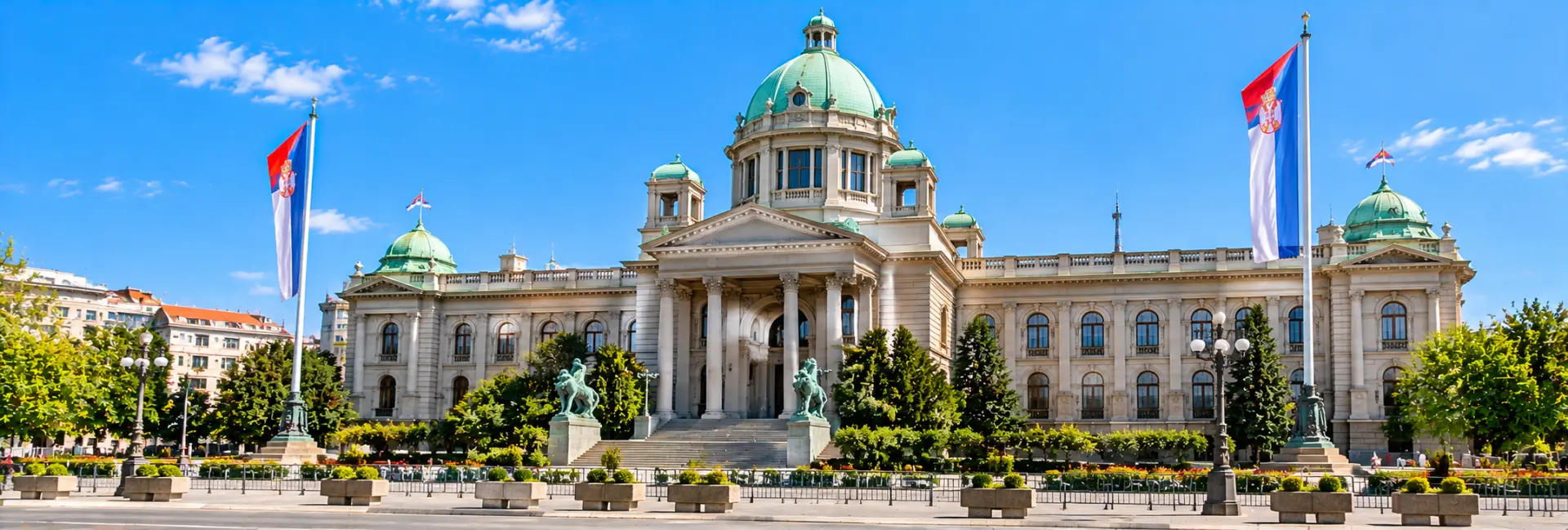
The House of the National Assembly stands at the heart of official Belgrade, a monumental stone building with a columned portico and a lantern-topped dome. It is the seat of Serbia's parliament, the National Assembly, and one of the most monumental public buildings in the city. Most visitors first notice it from Nikola Pašić Square, where its façade rises above the surrounding streets and the sculpted horses at its entrance.
The building took an astonishing 29 years to complete, and its story mirrors the turbulent history of the country. Planned for a Serbian kingdom, finished for a Yugoslav one, used by occupying forces during the Second World War and then by successive federal parliaments, it only became the home of Serbia's own Assembly in 2006, as originally intended.
It is a working government building, not a conventional museum. Even so, it is open to organized visits and rewards those who arrange one, offering a close look at richly decorated halls, a significant art collection and the interior designs of the Russian architect Nikolay Krasnov.
History
A Symbolic Location
The site was chosen with history in mind. According to the Assembly's own account, the building rises near the place where the Great National Assembly met on 30 November 1830, one of the early gatherings associated with the emergence of Serbia's modern statehood. At the time the plot lay on the outskirts of town, close to the former Batal Mosque, but it later became part of the city's administrative core next to the royal courts.
A Parliament Needs a Home
For decades, Serbia's legislators met in a modest building that no longer suited a sovereign state. After independence in 1878 and the proclamation of a kingdom in 1882, the idea of a grand, purpose-built parliament took hold. The first plans were drawn in the early 1890s by architect Konstantin Jovanović, who had also designed the parliament building in Sofia.
Competition and Foundation
A new design competition was announced in 1901, and architect Jovan Ilkić won it, building on the basic layout from Jovanović's earlier drawings. King Peter I laid the cornerstone on 27 August 1907. A charter placed in the foundation named the king, the metropolitan and the chief architect.
Decades of Interruptions
Progress was repeatedly halted. The Balkan Wars, the First World War and later the economic crisis of the 1930s all delayed the work. The new Kingdom of Yugoslavia also required a two-chamber legislature, which forced revisions to the original single-chamber plan. After Jovan Ilkić died in 1917, his son Pavle Ilkić took over, adapting the design and carrying it forward in stages.
Completion in 1936
The building was dedicated on 18 October 1936, nearly three decades after its cornerstone was laid, and the first session was held two days later. The elaborate interior, designed down to the smallest detail by Nikolay Krasnov, was finished in the years that followed.
War, Federation and Return
During the Second World War, the German high command for southeastern Europe used the building. After 1945 it served as the seat of the federal and republic parliaments of Yugoslavia and later of the State Union of Serbia and Montenegro. In 2006, after Montenegro's independence, it became the home of the National Assembly of the Republic of Serbia once more.
Architecture & Design
The Exterior
The building is designed in an academic style that draws on neo-Renaissance and neo-Baroque models. A central projecting section is dominated by a portico with a triangular pediment, topped by a dome with a lantern. The lower level is faced in rough green stone from Ripanj, while tall windows and pilasters rise through the central floors to a balustraded cornice.
Sculpture is used sparingly. Medallions of the ancient orators and statesmen Pericles and Demosthenes, along with Athena and Cicero, appear on the side sections, the work of sculptor Đorđe Jovanović. Above the portals, an angel holding a torch and an olive branch was designed by Petar Palavičini.
Scale and Layout
The building covers about 13,400 square metres and holds roughly 100 offices, several halls and conference rooms, a central vestibule under a dome, and a library of more than 60,000 books. Its basement, ground floor, first floor and attic are linked by mezzanine levels, giving it a sense of grandeur that is felt even before you step inside.
Art Inside the Walls
The decoration goes beyond architecture. The building contains 23 frescoes and a range of paintings, sculptures and other fine art, making it something of a state gallery as well as a legislative chamber. Part of this collection was lost in 2000, when dozens of works were taken during the unrest, and while some have since been recovered, many remain missing.
Krasnov's Interiors
Nikolay Krasnov, a Russian architect who worked widely in Belgrade, designed almost every interior element, from chandeliers and handles to windows and furniture. The result is a unified setting where architecture, sculpture, craftsmanship and rich materials work together, with polychrome walls, columns, niches, loggias and marble floors.
Recognition / Status
In 1984, the House of the National Assembly was declared a cultural monument because of its architectural, historical and artistic value. It is recognized not only for its exterior but also for the complete design of its interior and its collection of artworks, which includes frescoes, paintings and sculptures.
Its status as a functioning parliament adds another layer. Few buildings in Serbia have been the scene of so many pivotal political events, from royal and federal sessions to modern debates, and it is formally part of an architectural and functional complex with the nearby Old and New Palaces and Pionirski Park.
The building has also been in the public eye beyond politics. It was damaged during the demonstrations of 5 October 2000, when dozens of artworks were taken from the interior, and it later appeared as a filming location in the 2011 film adaptation of Coriolanus.
What to See There
- The portico and dome: the façade's most recognizable features, best seen from Nikola Pašić Square.
- "Igrali se konji vrani": a sculpture group of black horses by Toma Rosandić, installed in front of the building in 1939.
- The vestibule: the first ceremonial space inside, notable for its dome, marble, columns and combination of architecture and sculpture.
- The Great Hall: the main chamber where parliamentary sessions take place, with a gallery for guests above.
- Smaller halls: rooms used for committees and ceremonies, where wooden paneling and the state crest set a formal tone.
- The art collection: more than twenty frescoes plus paintings and sculptures, spread across the building's halls and corridors.
- The library: a first-floor reading room with more than 60,000 volumes.
Not every room is included in every visit, and access depends on what the Assembly is doing that day.
Ways to Experience It
Group Visits
The National Assembly organizes visits for groups on workdays, generally between morning and early afternoon. Requests are made by email in advance, and a list of visitors is usually required a few days before the visit. This is the main route for school groups, associations and organized tourist parties.
Individual Visitors
Individual visitors can apply through the Belgrade Tourist Organization, which coordinates places on organized visits. The program usually combines the National Assembly with a tour of the nearby New Palace, the seat of the President of Serbia, so it works well as a half-day outing.
Watching a Session
One of the educational programs allows citizens to watch parliamentary sessions from the gallery of the Great Hall. Availability depends on the parliamentary calendar and security arrangements.
Virtual Tour and Exterior Walk
If you cannot arrange an entry visit, the Assembly offers an online 3D tour covering more than 2,000 square metres of the building. A walk around the exterior, taking in the façade, the sculpture and the neighboring palaces, can fill a pleasant twenty minutes.
Best Time to Visit
Interior visits run on workdays during the daytime, so plan around weekdays and book well ahead. Spring and early autumn are comfortable months for combining a visit with a walk through the surrounding district.
For photographs of the exterior, morning and late afternoon light flatters the pale façade and dome. The façade can also look striking after dark, when the square takes on a different mood.
Check the parliamentary calendar if you hope to see a session, and be aware that security measures may be stricter during major sittings, official visits or public gatherings.
Visitor Tips
- Visits must be arranged in advance. Do not expect to walk in on the day.
- Bring identification, since visitor lists are usually submitted ahead of time and security checks are standard in government buildings.
- Dress neatly and expect standard security checks, which may include limits on large bags.
- Photography inside may be limited, so ask your guide before taking pictures.
- Access to the plaza and Pionirski Park in front of the building has been restricted or changed at various times since 2025 because of protests and encampments. Check current local information before you go and follow instructions from police and staff.
- Allow a little extra time if you combine the visit with the New Palace, since the two buildings are visited together.
- Details such as hours, booking procedures and what is open to visitors can change, so confirm them with the Assembly's education center or the Belgrade Tourist Organization.
Nearby Attractions
- Nikola Pašić Square: the open space in front of the building, with fountains and a view of the façade.
- New Palace (Novi Dvor): the seat of the President of Serbia, directly across from the Assembly and often visited on the same program.
- Old Palace (Stari Dvor): the former royal residence of the Obrenović dynasty, now Belgrade's City Hall.
- Pionirski Park: a historic green space between the palaces and the Assembly, whose accessibility may vary.
- Terazije: the historic central boulevard and square, a short walk away.
- Republic Square and Knez Mihailova Street: Belgrade's main meeting place and pedestrian promenade, reachable on foot from the Assembly.
FAQs about visiting the House of the National Assembly
What is the House of the National Assembly? +
It is the seat of Serbia's parliament, located on Nikola Pašić Square in central Belgrade. The building was completed in 1936 and has been used by the National Assembly of the Republic of Serbia again since 2006.
Can tourists go inside? +
Yes, but only through organized visits. Groups arrange visits in advance by email, and individuals can apply through the Belgrade Tourist Organization.
Is there an entrance fee? +
Visits organized by the National Assembly are presented as a public education program. Check with the Assembly or the tourist organization about any charges before you plan your trip.
How long does a visit take? +
Plan roughly one to two hours for the National Assembly, longer if your program also includes the New Palace. Exact timing depends on the group and the day's schedule.
Who designed the building? +
The main design is by Jovan Ilkić, following earlier plans by Konstantin Jovanović, and his son Pavle Ilkić completed it. The interior was designed by the Russian architect Nikolay Krasnov.
Why did it take so long to build? +
Construction began in 1907 and ended in 1936, interrupted by the Balkan Wars, the First World War, financial problems and changes to the design when Yugoslavia was created.
Can I take photos? +
You can photograph the exterior from public areas. Inside, photography may be restricted, so ask your guide first.
Is the area in front of the building open? +
Access to the plaza and park in front of the building has varied since 2025 because of protests and encampments. Check current local news and follow police instructions on the day of your visit.
