
Table of Contents
Overview
The Nikola Tesla Museum is a compact science museum in a quiet residential street in Belgrade's Vračar district, and it holds the world's most important collection of Tesla's personal legacy. Instead of a sprawling gallery, it offers an intimate, guided look at the life and ideas of the inventor whose work on alternating current helped shape the modern electrical world.
Tesla was born in 1856 in a Serbian family in what was then the Austrian Empire, and he spent most of his working life in the United States. Yet his papers, instruments and personal belongings ended up in Belgrade, and so did his ashes. The museum is therefore both a technical museum and a memorial to the man himself.
The museum draws a steady stream of visitors, with roughly 120,000 people passing through its doors in 2017. Many arrive curious about the inventor whose name is also on the unit of magnetic flux density and on Belgrade's international airport, and leave with a much clearer picture of what he actually did.
A visit is short, usually around an hour, but it is memorable. Guides explain the principles behind Tesla's discoveries, show working models of his machines and bring the science to life with demonstrations that surprise even visitors who know little about electricity.
History of the Museum
From New York to Belgrade
Tesla died in New York in 1943, leaving a large collection of papers, notebooks, instruments and personal items. His nephew, Sava Kosanović, a Yugoslav diplomat and politician, worked to bring this legacy to Belgrade. After years of effort, the material was shipped across the Atlantic in 1951 and stored at the city's electrical engineering faculty.
According to his nephew, it was Tesla's wish that his work and papers eventually be returned to Serbia, even though he lived and worked in the United States for most of his adult life. The transfer fulfilled that wish and made Belgrade the keeper of his original legacy.
Founding the Museum
The Yugoslav government decided to establish the museum on 5 December 1952, and the collection moved into a villa in Vračar. The permanent exhibition was arranged, and the museum opened to the public on 20 October 1955. It was the first technical museum in Yugoslavia.
The museum's work as a memorial began in earnest in 1957, when the urn containing Tesla's ashes was transferred to Belgrade and placed on permanent display. Responsibility for the museum later passed to the city and, in 2020, to the Republic of Serbia, making it a national cultural institution.
Global Recognition
In 2003, UNESCO inscribed the Nikola Tesla Archive in its Memory of the World Register, recognizing its importance to the history of electrification and to future technological development. The museum has digitized and microfilmed material to preserve it for future generations.
Architecture & Building
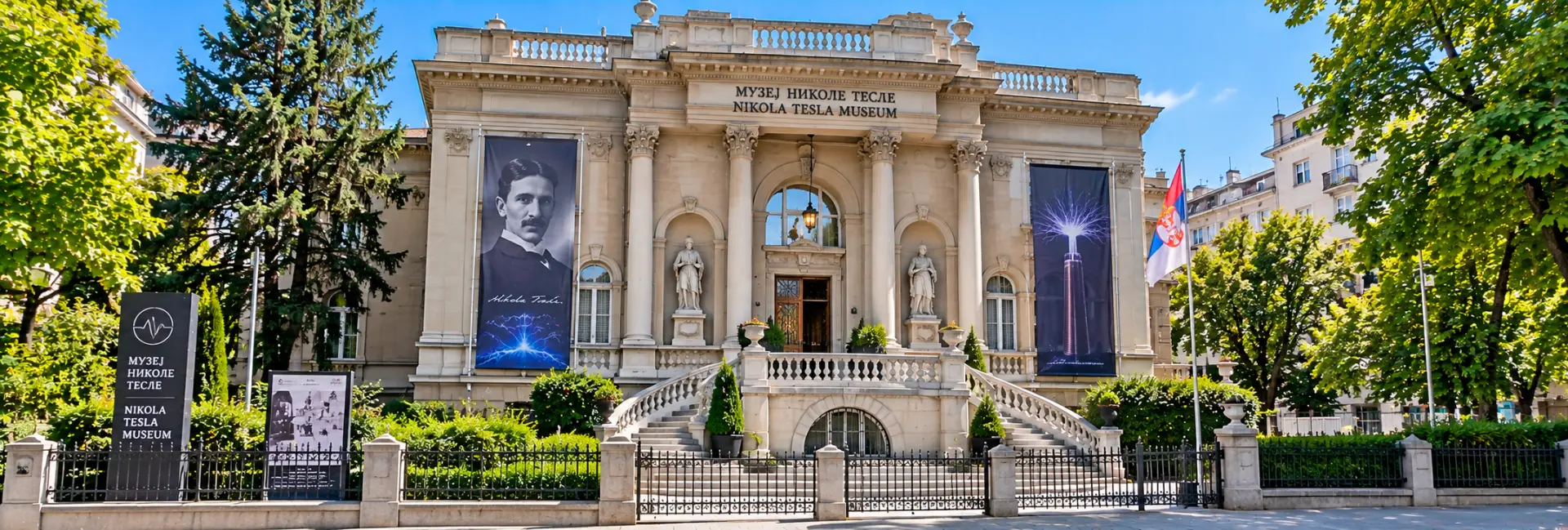
The museum occupies a residential villa built in the late 1920s for Đorđe Genčić, to designs by the distinguished Serbian architect Dragiša Brašovan. It is a handsome, human-scale building that feels more like a private house than a typical museum, and it sits among the leafy streets and apartment buildings of central Vračar.
After the Second World War, the villa was taken over by the new communist authorities and used for various purposes until it became the museum in 1952. Its modest size explains why the exhibition space is limited and why visits are organized as guided tours instead of free wandering.
Walking through the entrance, you feel the scale of a family home rather than a grand institution. Rooms are modest in size, which keeps the atmosphere personal but also explains why guides lead small groups from room to room instead of letting visitors move freely.
The ground floor holds the permanent exhibition, divided into rooms with different themes. Museum staff have also renovated the building over the years, including works in the 2000s, while keeping the character of the original villa.
Collections & Exhibits
The Archive
The museum's greatest treasure is Tesla's archive, which includes more than 160,000 original documents. Letters, manuscripts, notes, calculations, drawings and photographs record his thinking over decades. The museum also keeps over 2,000 books and journals, more than 1,200 historical technical exhibits, over 1,500 photographs and glass plates, and more than 1,000 plans and drawings.
The Permanent Exhibition
Only a small portion of the collection can be shown at any one time. The ground-floor display combines a memorial section about Tesla's life with a technical section on his inventions, including working models and computer-generated 3D reconstructions of key machines.
Personal Items and Memorabilia
Visitors see objects that belonged to Tesla himself, including clothing, medals, plaques he received, his death mask and a baptismal record from 1856. There is also furniture from the New York hotel room where he spent his final years, and a bust of Tesla by the sculptor Ivan Meštrović.
Tesla's Ideas in Brief
You do not need a science degree to follow the exhibition. The displays and guides focus on a handful of big ideas: the rotating magnetic field and the induction motor, which let machines run on alternating current; polyphase systems for generating and transmitting electrical energy over long distances; high-frequency apparatus such as the Tesla coil; and early experiments in wireless control. Seeing these concepts in working form makes it easier to understand why Tesla's work mattered so much for the way electricity is produced and used today.
Temporary Exhibitions
From time to time the museum puts on thematic exhibitions of documents and photographs focused on particular periods of Tesla's inventive life, which gives repeat visitors something new to see.
Must-See Highlights
- The urn with Tesla's ashes: kept in a gleaming spherical container on a pedestal, it is the emotional center of the museum and a reminder that Tesla's remains rest in the country of his heritage.
- Live demonstrations: guides run working models that show how Tesla's ideas operate, including the rotating magnetic field and the induction motor, and often a Tesla coil that produces dramatic effects.
- The induction motor and the "Egg of Columbus": copies of famous machines that illustrate how alternating current can turn a rotor without physical contact.
- The remote-controlled boat model: a display about Tesla's early work on wireless control, long before remote control became common.
- The introductory film: a short film about Tesla's life, shown during the tour, that sets the scene before the demonstrations begin.
- Tesla's personal belongings: everyday and ceremonial objects that bring the inventor's story down to a human scale.
Ways to Experience It
Guided Tour
The standard way to see the museum is on a guided tour. Tours start at the beginning of each hour, last roughly 45 minutes, and are offered in Serbian and English. Guides tell stories about Tesla and show authentic working models, so it helps to arrive a little early.
Group Visits
Groups and school parties can book in advance by contacting the museum during its office hours. This is a good option for travelers who want a set time and a guide dedicated to their group.
Combining It With Other Sights
Because the museum is small, it pairs well with a walk through Vračar. Many visitors combine it with the nearby Church of Saint Sava and a coffee in the surrounding neighborhood.
For Science Fans
Visitors with a deeper interest in physics and engineering can use the tour as a starting point and read more about Tesla's patents and writings afterward.
Best Time to Visit
The museum is generally open every day, with longer hours on most days and a shorter schedule on Mondays, so it is easy to fit into an itinerary. Hours can change around holidays, so check the official website before you go.
Weekday mornings and early afternoons are usually the calmest. Weekends, school holidays and the main tourist months from late spring to early autumn tend to be busier, and English tours can fill up, so aim for an earlier slot if you want a smaller group.
Because the tour starts every hour, the best approach is to arrive about fifteen minutes beforehand and pick the next available time. Late tours are a convenient way to end a day of sightseeing.
Visitor Tips
- Tours begin on the hour and take about 45 minutes, so plan roughly an hour in total including waiting time.
- Arrive at least fifteen minutes before your chosen tour to buy a ticket and avoid missing the start.
- Check the payment options in advance. The museum has accepted only cash in local currency, so carry dinars rather than relying on cards.
- Group tours should be booked ahead by phone or email during the museum's office hours.
- The building is a small villa, so bring only a small bag, and expect limited space inside during busy periods.
- Photography rules can vary by room or exhibit, so ask your guide before taking pictures, especially near the urn.
- Street parking nearby is paid and limited, and public transport or walking is usually easier.
- Ticket prices and opening hours change, so check the official website before you plan your trip.
Nearby Attractions
- Church of Saint Sava: one of the largest Orthodox churches in the world, about a ten-minute walk away on the Vračar plateau.
- Karađorđe Park: the green space around the church, good for a relaxed stroll after the museum.
- Kalenić Market: a traditional neighborhood market close to the museum, ideal for fresh produce and a snack.
- Slavija Square: a major roundabout and transport hub at the foot of Vračar, a convenient connection to other parts of the city.
- Knez Mihailova Street and Republic Square: Belgrade's pedestrian heart, reachable on foot or by public transport for shopping, cafes and further sightseeing.
FAQs about visiting the Nikola Tesla Museum
What can I see at the Nikola Tesla Museum? +
You can see Tesla's personal belongings, models and copies of his inventions, parts of his archive and the urn with his ashes. Guided tours also include a film and live demonstrations of how his devices work.
Do I need to book a tour? +
Individual visitors can usually join the next hourly tour, though it is wise to arrive early. Groups should book in advance by phone or email through the museum.
How long does a visit take? +
The guided tour lasts about 45 minutes. Allow around an hour in total, a little more if you arrive early and have to wait for the next tour.
Are tours available in English? +
Yes. Tours are held in both English and Serbian, and the schedule runs on the hour, so check the museum's website for the current timetable.
Can I pay by card? +
The museum has accepted only cash in the local currency, so bring dinars to be safe. Check the official website before your visit in case payment options have changed.
Is Tesla really buried here? +
His ashes are kept in a spherical urn on display at the museum, which serves as a memorial. This is the museum's most striking exhibit.
How do I get to the museum? +
It is at Krunska 51 in Vračar, close to Slavija Square and about a ten-minute walk from the Church of Saint Sava. City buses serve the area, and nearby street parking is paid.
Is it suitable for children? +
Yes, many children enjoy the demonstrations, especially the electrical effects. The tour is short, which suits younger visitors, though the content is more engaging for school-age children and above.
